Clear Sky Science · en
Time-delay reservoir for signal demixing using Kalman weight updates in fixed point and limit cycle regimes
Why teasing apart tangled signals matters
Modern life is filled with overlapping signals: crowded wireless networks, noisy brain recordings, and even people speaking at once at a party. To make sense of this tangle, we often need to separate faint, meaningful patterns from stronger, distracting ones. This study explores a fast, hardware-friendly way to pull apart such mixed signals, even when they come from chaotic systems that look almost identical on the surface.
Turning a single loop into a clever listener
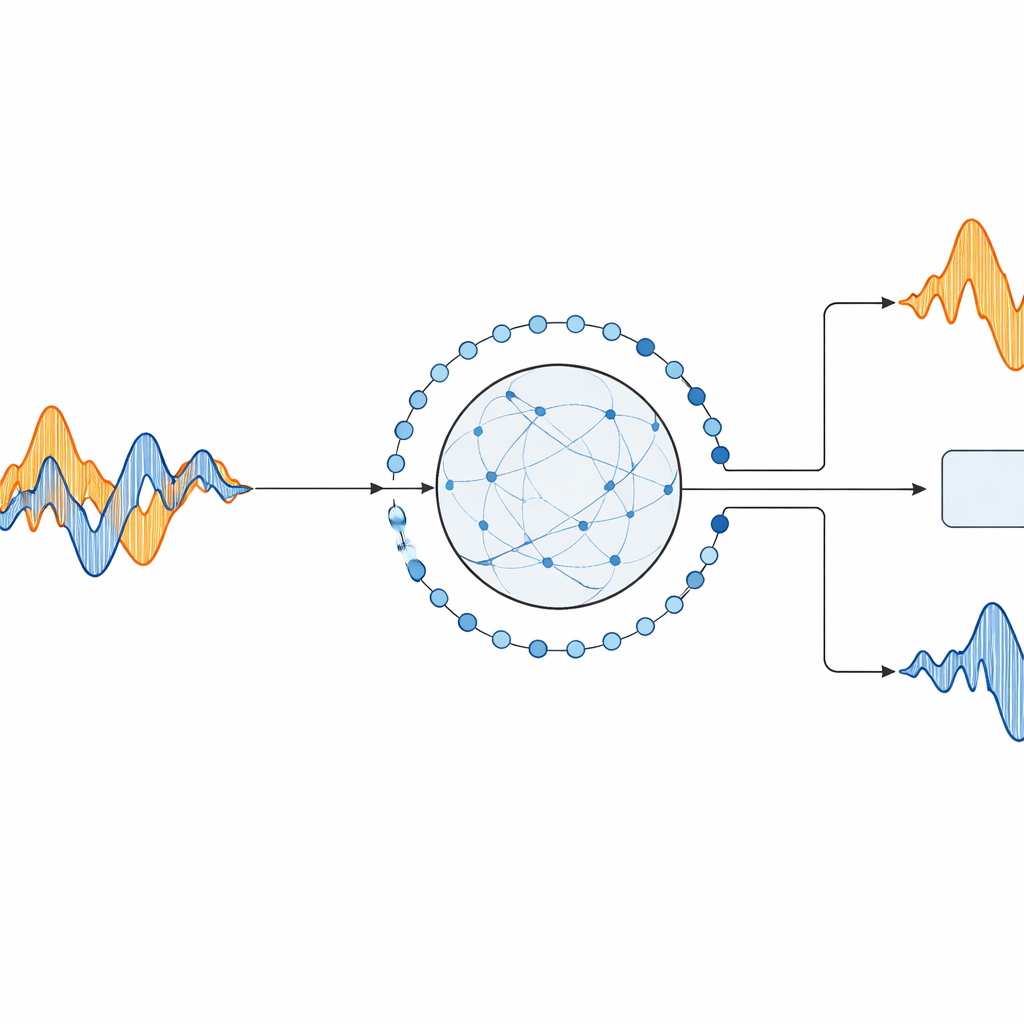
The authors build on a computing idea called a “reservoir,” where an incoming signal is fed into a fixed, richly responsive system, and only a final linear stage is trained to produce the desired output. Instead of a large artificial neural network, they use a single physical unit with a time delay, such as an electro-optic loop. By feeding the mixed signal into this loop and sampling it at many points in time, they effectively create a large cloud of virtual nodes. Each new input causes complex ripples in this delayed system, spreading information about the recent past across many internal states. A simple linear combination of these states can then be tuned to reconstruct one of the original sources hidden in the mixture.
Teaching the system on the fly
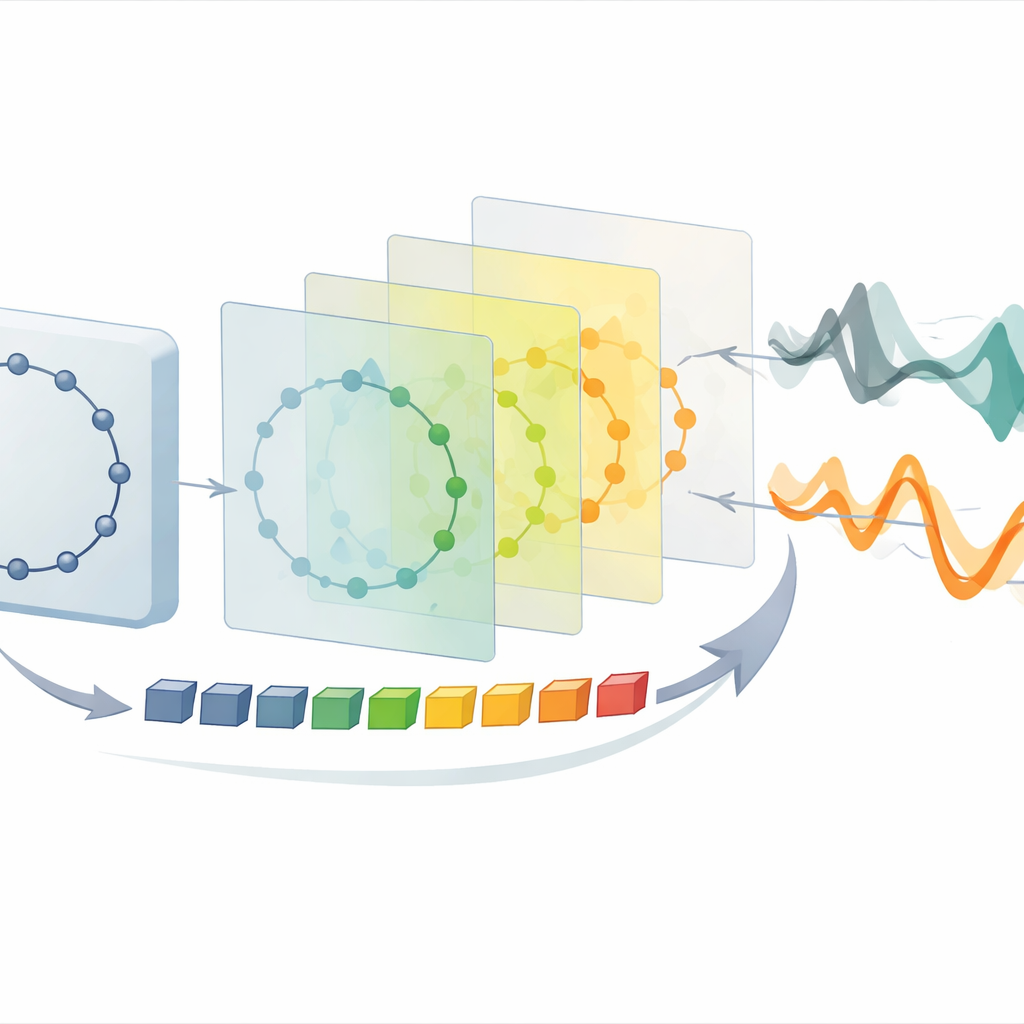
Traditional approaches train this readout once, using a method similar to linear regression, and then freeze the weights. Here, the authors instead allow the readout to keep learning online using a technique borrowed from control theory known as Kalman filtering. After an initial offline training step, each new prediction is compared to the desired output, and the readout weights are nudged according to the recent errors. Rather than updating on a single sample at a time, they introduce a sliding window: at each step, the algorithm looks back over several of the most recent data points and updates the weights using this short history. This lets the system adapt to subtle patterns and slow drifts in the mixture that a one-shot training would miss.
Separating nearly indistinguishable chaos
The researchers put this adaptive reservoir to the test on especially challenging cases. First, they mix two chaotic signals from the same Lorenz system, differing only in their starting conditions. These signals share almost identical statistics, making them notoriously hard to disentangle with standard tools that assume independence. Second, they mix a Lorenz signal with one from the Mackey–Glass system, which has a very different temporal structure and often overwhelms the Lorenz component. Across many mixing ratios, they show that the online Kalman-trained readout can recover the weaker source far more accurately than static training, even when that source contributes only a small fraction of the total mixture.
How the system’s own rhythm helps
A distinctive aspect of this work is that the time-delay reservoir itself can behave in different dynamical modes when there is no input: it may sit quietly at a stable fixed point or oscillate in a regular limit cycle, depending on parameters like feedback strength. The authors map out how separation accuracy changes across these regimes. They find that short sliding windows often work best when the system is near a stable point, especially for separating very similar signals. In contrast, when the reservoir naturally oscillates, it tolerates longer windows and maintains good performance over a wider range of mixing ratios. Intriguingly, the highest accuracy frequently appears near critical transition points—bifurcations—where the reservoir’s qualitative behavior changes, suggesting that operating near these boundaries boosts its computational power.
Finding the sweet spot for adaptation
The Kalman filter includes parameters that control how quickly the weights are allowed to drift and how much trust is placed in the observed data. By scanning these settings, the authors identify regions where prediction error is lowest. They show that moderately large process noise and smaller assumed measurement noise encourage the readout to adapt briskly without becoming unstable. Increasing the window size initially improves separation, but pushing it too far causes the weights to fluctuate excessively, which degrades accuracy. Overall, window sizes of just a few time steps strike a good balance between responsiveness and stability in both fixed-point and oscillatory regimes.
What this means for real-world signal untangling
In plain terms, this study shows that a simple, delay-based physical system, paired with a lightweight learning rule that updates in real time, can pull apart very tricky mixtures of chaotic signals. It can recover a faint, structured component that would otherwise be buried under a stronger one, and it does so reliably across different operating modes of the device. These insights point toward compact, high-speed hardware that could one day help separate overlapping brain signals, wireless transmissions, or other complex data streams, simply by tuning the system near the right dynamical regime and letting it keep learning as new information arrives.
Citation: Tavakoli, S., Lefebvre, J. & Longtin, A. Time-delay reservoir for signal demixing using Kalman weight updates in fixed point and limit cycle regimes. Sci Rep 16, 8245 (2026). https://doi.org/10.1038/s41598-026-38398-7
Keywords: chaotic signal separation, reservoir computing, time-delay systems, online learning, Kalman filtering