Clear Sky Science · en
Computational prediction of grain features during friction stir processes through a mechanistic discontinuous dynamic recrystallization model
Why smaller building blocks make stronger metal joints
Modern planes, cars and power plants increasingly rely on a solid-state joining method called friction stir processing and welding to make strong, reliable joints. In these processes, a spinning tool stirs the metal without melting it, creating a band of intensely worked material with a very fine internal texture. That internal texture – the size and arrangement of microscopic “grains” inside the metal – controls how strong, hard and durable the joint will be. This paper introduces a new computer-based way to predict how those grains form and evolve in copper during friction stir processing, so engineers can design better joints on a screen before ever cutting metal. 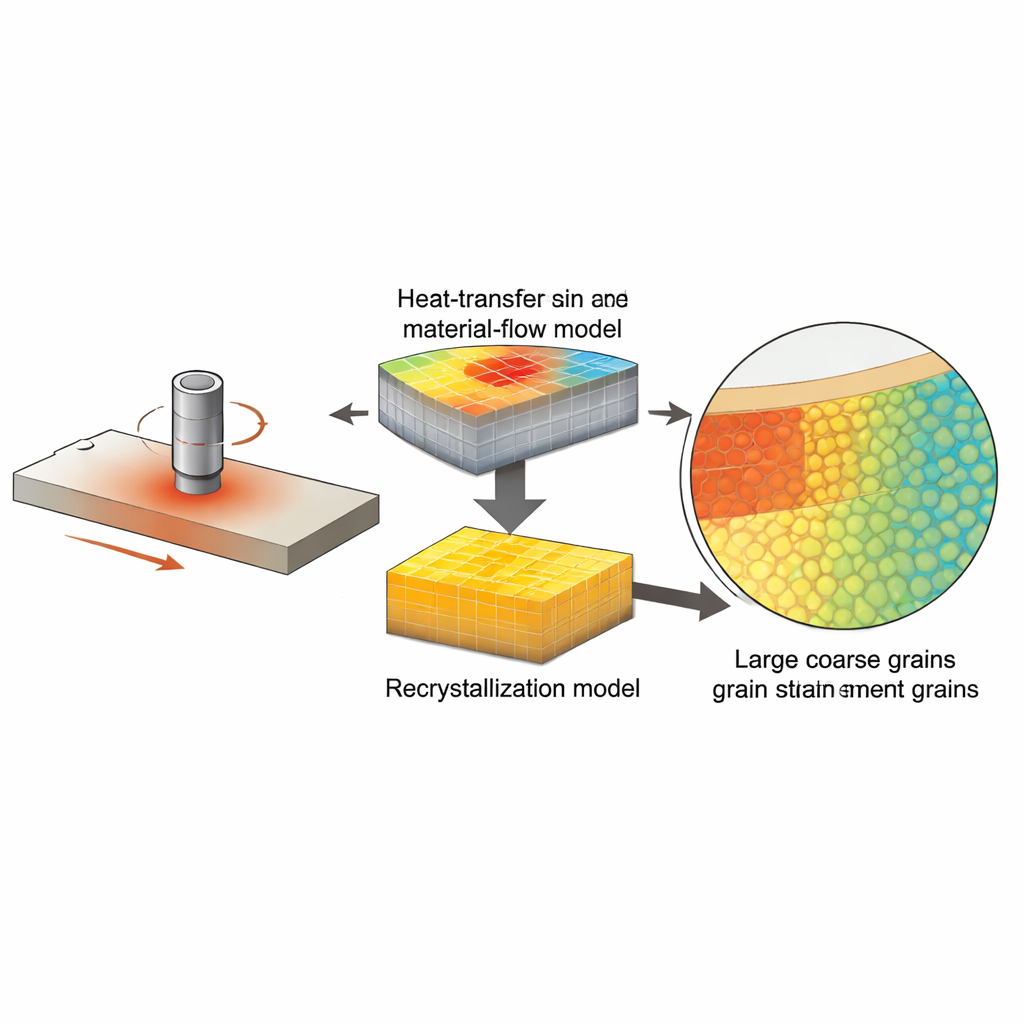
Stirring metal like thick honey
In friction stir processing, a rotating pin and shoulder are plunged into a metal plate and then moved along it, much like a spinning screwdriver pushed through thick honey. The intense rubbing and deformation generate heat and force the metal to flow around the tool in a complex pattern. This combination of high temperature, high strain and high strain rate triggers a restructuring of the metal’s internal grains, breaking large grains into smaller ones and changing how defects called dislocations are arranged. Experiments have shown that this grain refinement can dramatically boost strength and hardness, but getting the exact mix of properties requires precise control over the internal structure, which is hard to measure directly during such a fast, localized process.
Limits of trial-and-error and simpler models
Researchers have used both experiments and earlier computer models to understand friction stir processing. While experiments reveal clear links between processing conditions, grain size and mechanical properties, they are time-consuming, expensive and limited in how finely they can track changes in heat and deformation inside the stirred zone. On the modeling side, methods such as neural networks and simple formulas can estimate average grain size, but they often ignore the underlying physics of how grains actually form and grow. More sophisticated approaches that track individual grains in detail – like phase-field or Monte Carlo simulations – can capture the physics but are so computationally demanding that they are impractical for modeling an entire weld or processing pass.
A physics-based bridge between heat flow and microstructure
The authors build a new computational framework that strikes a balance between physical realism and efficiency. First, they develop a three-dimensional heat transfer and material flow model for friction stir processing of high-purity copper. This model treats the flowing metal as a thick, deformable fluid and solves the governing equations to predict temperature, strain and strain rate throughout the workpiece. They validate this part of the model by comparing predicted temperature histories with measurements from thermocouples embedded in real processed copper plates, finding excellent agreement in peak temperature and cooling rate. These predicted thermal and deformation histories then serve as the input to a second model that describes how grains evolve under those conditions. 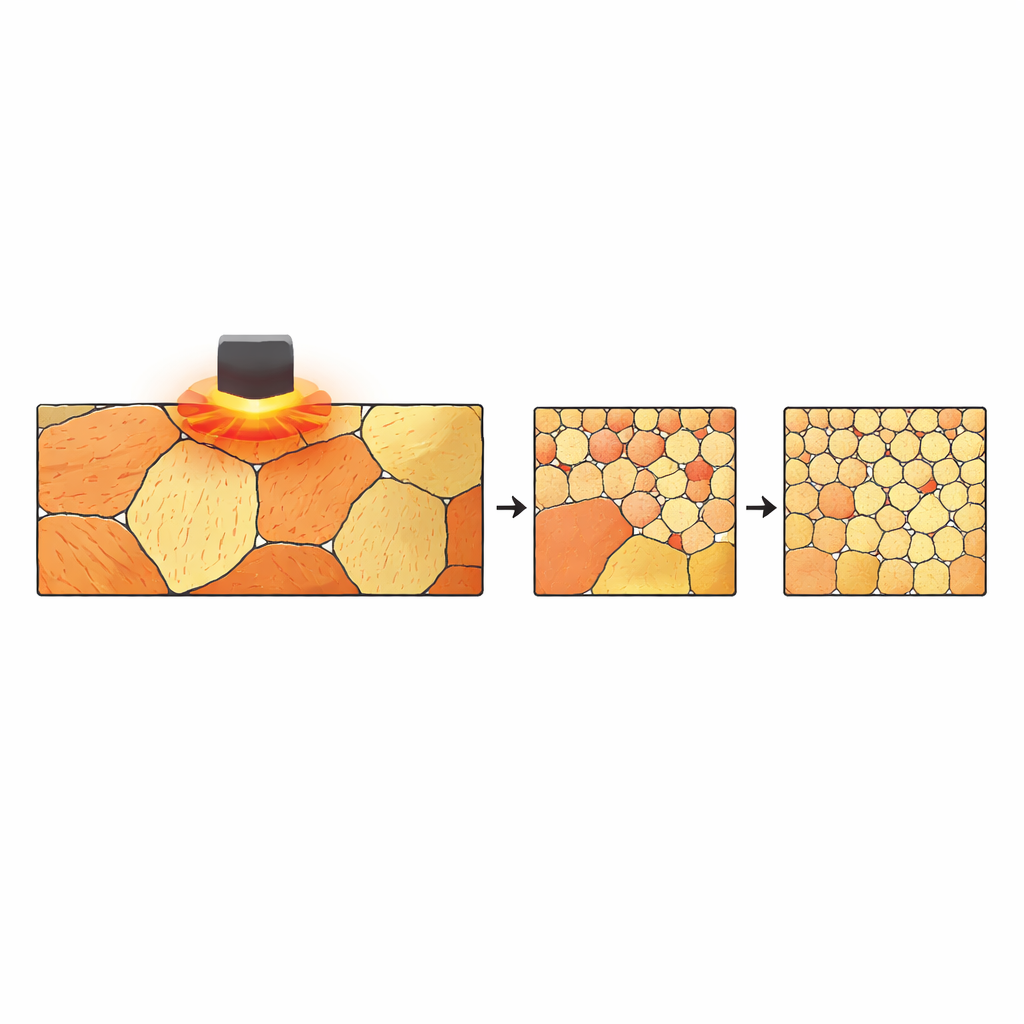
Following grains as they fragment, form and grow
The second part of the framework focuses on a particular grain-refining mechanism called discontinuous dynamic recrystallization, which is known to dominate in copper during friction stir processing. The authors represent the metal as a collection of grains, each described by its size, dislocation content and an orientation factor. As the simulated material deforms, dislocations multiply and store energy, causing grain boundaries to bulge and form small subgrains at high-energy sites. When these subgrains exceed a critical size, they become new strain-free grains. The model then lets these new grains grow or shrink depending on the local energy landscape and boundary mobility, all driven by the evolving temperature and strain rate from the heat-flow model. Over time, this produces a dynamic picture of how many new grains form, how dislocations rise and fall, and how the overall grain size distribution shifts toward finer scales.
How close the computer gets to reality
To test their framework, the authors perform actual friction stir processing on copper plates and map the resulting grain structure using electron backscatter diffraction, a high-resolution microscopy technique. They compare the measured average grain size in the stirred zone to the value predicted by their coupled model. The agreement is striking: the simulation predicts a final average grain size of about 5.25 micrometers, while experiments give about 5.4 micrometers, corresponding to roughly 97% accuracy. The model also reproduces trends such as rapid dislocation build-up during early deformation, subsequent reduction as temperature promotes recovery, and the formation of a large number of fine, equiaxed grains. While the current framework does not yet capture changes in grain orientation (texture) in detail, it still provides a rich description of key features that control mechanical behavior.
Why this matters for future metal design
For non-specialists, the main takeaway is that this work offers a practical way to look inside a friction stir processed joint and predict its hidden internal structure based on processing conditions alone. By coupling realistic heat and flow calculations to a grain-level model of fragmentation, nucleation and growth, the authors provide a tool that can help engineers tune tool speed, travel rate and other settings to achieve desired combinations of strength and ductility without extensive trial-and-error. This approach fits into the broader vision of integrated computational materials engineering, where virtual processing and microstructure prediction shorten development cycles and enable more reliable, lightweight and efficient metal components.
Citation: Sharma, P., Dhariwal, D. & Arora, A. Computational prediction of grain features during friction stir processes through a mechanistic discontinuous dynamic recrystallization model. Sci Rep 16, 8182 (2026). https://doi.org/10.1038/s41598-026-38396-9
Keywords: friction stir processing, grain refinement, dynamic recrystallization, copper welding, microstructure modeling