Clear Sky Science · en
Effects of acute high-intensity exercise on heart rate variability following rapid weight loss in elite wrestlers
Why cutting weight before a match matters
Before big competitions, many wrestlers drop several kilos in just days to qualify for a lighter weight class. They sweat in heavy clothes, limit food and water, and push through hard workouts while dehydrated. This strategy can influence not only performance but also how the heart is controlled by the body’s automatic systems. This study asked a simple but important question: when elite wrestlers quickly lose a small amount of weight, does it put extra hidden strain on their hearts during intense exercise?
What the researchers set out to test
Scientists in Turkey and several other countries studied twelve elite male freestyle wrestlers, all with national-level experience. About two weeks before competition, the athletes had their body composition and heart rhythm measured under carefully controlled conditions. Then they followed their usual rapid weight loss routines to shed about 3–5% of their body weight, mainly through diet restriction and sweat-inducing training. Just before the official weigh-in, while still in this “weight-cut” state, the wrestlers repeated the same measurements. The goal was to see whether this short-term weight drop altered how the nervous system controlled the heart at rest and during hard exercise.
How the heart’s “autopilot” was measured
The team focused on heart rate variability, or HRV—the tiny, natural beat-to-beat changes in heart rhythm that reflect how the body’s automatic (autonomic) nervous system is working. Generally, more variability at rest is seen as a sign of better adaptability and resilience. The wrestlers wore a high-quality heart monitor and chest strap while lying quietly on their backs, while standing quietly before exercise, while running hard on a treadmill at 75–80% of their maximum heart rate, and while recovering afterward. From these recordings, the researchers calculated time-based HRV measures, which are considered solid indicators of overall heart rhythm flexibility, and frequency-based measures that are often used—though still debated—to estimate the balance between “fight-or-flight” (sympathetic) and “rest-and-digest” (parasympathetic) activity.
What changed with rapid weight loss
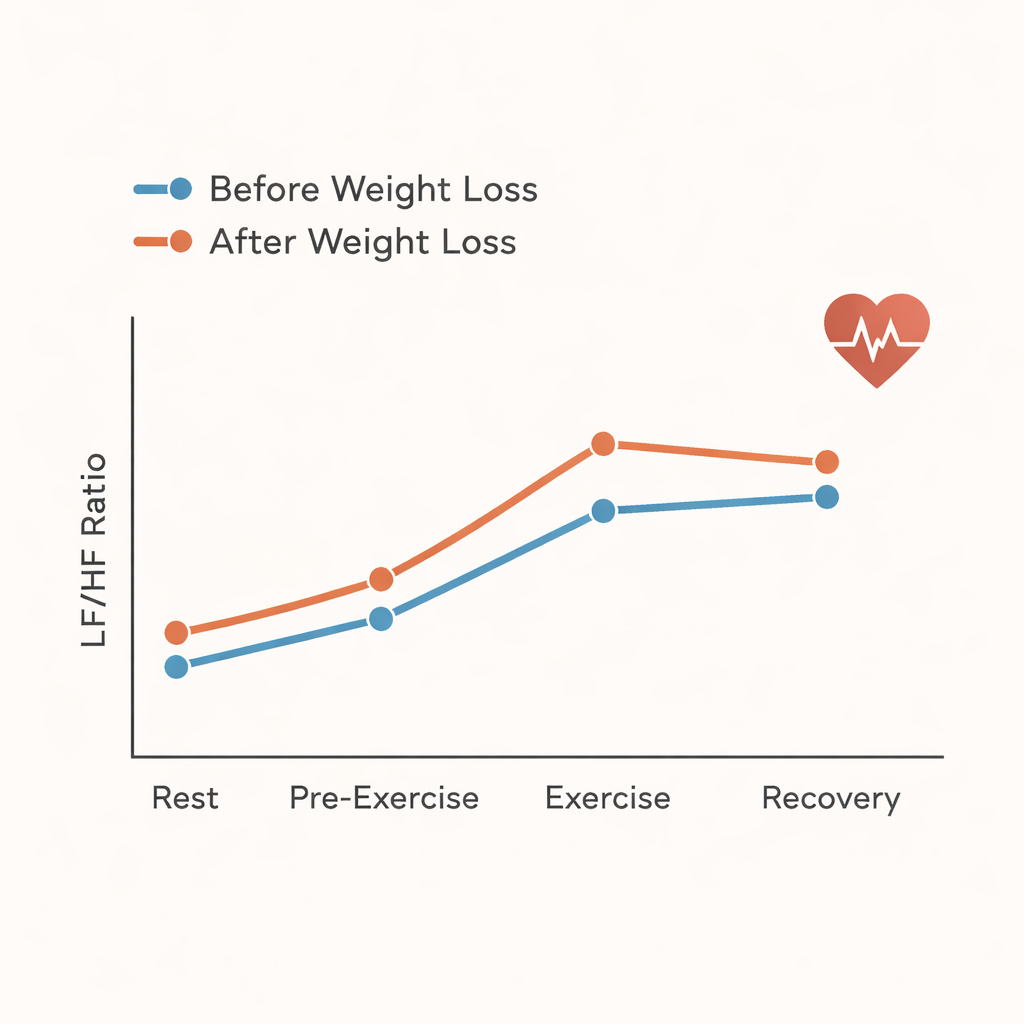
As expected, the wrestlers’ weight, body mass index, and body fat dropped after the weight-cut, while their lean mass stayed about the same. However, the core time-based HRV measures—the ones that capture overall variability in heartbeats—did not show meaningful changes after the rapid weight loss, whether the wrestlers were resting, warming up, running hard, or recovering. In simple terms, the basic flexibility of their heart rhythm appeared stable despite losing up to 5% of body weight. The more complex, frequency-based measure called the LF/HF ratio told a slightly different story. This ratio, often interpreted as a rough sign of the heart’s tilt toward “fight-or-flight” control, showed a modest increase after weight loss, especially during the high-intensity run and recovery phases. This suggests a subtle shift toward more sympathetic drive, or higher autonomic strain, even though the overall rhythm remained largely unchanged.
Why the findings call for caution
The authors are careful not to overstate these results. The LF/HF ratio is controversial among experts, and the data during fast-changing conditions like intense exercise are harder to interpret. This was also a small, exploratory study, and the amount of weight loss was kept below 5%, which may be less extreme than what some fighters attempt. On top of that, hydration was estimated by a simple body composition device that can miss short-term fluid shifts, so the researchers cannot say for sure how dehydrated the wrestlers really were. Still, the hint of greater “fight-or-flight” activity in the heart during and after hard exercise raises questions about how repeated weight cuts might affect long-term cardiovascular health, especially in athletes who cycle through this process many times per year.
What this means for wrestlers and coaches
For fans and athletes, the takeaway is nuanced. In highly trained wrestlers who lose less than 5% of their body weight over a couple of weeks, the heart’s basic rhythm control appears to cope reasonably well, at least in the short term. Yet the slight rise in stress-related signals suggests that even modest rapid weight loss can nudge the heart toward a more strained, “on edge” state during tough workouts. While this study does not show clear damage, it reinforces existing concerns about aggressive weight cutting. Coaches, medical staff, and athletes may wish to treat rapid weight loss as a practice that should be closely monitored and kept within conservative limits until larger studies can clarify the true risks to the heart over a season or a career.
Citation: Yıldırım, Y., Arabacı, R., Rodoplu, C. et al. Effects of acute high-intensity exercise on heart rate variability following rapid weight loss in elite wrestlers. Sci Rep 16, 7631 (2026). https://doi.org/10.1038/s41598-026-38394-x
Keywords: rapid weight loss, wrestling, heart rate variability, dehydration, combat sports