Clear Sky Science · en
Research on bending tests and modified calculation of flexural strength for hybrid reinforced pipe piles
Stronger Foundations for Everyday Structures
Bridges, ports, and high-rise buildings all rely on deep foundations hidden below ground. Many of these foundations use hollow concrete columns called pipe piles, which must withstand not only vertical weight but also sideways forces from wind, waves, and earthquakes. This study explores a practical way to make these buried supports bend more safely instead of snapping, and introduces a refined method for engineers to calculate just how much bending they can take.
Why Some Piles Crack and Fail
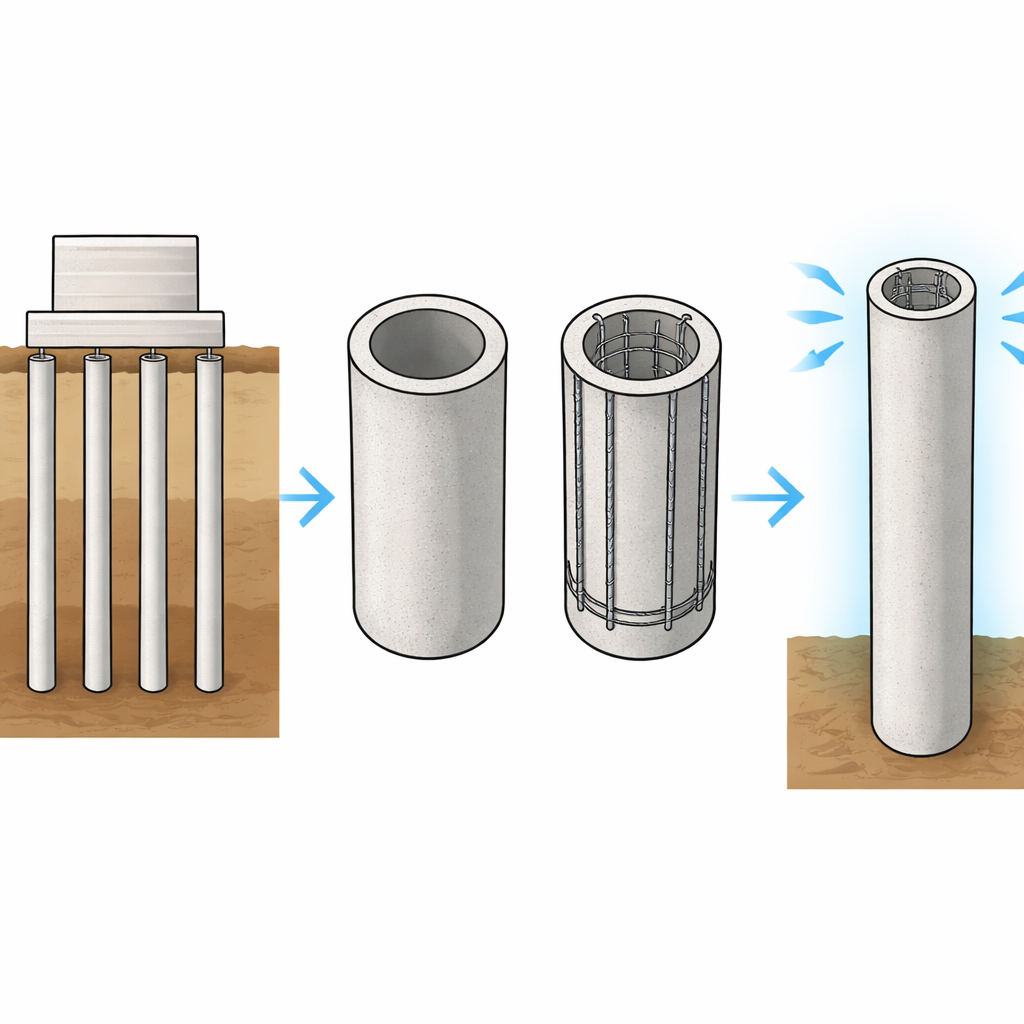
Modern projects often use prestressed high-strength concrete (PHC) pipe piles. These hollow tubes are spun in a factory so the concrete becomes dense and strong, then tightened with high-strength steel wires that keep them in compression. This makes them very good at carrying vertical loads. However, when strong sideways forces act on them, PHC piles can crack and sometimes even break, especially near ground level where bending is most severe. That weakness has limited their use in some demanding projects, such as deep excavations or seismic zones, where both strength and flexibility are essential.
Adding Extra Steel to Make Piles More Forgiving
To tackle this problem, the researchers tested a newer type of pile: the prestressed reinforced concrete (PRC) pipe pile. These piles keep the original prestressed wires but add a ring of ordinary reinforcing bars inside the concrete wall. In the laboratory, they compared four PRC piles with two traditional PHC piles, all nine meters long and made from very high-strength concrete. The tests bent the piles in carefully controlled steps, watching for the first cracks, tracking how those cracks spread and widened, and measuring how far the piles could deflect before failure.
How the New Piles Behave Under Stress
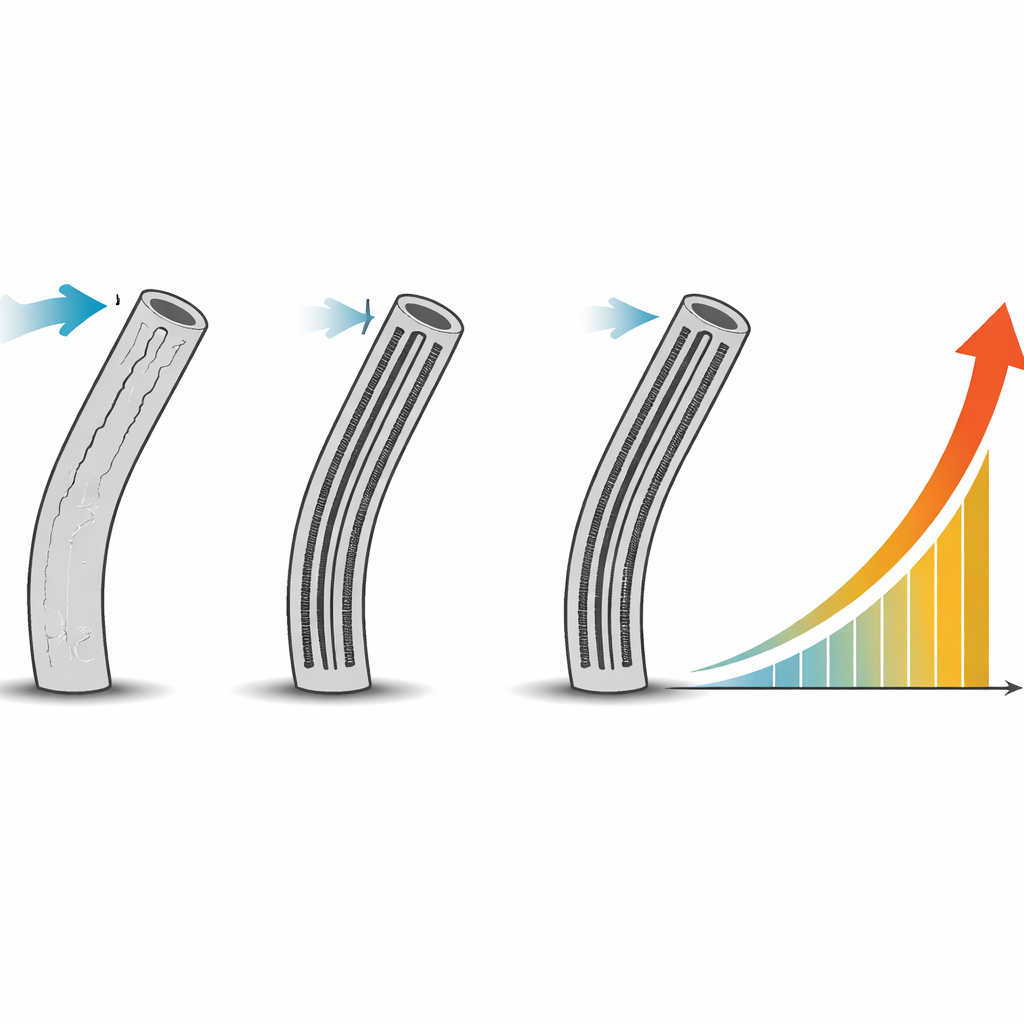
The difference in behavior was clear. Piles with the extra reinforcement carried 36% to 51% more bending load than the traditional ones. Instead of forming a few wide cracks, the PRC piles developed many finer cracks that stayed relatively narrow, showing that the added steel was holding the concrete together and sharing the tension. They also bent more before failing, which means they absorbed more energy and gave more warning rather than breaking suddenly. Increasing the diameter of the added bars gave an extra boost in performance, slightly raising both the maximum bending moment and the ultimate sideways deflection the piles could sustain.
Rethinking How Engineers Do the Math
Design rules for these piles depend on how much of the concrete section is in compression when the pile is on the verge of failure. Existing formulas estimate this compressed region and then predict the ultimate bending strength. But past experiments have shown that the calculated strengths for hybrid piles often lag behind what tests reveal, meaning the designs can be overly conservative and waste material. In this study, the team directly measured strain in the concrete during bending tests and used it to determine the actual height of the compressed zone. They then compared these values with the theoretical ones and introduced a new coefficient, called η, to better link the real compressed area to what the formulas assume.
Sharper Predictions for Safer, Leaner Designs
By building a simple relationship between η and existing compression parameters, the authors modified the standard formula used to calculate the ultimate bending capacity of hybrid pipe piles. When they checked this revised formula against 95 tested piles from their work and earlier studies, the improved version matched the experiments more closely and with less scatter, while still leaving a comfortable safety margin. For non-specialists, this means engineers can design slimmer or more efficient piles that remain safe under extreme bending, potentially saving concrete and steel without sacrificing reliability. The combination of added reinforcement and better prediction tools brings us closer to foundations that are not only strong, but also tougher and more resilient when nature or human activity pushes them to their limits.
Citation: Liu, X., Men, S., Wang, W. et al. Research on bending tests and modified calculation of flexural strength for hybrid reinforced pipe piles. Sci Rep 16, 8241 (2026). https://doi.org/10.1038/s41598-026-38392-z
Keywords: pipe piles, concrete foundations, structural bending, reinforcement design, structural ductility