Clear Sky Science · en
Design of security situation awareness power grid SCADA system based on improved GWO-LSTM
Keeping the Lights On in a Connected World
Modern power grids do far more than move electricity; they are vast digital systems that constantly talk to sensors, computers, and control rooms. This connectivity boosts efficiency but also opens doors to cyberattacks that could disrupt power to homes, hospitals, and factories. The paper explains a new way to monitor the "health" of a power grid’s control network in real time, spotting attacks and problems earlier and more accurately than current tools.
Why the Grid Needs Digital Bodyguards
Electric utilities rely on grid information systems and SCADA control networks to track flows of electricity and send commands to equipment. As these systems have become more complex and more connected to wider networks, they have also become more exposed to hacking and other digital threats. Existing security tools often miss subtle warning signs, generate too many false alarms, or cannot keep up with the ever-changing traffic patterns on the network. The authors argue that utilities need "situational awareness"—an always-on view of overall security conditions that can detect abnormal behavior, assess the level of risk, and forecast how threats might evolve over time.

Teaching Algorithms to Hunt for Threats
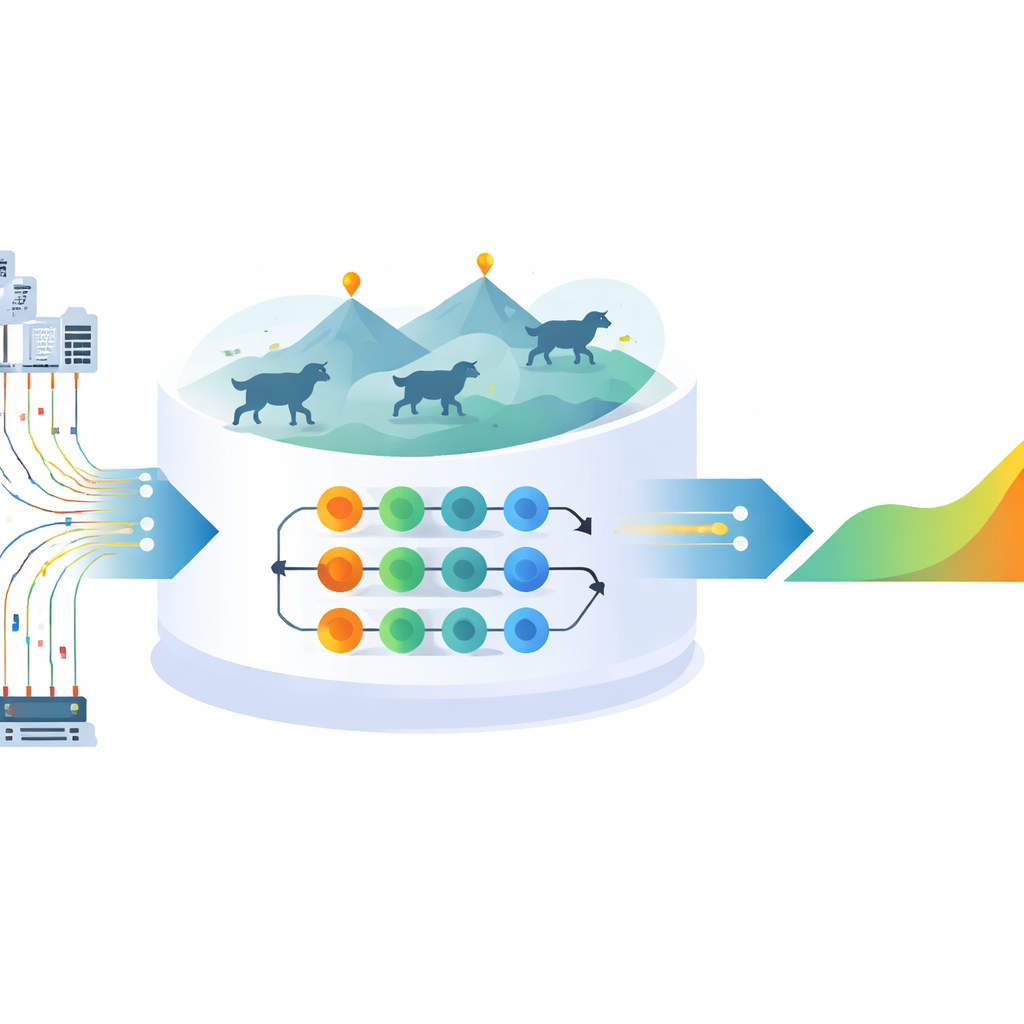
To improve this security picture, the study combines two types of computer methods: an optimization approach inspired by how grey wolves hunt in packs, and a time-series prediction network often used in speech and language processing. The wolf-inspired method explores many possible settings for the prediction model, searching for combinations that produce the most accurate forecasts. The prediction network then learns patterns from past network activity and security events, such as attacks and normal traffic, to anticipate future "posture"—a single value that reflects how safe or threatened the grid appears to be. By automatically tuning key internal settings, the improved wolf algorithm helps the prediction network avoid getting stuck in poor solutions and better track subtle shifts in behavior.
Seeing Cascading Problems Before They Spread
Because power grids are tightly interconnected, a failure or attack in one place can trigger a chain reaction. The researchers therefore link their prediction model with an analysis of cascading faults—how local problems might ripple through the wider network. Using a widely studied cybersecurity dataset that mimics grid traffic, they show that their combined method can more precisely estimate where and when trouble is likely to appear, and how it might propagate between services, individual machines, and the network as a whole. The model not only classifies the current security level (from "safe" up to "extremely high risk") but also forecasts upcoming changes so operators can respond before minor issues become major outages.
Building a Smarter Nerve Center for the Grid
On top of the forecasting model, the authors design a full SCADA security platform with distinct layers for data collection, analysis, storage, and visual dashboards. Incoming network data are cleaned and compressed, then passed through a deep belief network to assess the current situation and through the wolf-tuned prediction model to look ahead. Additional algorithms help reduce false alarms by refining how the system weighs different kinds of attacks and their impact on the confidentiality, integrity, and availability of grid data. In tests, the new approach sharply cuts common error measures, lowers false positives and missed attacks by more than half compared with several standard techniques, and still runs fast enough to be practical for real-time monitoring.
What This Means for Everyday Reliability
For non-specialists, the core message is that the authors have built a smarter early-warning system for cyber risks to the power grid. By letting algorithms explore many possible configurations and learn from rich traffic data, their method can more accurately judge how secure the grid is at any given moment and how that condition is likely to change. This gives operators clearer, earlier signals about where to focus attention and how urgently to respond. If further validated on real utility networks, similar techniques could help keep electricity, and other critical services such as water, gas, and traffic control, running safely even as they become more connected and more exposed to digital threats.
Citation: Chen, Z., Zheng, H., Gao, L. et al. Design of security situation awareness power grid SCADA system based on improved GWO-LSTM. Sci Rep 16, 8788 (2026). https://doi.org/10.1038/s41598-026-38382-1
Keywords: power grid cybersecurity, situational awareness, intrusion detection, machine learning for SCADA, critical infrastructure security