Clear Sky Science · en
Scenario-dependent northward shifts in wintering centroids of Anatidae in South Korea
Why winter birds and rice fields matter to us
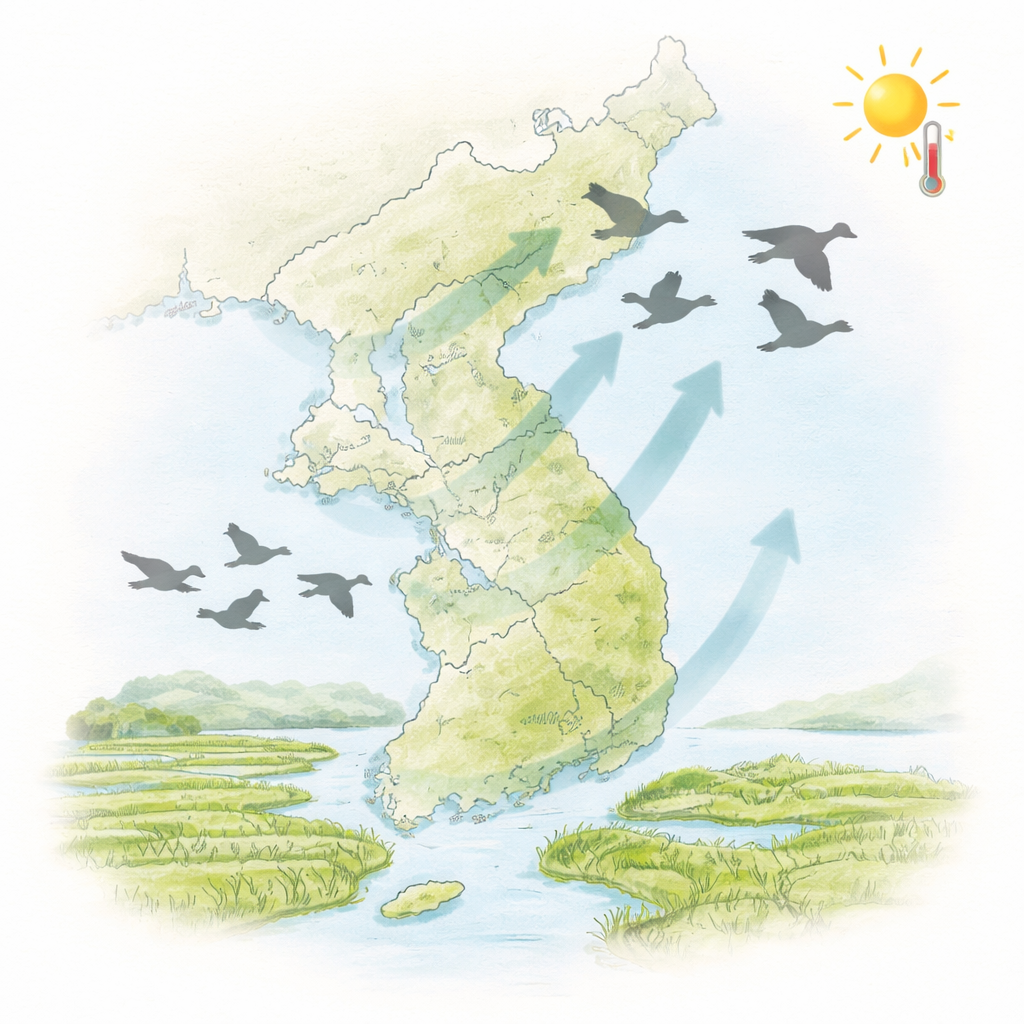
Each winter, millions of ducks and geese fly to Korea’s rivers and rice paddies, turning working farms into temporary wetlands. These birds are not only a familiar sight to local communities; they are also early warning systems for how fast our climate and landscapes are changing. This study asks a simple but important question: as South Korea warms and agriculture transforms, where will these winter visitors go—and will there still be enough safe places for them to rest and feed?
Following birds across a changing map
The researchers focused on six common species of ducks and geese that depend heavily on flooded rice fields in winter, including bean geese and mallards. Using records from field surveys and global bird databases, they mapped where these species currently spend the winter across South Korea. They then combined detailed information on land cover, elevation, and climate with computer models to estimate where suitable winter habitat exists today, and how it might shift under four different future climate pathways. These pathways range from relatively low greenhouse gas emissions to very high ones, and the team looked at changes over the rest of this century.
Rice paddies as temporary wetlands
In East Asia, winter rice paddies act like substitute wetlands: shallow water and leftover grain provide rich feeding grounds when natural marshes are scarce. The study confirms that, under past and present conditions, the best wintering areas for the six species cluster along South Korea’s western and southern coastal plains and major rivers such as the Geum and Nakdong. These regions offer low-lying land, abundant paddies, and open water. But satellite-based land-cover data show that many of these same areas have been losing rice paddies since 2007, as greenhouse agriculture expands and other land uses encroach. In some key districts, more than 240 hectares of paddies have disappeared in less than two decades.
Northward shifts and broken-up habitats
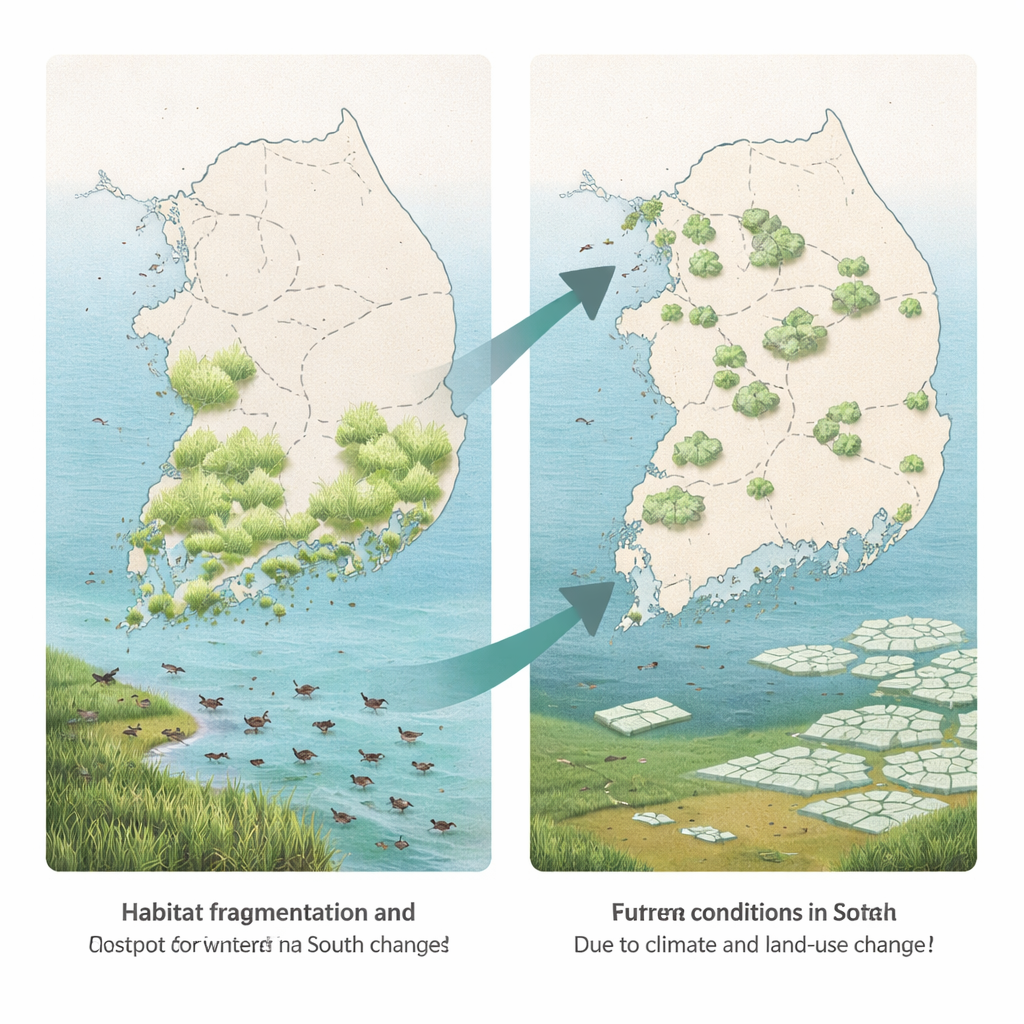
When the team projected these bird distributions into the future, a clear pattern emerged: under every climate scenario, the “center of gravity” of wintering areas moved north. In some near-future cases, that shift reached more than 25 kilometers. Early in the century, warmer winters can even expand total suitable habitat in central regions, including along the lower Han River. But this is not a simple good-news story of birds finding new places. The models show that areas where all six species are likely to overlap become more scattered and fragmented under many scenarios, especially in mid- to late century. The number of distinct habitat patches rises and the largest continuous patch often shrinks, signaling that what used to be broad, stable wintering zones are breaking into smaller, isolated pieces.
Climate stress meets farming change
The loss of southern rice paddies is especially worrying because those areas have historically served as fall-back refuges during severe cold snaps. As birds track milder average winters northward, they may find themselves farther from these safety nets when extreme cold strikes. In a warmer but more variable climate, this creates a paradox: moving north generally saves energy, but sudden cold events could force birds to make long, costly flights back to shrinking southern refuges or to second-rate sites. The study also points out that its maps assume birds can freely reach and use all newly suitable areas, which in reality may be limited by barriers, strong site loyalty, and continuing changes in farming.
What this means for conservation
For non-specialists, the key message is straightforward: climate change is not just nudging wintering birds a little farther north; it is also squeezing and breaking up the very habitats they rely on. In South Korea, this squeeze is intensified by the rapid spread of greenhouse farming across rice country. The authors argue that conservation plans must protect remaining southern rice-field refuges, safeguard and connect emerging northern habitats, and weave bird needs into agricultural policy. Because these ducks and geese travel along the broader East Asian–Australasian Flyway, international cooperation will also be essential. Keeping winter skies filled with familiar flocks will require not only cutting emissions, but also managing farmland and wetlands as a connected safety net that can withstand both gradual warming and sudden cold shocks.
Citation: Choi, HI., Lee, S. & Nam, HK. Scenario-dependent northward shifts in wintering centroids of Anatidae in South Korea. Sci Rep 16, 6890 (2026). https://doi.org/10.1038/s41598-026-38381-2
Keywords: climate-driven range shifts, migratory waterbirds, rice paddy wetlands, habitat fragmentation, South Korea conservation