Clear Sky Science · en
Effects of applied magnetic fields on the performance of magnetoplasmadynamic thrusters
Rocket Engines That Run on Electrified Gas
Sending large spacecraft to Mars or the outer planets will demand engines that squeeze far more push out of every kilogram of fuel than today’s chemical rockets. This study looks at one such technology, called a magnetoplasmadynamic (MPD) thruster, which uses electric power and magnetic fields to hurl ionized gas out the back of a spacecraft. The researchers ask a deceptively simple question with big practical consequences: is it better to shape the thruster’s magnetic field with an adjustable electromagnet or with a power‑free permanent magnet?
Why Electric Rockets Need Magnetic Fields
MPD thrusters are a leading candidate for future high‑power electric propulsion, especially when paired with compact space nuclear reactors that can deliver tens or hundreds of kilowatts of electricity. In these engines, a gas such as argon is turned into plasma— a soup of ions and electrons— and accelerated by electric currents interacting with magnetic fields. The way that magnetic field is produced matters. Electromagnets draw electrical power but are highly tunable; permanent magnets need no power and are mechanically simple, but their field is fixed and often harder to shape. Previous research mostly focused on how strong the magnetic field is. This work digs deeper into something more subtle: how the three‑dimensional shape, or geometry, of that field affects engine performance.
Two Ways to Shape the Invisible Force
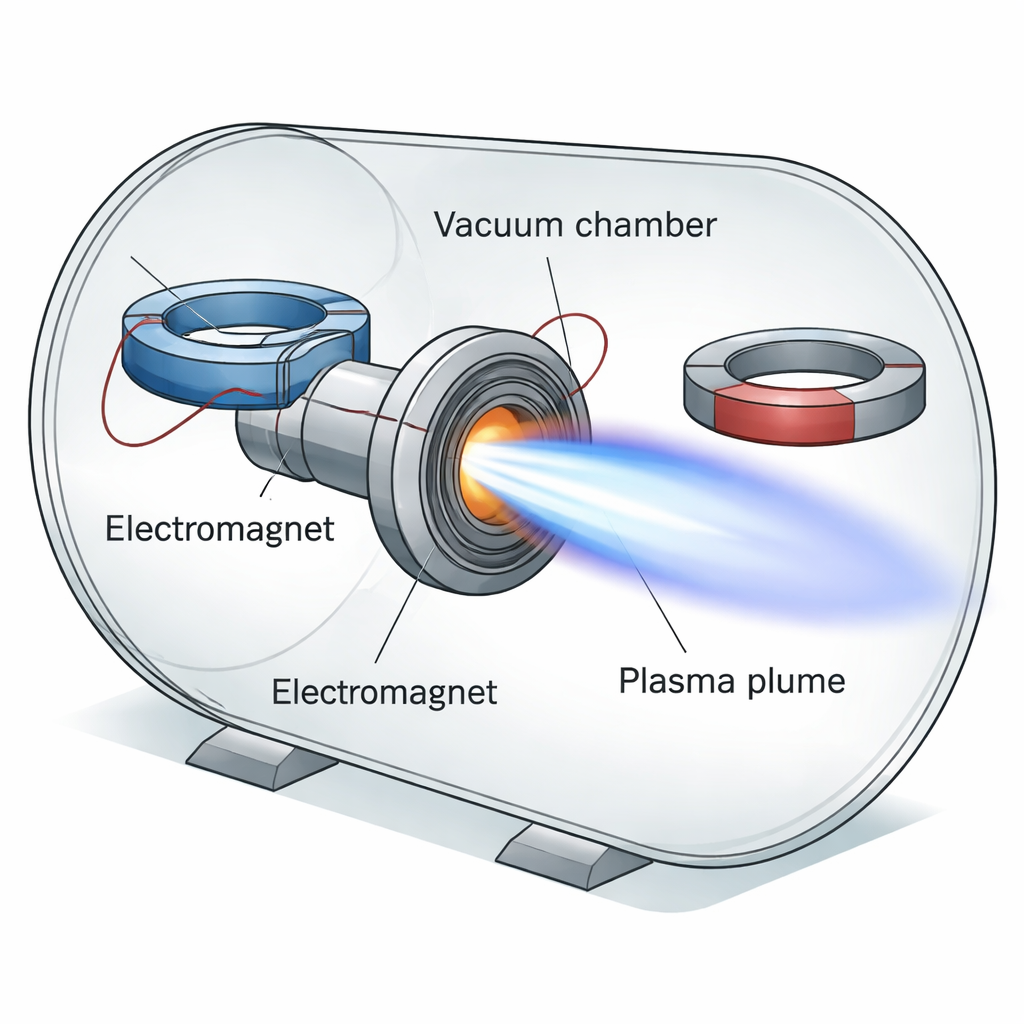
The team built a low‑power MPD thruster and tested it in a vacuum chamber under many operating conditions. They compared two otherwise similar magnet setups: a water‑cooled ring‑shaped electromagnet, whose current could be varied, and a ring‑shaped neodymium permanent magnet producing a much stronger field at the thruster exit. They measured basic electrical behavior (the relationship between current and voltage), the thrust produced, the effective exhaust speed of the ions (known as specific impulse), and how the ions’ energies were distributed. By changing the gas flow rate and the discharge current through the plasma, they could see how each magnetic layout affected the way energy was transferred from the power supply into directed exhaust.
Stronger Is Not Always Better
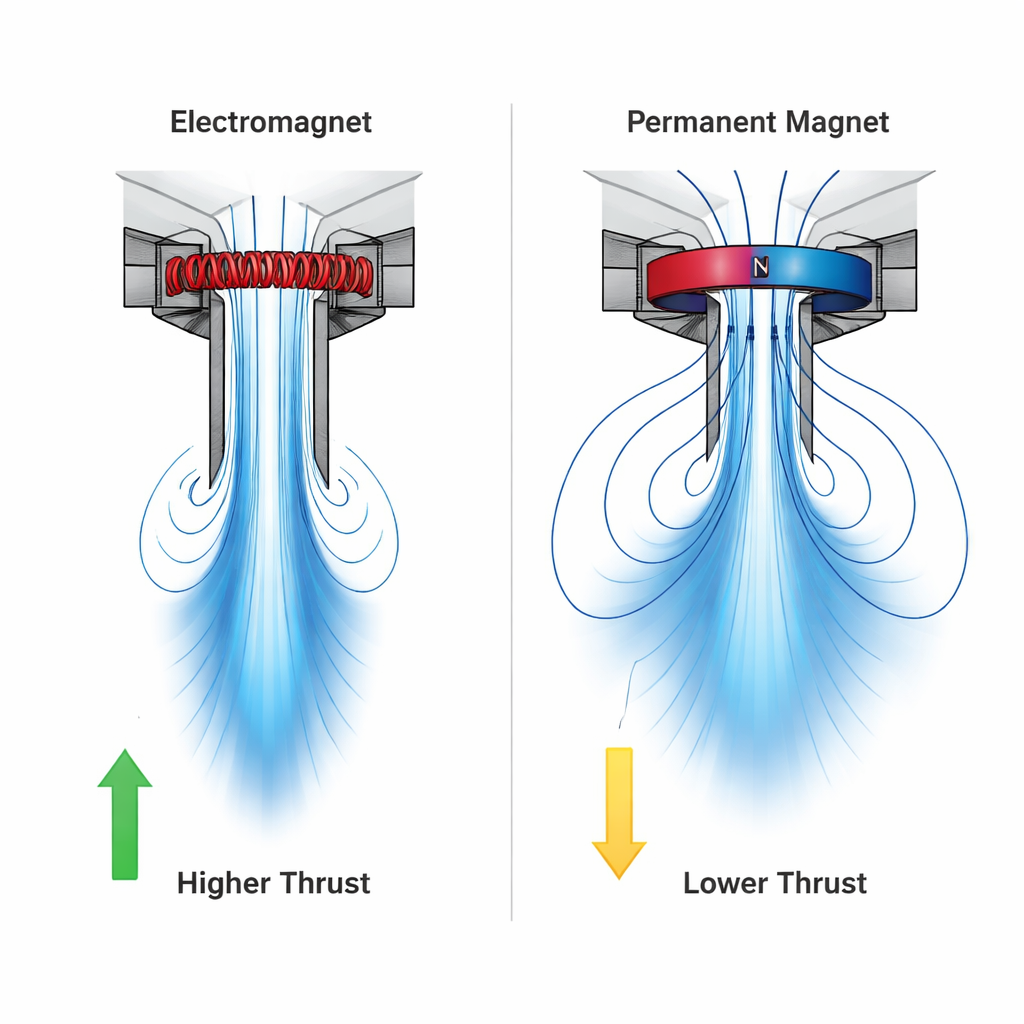
Despite delivering a magnetic field roughly three to ten times stronger than the electromagnet, the permanent magnet configuration consistently produced less thrust and lower efficiency at comparable power levels. With the electromagnet and a relatively low gas flow, the thruster reached about 436 millinewtons of thrust and a specific impulse near 3000 seconds at 15 kilowatts— indicating very fast exhaust and efficient use of propellant. The permanent magnet setup, even at its best, produced roughly a quarter less thrust and noticeably lower exhaust speed. Electrical measurements revealed why: for the same current, the permanent magnet case needed a higher voltage, so at fixed input power it was forced to run at lower current— the main driver of thrust in this type of engine. In other words, the stronger permanent magnet field pushed the system into a less favorable operating point.
How Field Shape Steers the Plasma
The key difference lies in how the field lines thread through the thruster. The electromagnet created a mainly axial field that guides electrons and ions smoothly along the engine’s centerline, supporting a long, effective acceleration region. The ring‑shaped permanent magnet, by contrast, introduced a magnetic null point along the axis and strong radial components nearby. This distorted pattern shortened the useful field lines and disrupted the easy motion of electrons along the axis. The result is weaker induced electric fields that do the work of accelerating ions, and likely poorer ionization of the gas, both of which sap thrust. Ion‑energy measurements supported this picture: under the right conditions, the electromagnet case produced higher‑energy ion beams, especially at lower gas flows where collisions are fewer and the accelerating voltage has a bigger impact.
Guiding Future Deep‑Space Engines
For non‑specialists, the main takeaway is that the “shape” of an invisible magnetic field can matter more than its raw strength when it comes to electric rocket performance. A powerful but poorly arranged permanent magnet field can actually slow progress compared with a weaker, well‑shaped electromagnet field. The study shows that adjustable electromagnets, despite their power cost, enable higher thrust, higher exhaust speed, and better overall efficiency for MPD thrusters in the tested range. As engineers design engines for deep‑space missions powered by advanced reactors, they will need to pay close attention not just to how strong their magnets are, but to how those magnets guide the plasma from the heart of the thruster into the exhaust plume.
Citation: Shin, H., Kim, J., Hwang, J. et al. Effects of applied magnetic fields on the performance of magnetoplasmadynamic thrusters. Sci Rep 16, 7541 (2026). https://doi.org/10.1038/s41598-026-38380-3
Keywords: electric propulsion, magnetoplasmadynamic thruster, space nuclear power, plasma rocket, magnetic field geometry