Clear Sky Science · en
Sleep deprivation alters early event-related potentials during emotional face processing in adults with ADHD
Why losing sleep matters for ADHD
Many adults with attention-deficit/hyperactivity disorder (ADHD) already struggle with focus, impulse control, and reading other people’s emotions. They are also more likely to have poor sleep. This study asks a simple but important question: what happens in the brain when adults with ADHD stay awake all night and then try to read emotional facial expressions? Using a combination of a reaction-time task and direct measures of brain activity, the researchers show that sleep loss hits emotional processing in ADHD especially hard, in ways that may help explain day-to-day social difficulties.
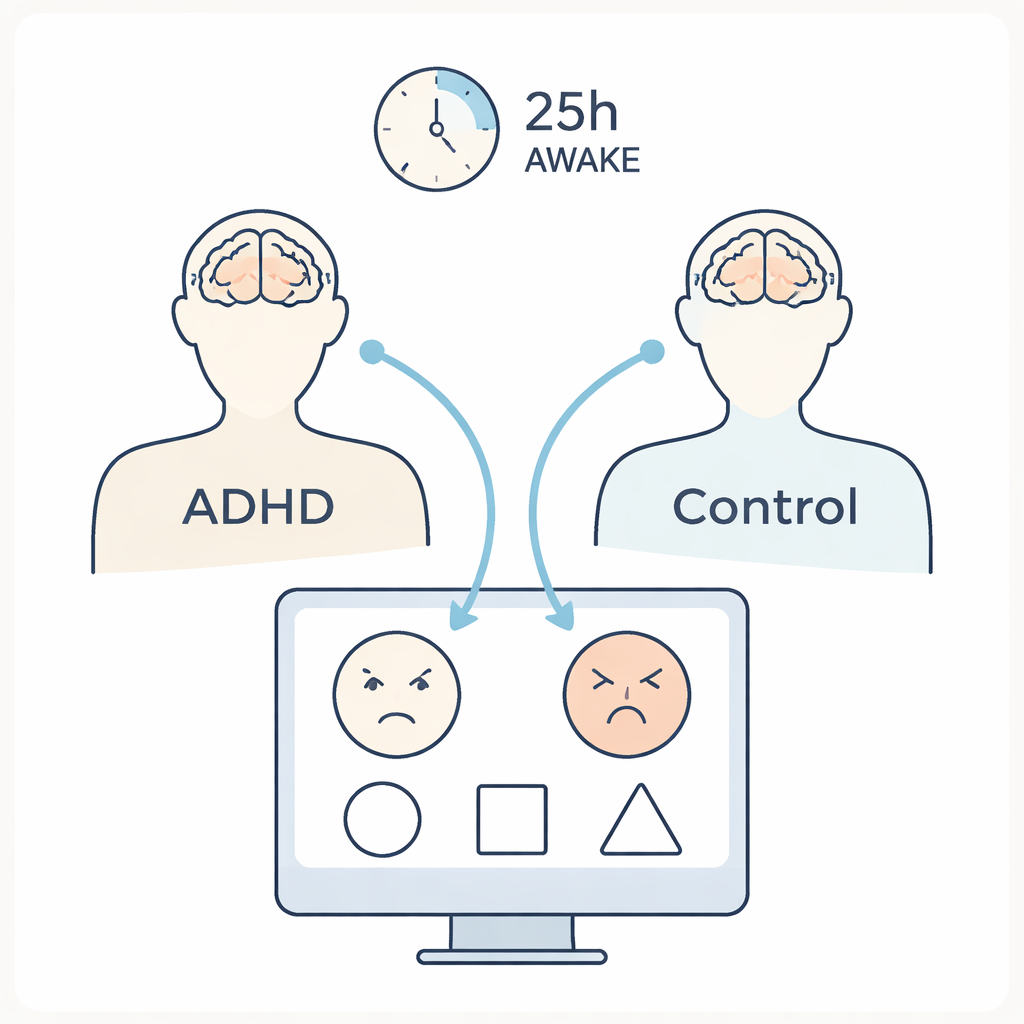
How the study was set up
The researchers recruited 19 young men with ADHD and 14 men without ADHD. All had fairly regular sleep during the week before the experiment, monitored with a wrist device that tracks movement at night. On the test day, everyone came to the lab in the morning, completed a computerized task while their brain activity was recorded, then stayed awake in the lab for 25 hours under supervision—no naps, caffeine, or heavy exercise allowed. The next morning, they repeated the same task, again with brain recordings.
A simple task with emotional faces
Participants performed a “visual oddball” task: they watched a stream of images on a screen and pressed a key whenever they saw a rare target image. Targets were either angry faces or simple shapes containing a small cross. More common non‑target images were neutral faces or empty shapes, to which they were supposed to withhold responses. This set‑up allowed the team to compare how people processed emotional faces versus non‑emotional shapes, and to separate mistakes of responding when they shouldn’t (commission errors) from failures to respond when they should (omission errors), as well as to measure reaction speed and how steady their responses were over time.
What sleep loss did to behavior
When everyone was well rested, adults with ADHD performed much like the control group. After a sleepless night, both groups slowed down somewhat when responding to angry faces, but only the ADHD group became clearly less accurate and more erratic. In ADHD, sleep deprivation led to more missed angry-face targets, more false alarms to neutral faces, and a large jump in how much their reaction times fluctuated from trial to trial. For non‑facial shapes, sleep loss increased some kinds of errors in both groups, but the increase in reaction‑time variability was again limited to the ADHD group. In short, staying up all night made people with ADHD especially prone to inconsistent and error‑prone responses when emotional faces were involved.
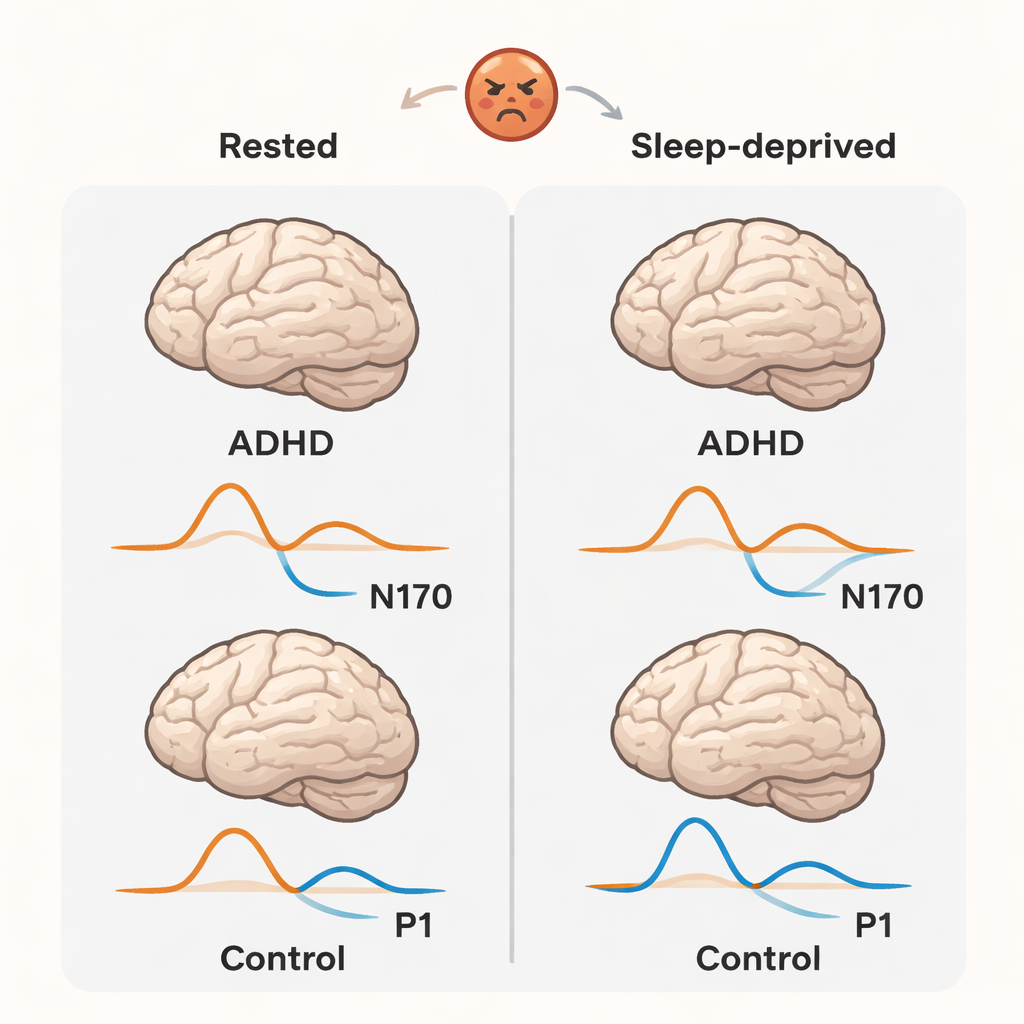
What sleep loss did to the brain
While participants did the task, the team recorded event‑related potentials (ERPs) — tiny, rapid voltage changes at the scalp that reflect brain responses to each image. They focused on early components that occur within a few tenths of a second after a face appears. One, called P1, reflects very early visual attention to a stimulus, and another, N170, is closely linked to recognizing faces. In men without ADHD, a sleepless night weakened the early P1 response but strengthened the N170 response to angry faces, suggesting that their brains reallocated resources from the first quick visual sweep to a slightly later stage that helps recognize and interpret faces. In men with ADHD, P1 either stayed the same or increased in some brain regions, and N170 barely changed at all. These contrasting patterns appeared only for angry faces, not for neutral faces or shapes, pointing to a specific disruption in early emotional face processing in ADHD under sleep loss.
What this means for real life
The results paint a picture in which a lost night of sleep drains mental resources for everyone, but people without ADHD can partly compensate by shifting how their brains process emotional faces. Adults with ADHD, in contrast, show altered early brain responses without the same helpful adjustment, and their performance on emotional tasks suffers. Because reading facial expressions is central to smooth social interaction, the findings suggest that chronic poor sleep may quietly worsen the social and emotional challenges faced by many people with ADHD. For clinicians, families, and adults with ADHD themselves, the message is straightforward: treating sleep problems and protecting sleep time could be a powerful, and often overlooked, way to support emotional understanding and everyday functioning.
Citation: Dan, O., Haimov, I., Harel, A. et al. Sleep deprivation alters early event-related potentials during emotional face processing in adults with ADHD. Sci Rep 16, 6956 (2026). https://doi.org/10.1038/s41598-026-38376-z
Keywords: ADHD, sleep deprivation, emotional faces, brain waves, attention