Clear Sky Science · en
Patterns of brown bear damages to agro-livestock activities in North-Eastern Italy across 15 years
Why bears at the farm gate matter
Across Europe, brown bears are slowly returning to mountains where they once vanished. In the North‑Eastern Italian Alps, this comeback brings a hopeful story of wildlife recovery—but also real worries for farmers whose animals, crops, and beehives can become easy meals. This study follows 15 years of records from two neighboring regions to understand when and where bears cause damage, how close they come to villages, and what that means for people trying to make a living from the land.
Bears, people, and a crowded mountain landscape
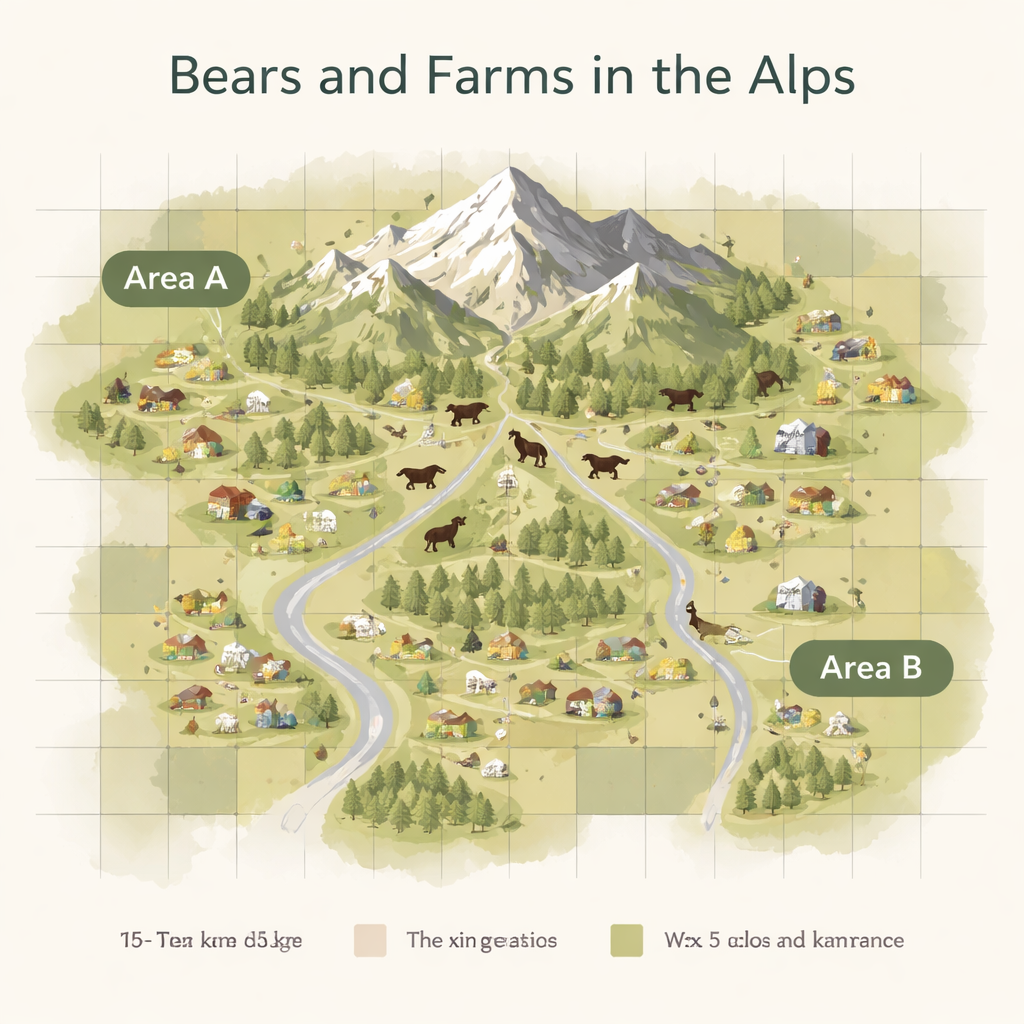
In the Alps of Trento and Friuli Venezia Giulia in North‑Eastern Italy, steep pastures, vineyards, and orchards sit right beside towns and roads. Brown bears were nearly wiped out here, but a reintroduction project at the turn of the century brought a small group from Slovenia into a protected area in Trento. Since then, the bear population in Trento has grown to several dozen animals, while only a few wandering males appear each year in neighboring Friuli. As bears explore beyond remote forests into farmed valleys, they occasionally clash with people through livestock attacks and raids on crops and beehives.
What the researchers set out to track
The authors examined every officially confirmed bear damage claim filed between 2009 and 2023 in both regions. Each claim was checked on site by trained staff, who identified the culprit using tracks, bite marks, and sometimes DNA tests. The team grouped damages into four everyday categories: livestock (including animals killed, injured, or missing), agriculture (such as vineyards and orchards), beehives, and simple structures like fences or sheds. Using statistical models and detailed maps divided into a grid, they asked three main questions: How have different kinds of damage changed over time? Are bears causing more trouble near towns? And are problem areas spreading across the landscape?
Seasons of risk on pastures, fields, and hives
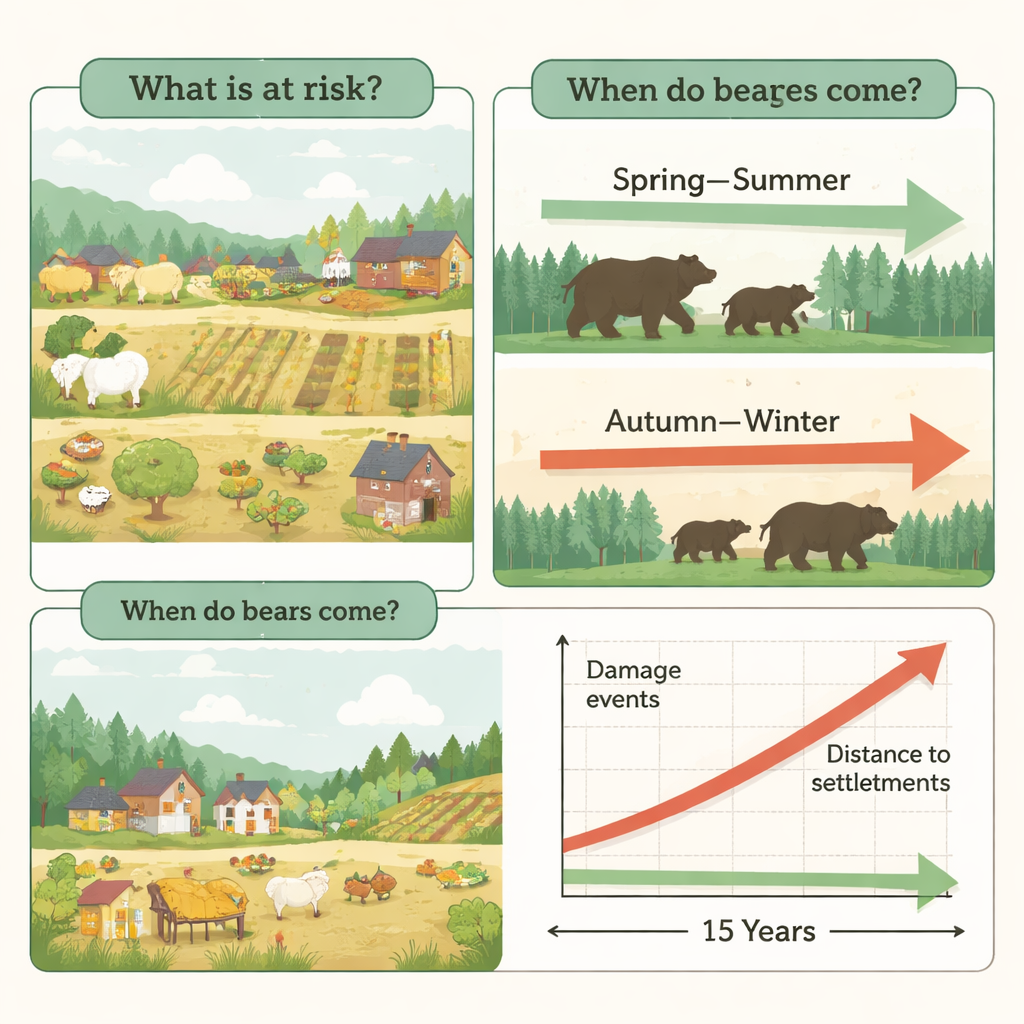
Most trouble came in spring and summer, when livestock are herded to high mountain grasslands, fruit crops ripen, and beekeeping is in full swing. Small animals such as poultry, rabbits, fish, and flocks of sheep and goats took the brunt of attacks, while cattle and horses were hit far less often. In fields, bears strongly favored vineyards and fruit orchards, especially cherries and plums, over ordinary croplands like maize or hay, likely because sweet fruit and grapes pack more calories. Beehives were another prime target and were usually located closer to villages than other damaged sites, reflecting how often hives sit along the edges of settlements. Overall damage events increased over the 15‑year period, particularly after 2018, and compensation payments to farmers rose in step.
How close bears come—and where hot spots form
Although most attacks occurred outside built‑up areas, about 4% happened inside urban zones, and many others were within just a couple of kilometers of houses. Over time, the distances from damage sites to the nearest town shrank, especially for livestock and structural losses, suggesting that bears are gradually operating closer to people. Mapping the incidents onto a grid of 5×5‑kilometer squares showed that the number of squares with at least one damage more than doubled over the study period. Hot spots—cells where damages were unusually frequent and clustered—were found only in Trento, where the bear population is established, and almost never in Friuli, where bears remain rare. Even within Trento, the exact locations of hot spots shifted with the seasons and with the type of damage.
Living with bears rather than against them
The study concludes that while bear numbers in Trento have climbed steadily, rising damage is not simply a matter of “more bears, more trouble.” Instead, repeated problems likely stem from a small number of bold individuals and from how farms are managed near villages. Because bears are now using a wider area and venturing closer to people, the authors argue that prevention—such as well‑maintained electric fencing, better protection for small livestock, and securing food waste—is essential. Removing particularly problematic animals may still be needed in extreme cases, but should not replace non‑lethal tools. For residents of these mountain valleys, the message is clear: thoughtful planning and protection can allow both traditional farming and a recovering bear population to share the same landscape.
Citation: Franchini, M., Raniolo, S., Corazzin, M. et al. Patterns of brown bear damages to agro-livestock activities in North-Eastern Italy across 15 years. Sci Rep 16, 7212 (2026). https://doi.org/10.1038/s41598-026-38371-4
Keywords: brown bears, human–wildlife conflict, livestock depredation, Alps, coexistence strategies