Clear Sky Science · en
Quantum swarm-optimized DV-Hop algorithm for accurate localization of weak nodes in wireless sensor networks
Smarter Maps for Invisible Networks
Billions of tiny, battery-powered sensors now watch over our bridges, forests, factories and battlefields. They quietly measure temperature, vibration, pollution or movement—and then report back. But these readings are only useful if we know where each sensor actually sits. This paper tackles a deceptively simple question with big consequences: how can we pinpoint the locations of inexpensive, GPS-free sensors scattered unevenly across rough terrain, and do it accurately, quickly and with little energy?
Why Finding Tiny Devices Is So Hard
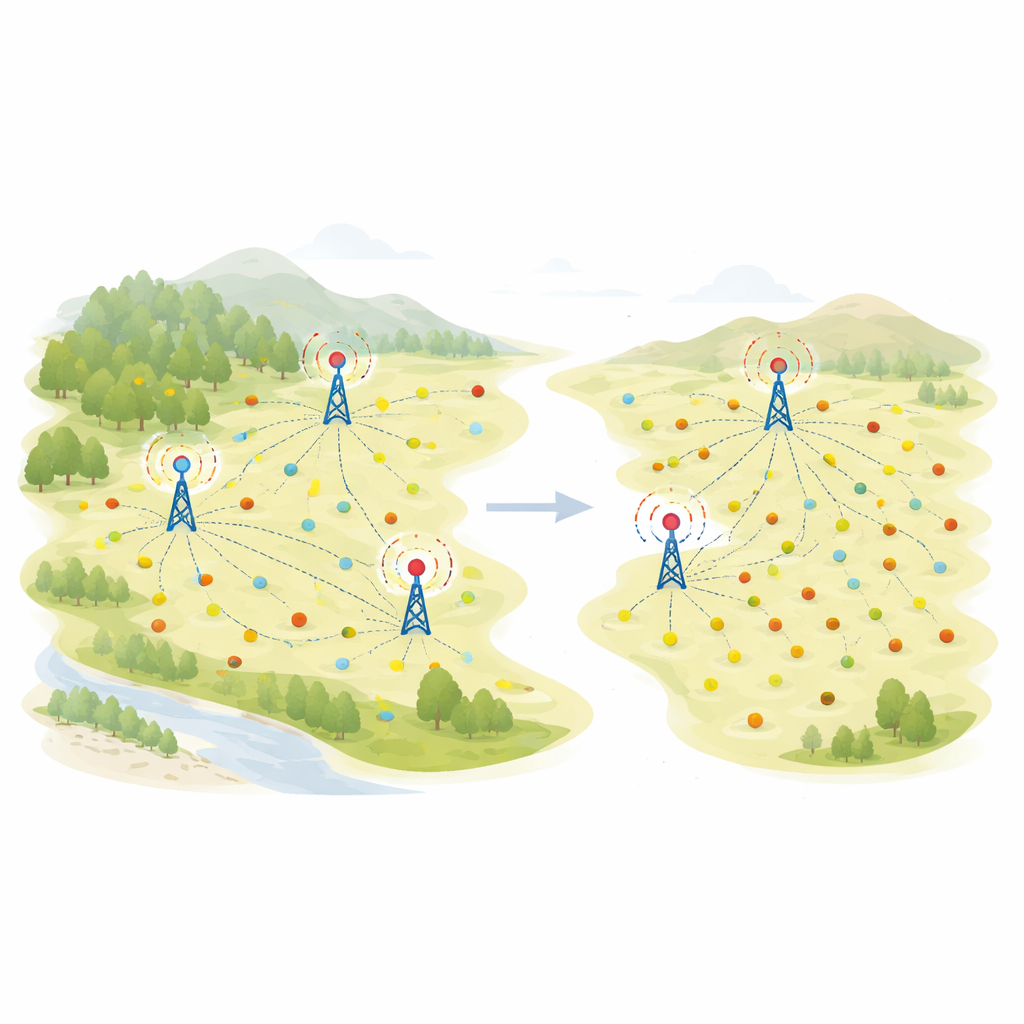
Wireless sensor networks resemble digital dust: many small devices are dropped into an area and left to self-organize. Only a few “anchor” nodes know their true position, typically using GPS. Most sensors do not, because GPS is costly and power‑hungry. A classic method called DV-Hop estimates distance in terms of “hops” along the communication links between nodes and then converts those hops into physical distance. DV-Hop is cheap and simple, but it struggles when sensors are placed unevenly or the network topology changes. Distances get distorted, positions drift, and the resulting maps can be too inaccurate for tasks like disaster warning, military targeting or precise industrial control.
Animal Packs and Quantum Ideas to the Rescue
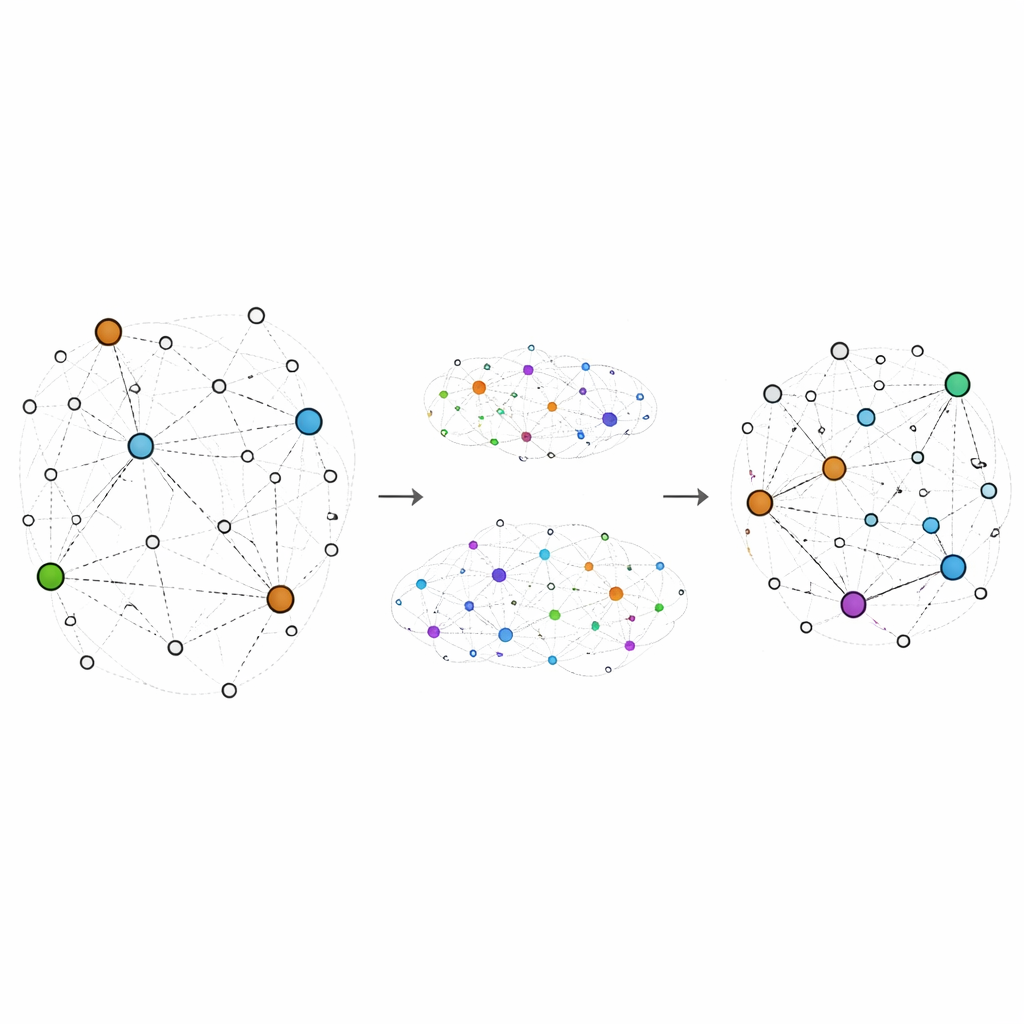
The authors propose two new twists on DV-Hop that borrow strategies from both nature and quantum physics. The first, Quantum Golden Jackal Optimization (QGJO), is inspired by the cooperative hunting of golden jackals. The second, Quantum Bullhead Shark Optimization (QBSO), mimics the way bullhead sharks detect, surround and attack prey. In both cases, the “animals” are mathematical agents that explore different guesses for where each unknown sensor might be. Quantum‑style elements—such as representing candidate solutions in a probabilistic way—help the swarm explore many possibilities in parallel and avoid getting stuck in mediocre, “local best” guesses. These methods are woven into DV-Hop so that hop-based distance estimates are refined into much sharper location predictions.
Making Better Use of the Paths Between Sensors
The improvement is not only in the swarm behavior. The authors also rethink how the network’s paths are used. Instead of relying solely on the nearest anchor, each sensor looks at both its closest anchor and other anchors whose communication paths share many of the same intermediate nodes—so‑called “similar paths.” By measuring how much different paths overlap, the algorithm gives more weight to those that provide consistent information about distance. This blended hop information feeds into the quantum swarms, which then adjust sensor positions to minimize the mismatch between estimated distances and the network’s actual hop structure. The result is a tighter map without adding new hardware or requiring direct distance measurements.
Testing Against Tough Benchmarks
To see whether their animal‑inspired, quantum‑flavored algorithms are more than clever metaphors, the authors run extensive computer experiments. First, they test QGJO and QBSO on nine standard mathematical landscapes that are notoriously full of deceptive peaks and valleys. Both methods outperform several respected optimization techniques, converging faster and finding better solutions. Then they embed the algorithms into DV-Hop and compare them with two advanced whale‑based methods (IWO-DV-Hop and EWO-DV-Hop) across 20 different network scenarios. These scenarios vary the area size, number of sensors, fraction of anchors, communication range and even simulated interference and mobility. In nearly every case, QGJO‑DV-Hop and especially QBSO‑DV-Hop cut the average positioning error by roughly 10–30 percent compared with the whale‑based competitors, while also converging in fewer iterations.
What This Means for Real-World Networks
For a non‑specialist, the practical message is clear: the authors show that we can locate many simple, inexpensive sensors far more accurately by being smarter, not by adding costly hardware. By combining hop‑based distance clues with swarm‑style search and quantum‑inspired randomness, their methods produce more reliable maps of where each node actually sits. That, in turn, makes the data from these networks far more trustworthy. While the work is currently validated through simulations, it points toward future deployments in complex three‑dimensional spaces—such as underwater, inside buildings or in urban canyons—where GPS often fails. Better localization means better early‑warning systems, smarter cities and more resilient monitoring of the critical systems we depend on every day.
Citation: Khan, Z.U., Gao, H., Ma, J. et al. Quantum swarm-optimized DV-Hop algorithm for accurate localization of weak nodes in wireless sensor networks. Sci Rep 16, 9029 (2026). https://doi.org/10.1038/s41598-026-38364-3
Keywords: wireless sensor networks, node localization, swarm optimization, quantum-inspired algorithms, DV-Hop