Clear Sky Science · en
Improving cognitive stress classification via multimodal EEG and ECG fusion: gender differences in physiological response
Why measuring everyday mental strain matters
Modern life constantly tugs at our attention, from tight deadlines to multitasking on screens. Yet we rarely see what this pressure does inside our bodies and brains in real time. This study explores a way to "listen" to both the brain and the heart at once to tell how mentally stressed a person is, and whether that response differs between men and women. Such tools could eventually help schools, workplaces, and even cars adapt to people’s changing mental load before errors or burnout occur.
Listening to the brain and heart together
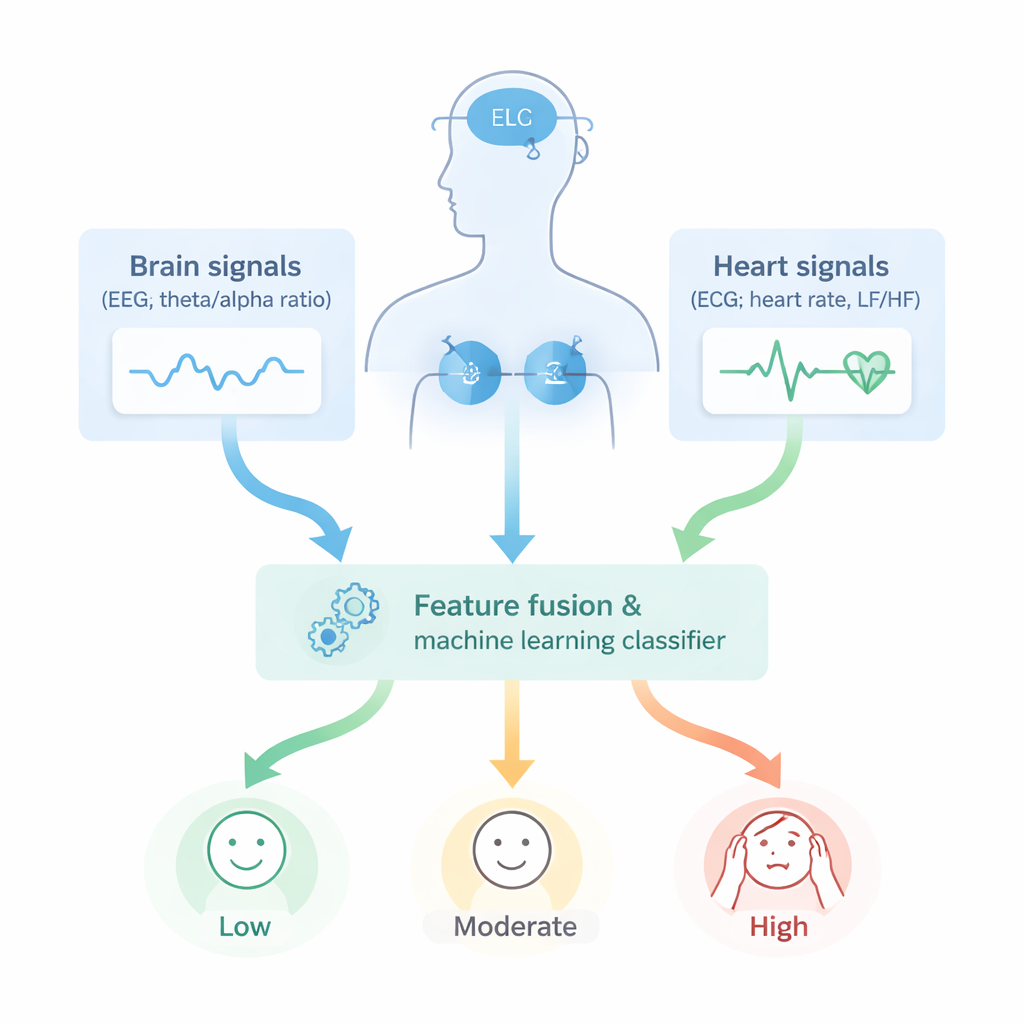
When we are under mental strain, our brain rhythms and heart activity both change. The researchers used two common medical recordings: electroencephalogram (EEG), which tracks tiny electrical signals from the brain, and electrocardiogram (ECG), which monitors heartbeats. Rather than feeding in hundreds of raw measurements, they focused on just three compact indicators that have clear physiological meaning: a brain-based theta/alpha ratio (TAR) that reflects mental effort, simple heart rate (HR), and a heart-variability balance measure called LF/HF that captures how the nervous system shifts under stress. These signals were collected from 66 healthy university students while they performed increasingly difficult mental arithmetic tasks designed to reliably trigger mild to strong cognitive stress.
From raw signals to a smart stress detector
The team did not simply hope that any signal would work; they first checked statistically that their chosen features actually differed between rest and stress. Using standard tests, they confirmed that TAR, HR, and LF/HF changed in systematic ways across the five stages of the task, from relaxed eyes-open rest to the hardest calculations. They then normalized the data so that brain and heart measures were on comparable scales, and used principal component analysis to confirm that each feature added unique information rather than duplicating what another already captured. Next, they built several classic machine-learning models—including decision trees, k-nearest neighbors, linear discriminant analysis, naive Bayes, random forests, and support vector machines (SVMs)—and trained them to tell rest from stress, and to separate low from high stress, using either EEG alone, ECG alone, or a fusion of both.
Combining signals boosts accuracy
Across almost every comparison, the fused model that used both EEG and ECG outperformed those that relied on a single signal. The SVM classifier emerged as the strongest approach, correctly distinguishing rest from the different stress levels with peak accuracies up to about 94–95%. A simpler brain-only model based on the theta/alpha ratio alone already did reasonably well, but adding heart measures substantially improved performance, especially when the stress was subtle rather than extreme. In technical terms, the combined model achieved higher accuracy, precision, and F1 scores, and more balanced performance across classes, showing that brain and heart are providing complementary views on the same underlying mental load.
Men and women do not respond exactly the same
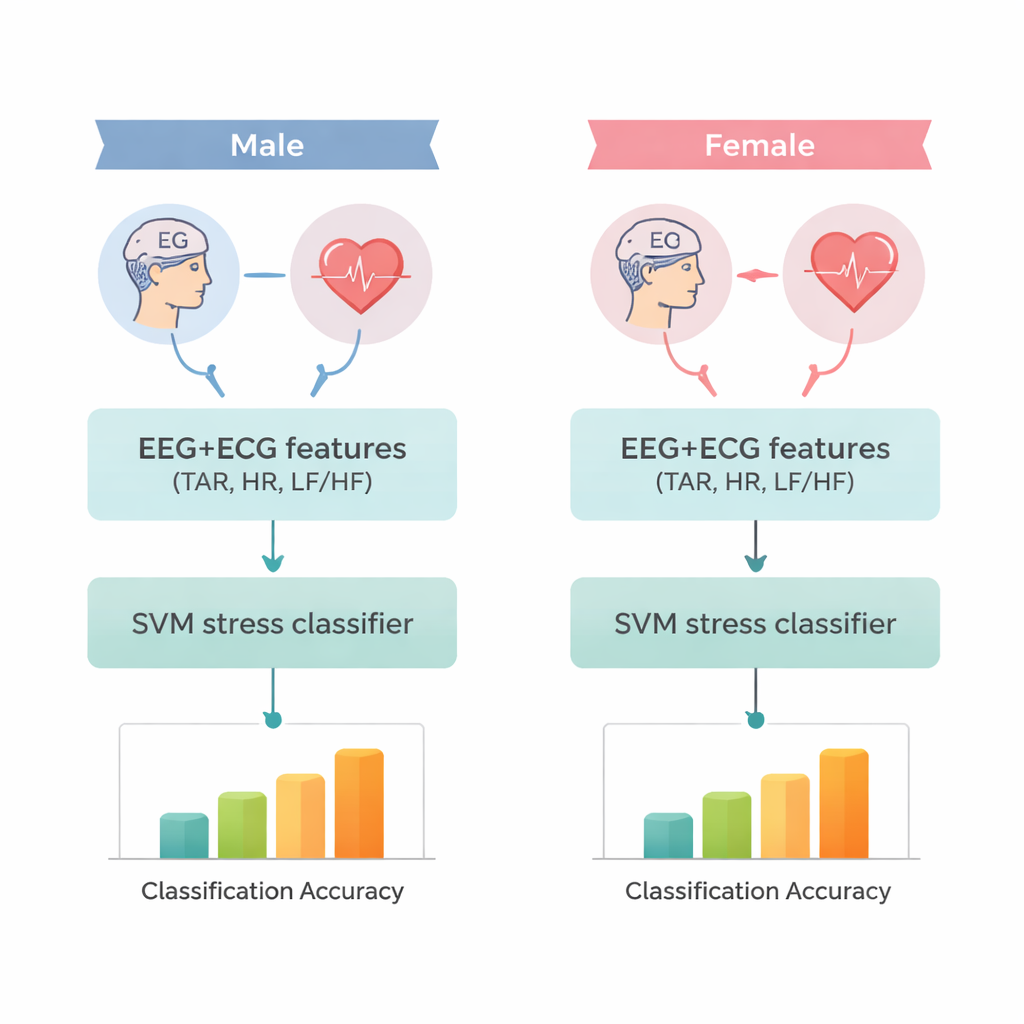
Because the public dataset carefully labeled each participant’s sex, the authors could go a step further and ask whether the patterns of brain and heart response to cognitive stress differ between men and women. They re-ran their models separately for each group and found that women tended to achieve higher classification scores than men for many of the tasks. On average, female participants showed slightly higher brain effort signals (TAR) and higher heart rate under load, while men showed a small tendency toward a higher LF/HF balance. Although the differences were not huge, they were strong enough for statistical tests to flag them and for the machine-learning models to exploit them. This suggests that a one-size-fits-all stress detector may not be entirely fair or optimal.
What this means for future smart systems
To a lay reader, the bottom line is straightforward: you can get a reliable readout of how mentally stressed someone is by combining a small number of well-chosen signals from the brain and heart, and those signals are not identical in men and women. This work shows that high performance does not require complex "black box" deep learning or hundreds of opaque features; a compact, interpretable trio—brain rhythm ratio, heart rate, and heart variability balance—fed into a standard classifier can reach impressive accuracy. In the long run, such gender-aware, multimodal systems could power wearable devices, learning platforms, or safety-critical interfaces that quietly sense when a user is overloaded and adjust demands in real time, helping to reduce mistakes, fatigue, and long-term stress.
Citation: Salam, A., Alam, F., Shah, D. et al. Improving cognitive stress classification via multimodal EEG and ECG fusion: gender differences in physiological response. Sci Rep 16, 7304 (2026). https://doi.org/10.1038/s41598-026-38356-3
Keywords: cognitive stress, EEG and ECG, machine learning, gender differences, physiological monitoring