Clear Sky Science · en
High-performance temperature regulation of nonlinear CSTRs via a hybrid stellar oscillation optimizer and differential evolution-based PID-F control
Keeping industrial chemistry safe and steady
From making medicines to producing fuels, many industrial chemical reactions happen in large stirred tanks that must be kept at just the right temperature. If the heat gets away from operators, reactions can slow down, spoil products, or in the worst case run out of control. This paper explores a new way to automatically tune a widely used type of temperature controller so that these reactors respond quickly and smoothly, even when their behavior is highly nonlinear and hard to predict.
Why controlling a stirred tank is harder than it looks
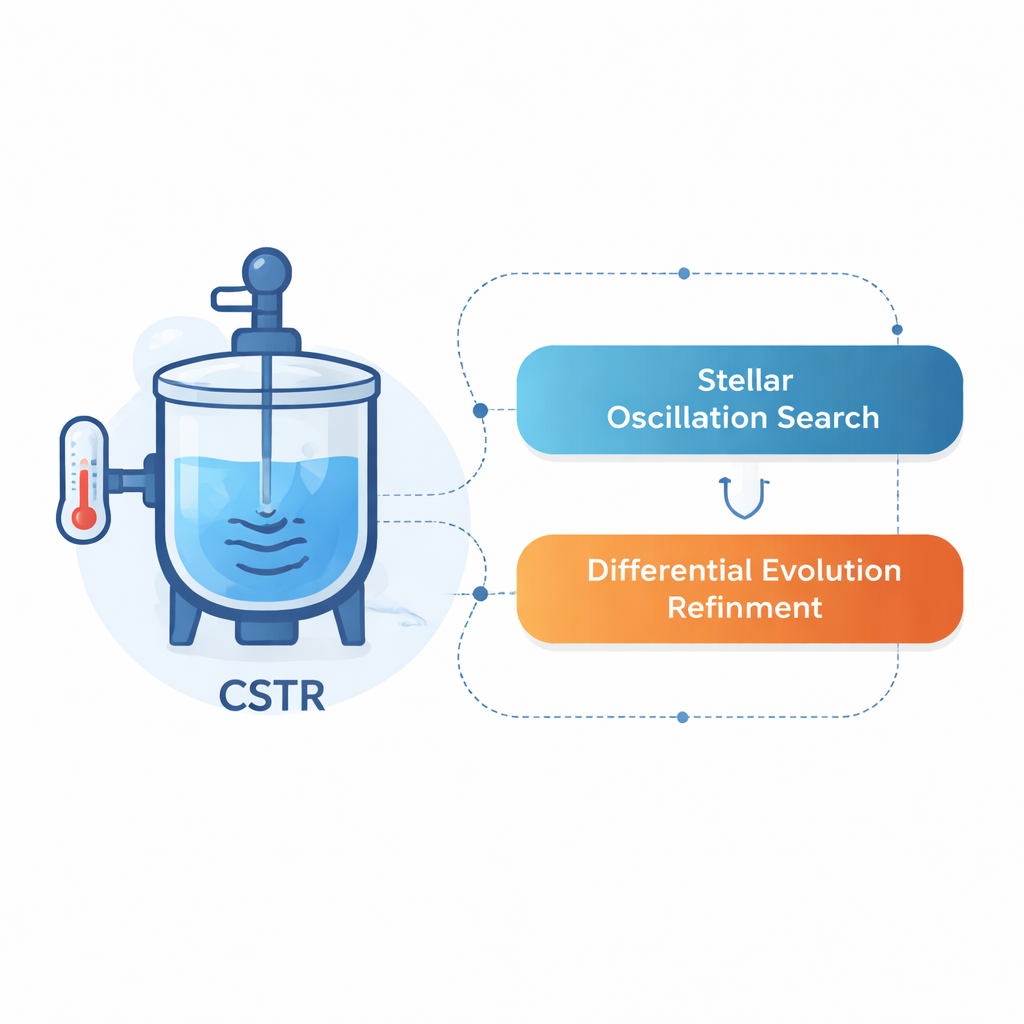
Continuous stirred tank reactors (CSTRs) are workhorses of the chemical, pharmaceutical, and energy sectors. Liquid containing a reactant flows in and out while a stirrer keeps everything well mixed. Because many reactions release heat and speed up as they get hotter, the reactor’s temperature can change rapidly and in complex ways, sometimes with multiple possible steady operating points. Even modest temperature errors can trigger side reactions, reduce product quality, or move the system toward thermal runaway. Traditional on–off or simple linear controllers struggle with this nonlinear behavior, so engineers need smarter tools to keep the reactor temperature on target without long delays or large overshoots.
Old and new ways to tune a familiar controller
The work focuses on the familiar proportional–integral–derivative (PID) controller, which is standard in industry because it is simple and interpretable. Here, the authors use a slightly enhanced form called PID-F, which adds a small filter to the derivative part to prevent noisy temperature readings from causing sudden jumps in the control signal. Classic tuning recipes, such as the Ziegler–Nichols and Tyreus–Luyben methods, pick PID settings by approximating the reactor as a linear system near one operating point. That approach is fast but often yields sluggish or overshooting behavior when the real reactor behaves nonlinearly. More modern approaches use artificial intelligence and advanced optimization algorithms to search for better settings, but these can be data hungry, computationally heavy, or sensitive to how they are configured.
A hybrid search inspired by stars and evolution
To improve tuning without requiring a detailed plant model, the study introduces a hybrid optimization algorithm called hSOO-DE. It combines two nature-inspired ideas. The first, the stellar oscillation optimizer (SOO), mimics the way stars expand and contract, using sine and cosine-like motions to explore a wide range of possible controller parameters. This broad exploration helps avoid getting stuck in poor local solutions. The second, differential evolution (DE), is an evolutionary scheme that takes promising candidates and refines them by mixing and mutating them, honing in on better-performing settings. In hSOO-DE, SOO first spreads a population of candidate PID-F settings around the search space; then DE immediately refines those candidates in each iteration. This fixed two-stage cycle repeats until the algorithm finds a set of four parameters—proportional, integral, derivative gains, and filter constant—that best balance quick response with small long-term error.
Testing the method on a benchmark reactor
The authors apply their hybrid tuner to a standard nonlinear CSTR model where an exothermic reaction converts one chemical species into another. The cooling jacket temperature around the reactor serves as the control input. They define a performance score that rewards both a small overshoot and a small accumulated tracking error when the setpoint temperature is stepped up by 20 kelvins. Using many repeated runs, they compare hSOO-DE with several state-of-the-art optimizers (the original SOO, birds-of-prey optimization, covariance matrix adaptation evolution strategy, and plain differential evolution) as well as with classical PID-F tuning rules and an automatic tuner in Simulink. The new method consistently finds parameter sets with the lowest average cost and the smallest spread in results, indicating both accuracy and reliability.
What better tuning looks like in practice
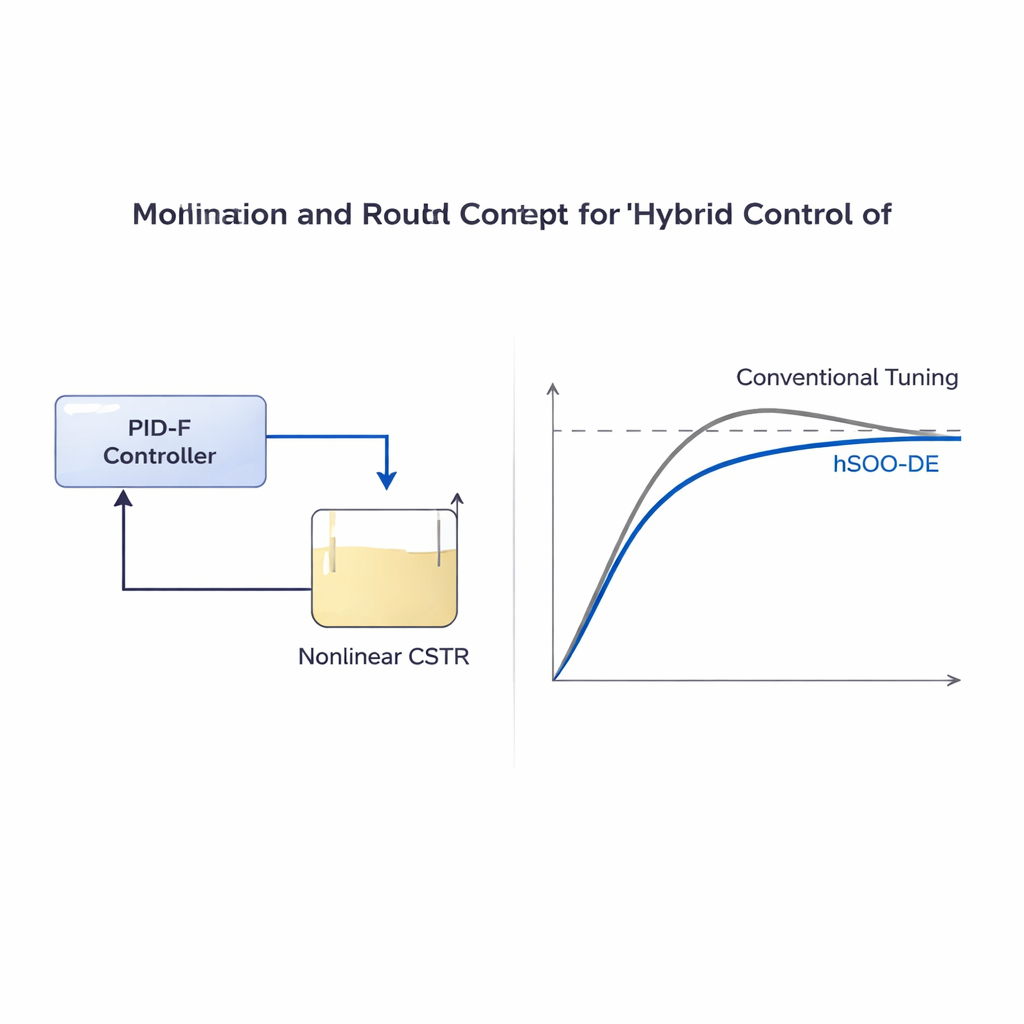
When the tuned controllers are tested in time-domain simulations, the differences are clear. The hSOO-DE-based PID-F controller brings the reactor temperature up to the new setpoint more quickly, with very small overshoot and a short settling time of about two minutes. Competing optimization methods either converge more slowly or leave small oscillations near the target. Classical tuning approaches show significantly larger peaks and slower damping, and some exhibit noticeable steady-state errors. Error measures that integrate the difference between actual and desired temperature over time all favor the hybrid approach, and a combined stability index confirms that hSOO-DE offers the best compromise between fast response and smooth behavior. Importantly, the reactor’s concentration profile also remains well behaved, indicating that chemical stability is preserved.
Takeaway for real-world reactors
For a lay reader, the main message is that the authors have found a smarter, automatic way to set the knobs of a standard industrial controller so that a difficult chemical reactor behaves more safely and efficiently. By letting a computer algorithm inspired by stellar pulsations and evolutionary competition search through possible controller settings, they obtain a PID-F controller that reacts quickly to setpoint changes, avoids large temperature spikes, and settles accurately at the desired value. While the study is based on simulations and specific operating conditions, it suggests that such hybrid optimization schemes could help plants upgrade existing control hardware to handle nonlinear processes more robustly, without requiring new sensors or entirely new control architectures.
Citation: Ekinci, S., Turkeri, C., Gokalp, I. et al. High-performance temperature regulation of nonlinear CSTRs via a hybrid stellar oscillation optimizer and differential evolution-based PID-F control. Sci Rep 16, 7713 (2026). https://doi.org/10.1038/s41598-026-38354-5
Keywords: chemical reactor control, PID tuning, metaheuristic optimization, temperature regulation, continuous stirred tank reactor