Clear Sky Science · en
Pore-micro fracture structure, porosity and gas- bearing property of deep shale under lithofacies-formation pressure coupling
Why tiny spaces in deep rocks matter
Far beneath southwest China, gas locked in dense black shales helps fuel homes and industry. Whether that shale holds a lot of usable gas, or almost none, turns out to depend on two quiet partners: the type of rock and the pressure squeezing it. This study looks inside deep shales of the Longmaxi Formation in the Sichuan Basin to see how rock ingredients and underground pressure work together to create – or crush – the microscopic spaces that store shale gas. Its findings help explain why some deep wells are highly productive while others, drilled into the same formation, disappoint.
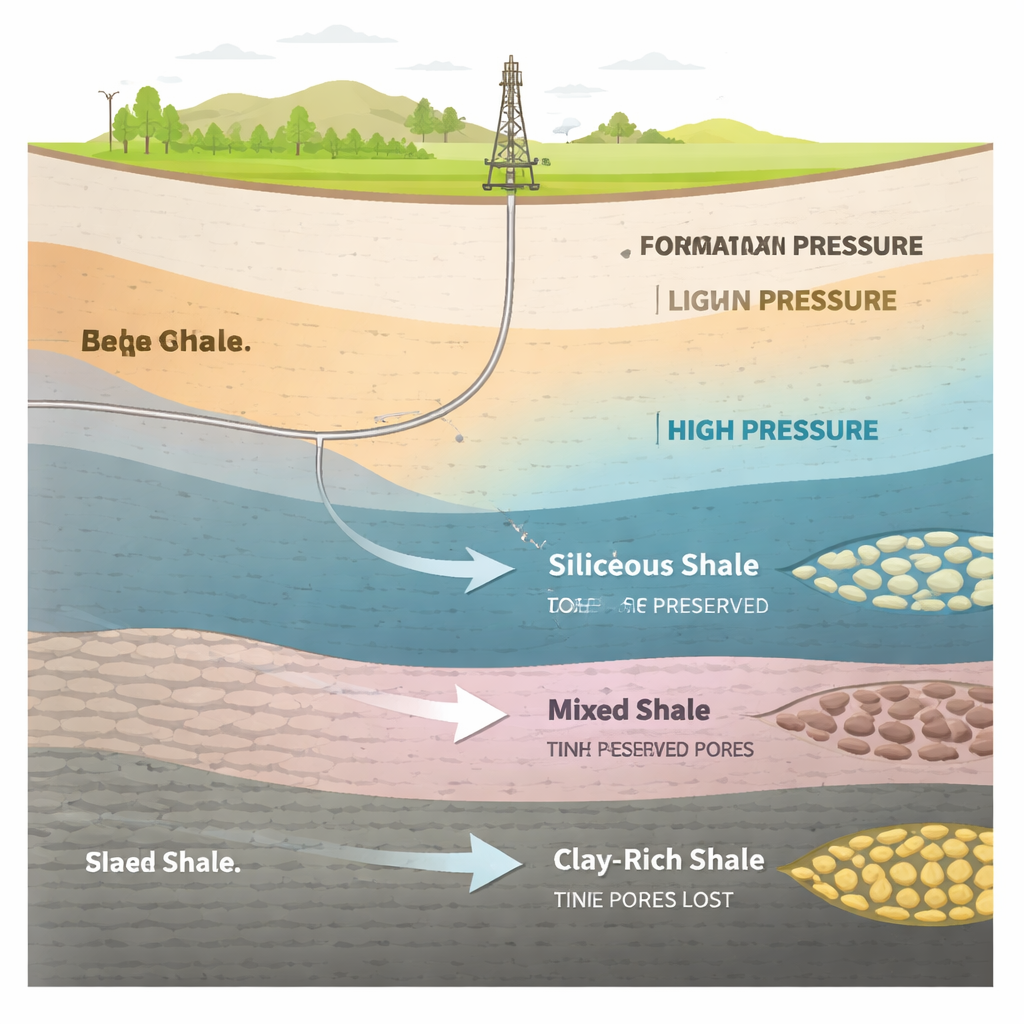
Different kinds of shale, different foundations
The researchers first sorted the Longmaxi shales into three main rock types, or lithofacies. Siliceous shale is rich in hard minerals such as quartz; mixed shale blends quartz with more clay; and clay-rich shale is dominated by softer, sheet-like clay minerals. They then analyzed nearly 100 core samples from four wells drilled across the basin, spanning depths greater than 3,500 meters and a range of pressure conditions from normal to strongly overpressured. For each sample they measured organic carbon (the fuel source for gas generation), mineral make-up, porosity (how much empty space the rock contains), and the amount of gas actually present using field desorption tests.
How pressure protects – or destroys – pore space
Microscope images and gas adsorption experiments show that most of the useful storage space for shale gas lies in pores only a few billionths of a meter across, plus extremely thin fractures. In siliceous shale with abundant organic matter, these pores form honeycomb-like networks inside the organic material and between rigid mineral grains. High formation pressure acts like an internal brace, helping the rock resist the weight of overlying layers and preserving this micro-architecture even at burial depths beyond 4,000 meters. In contrast, mixed and clay-rich shales deform more easily. As pressure conditions change over geological time – especially during uplift, when overpressure is lost – their pores collapse, shrink from larger to smaller sizes, and many of the spaces that once held free gas disappear.
What happens to gas as pores evolve
Gas in these shales occurs in two main forms: free gas that occupies open pores and fractures, and adsorbed gas that clings in thin layers to pore walls, especially within organic matter and clays. The study finds that as porosity falls, free gas content drops quickly, particularly in clay-rich and mixed shales, while adsorbed gas also declines but more gradually. In the most favorable siliceous, organic-rich intervals, total gas content can reach nearly 19 cubic meters per ton of rock under strong overpressure. There, rigid quartz grains and a high organic content work together: quartz helps preserve pore structure, while the organic matter both generates gas and offers abundant microscopic storage sites. Clay-rich shales, by comparison, tend to have low organic content, poor resistance to compaction, and the weakest pore networks, making them poor reservoirs even though their tightness can help seal gas in neighboring layers.
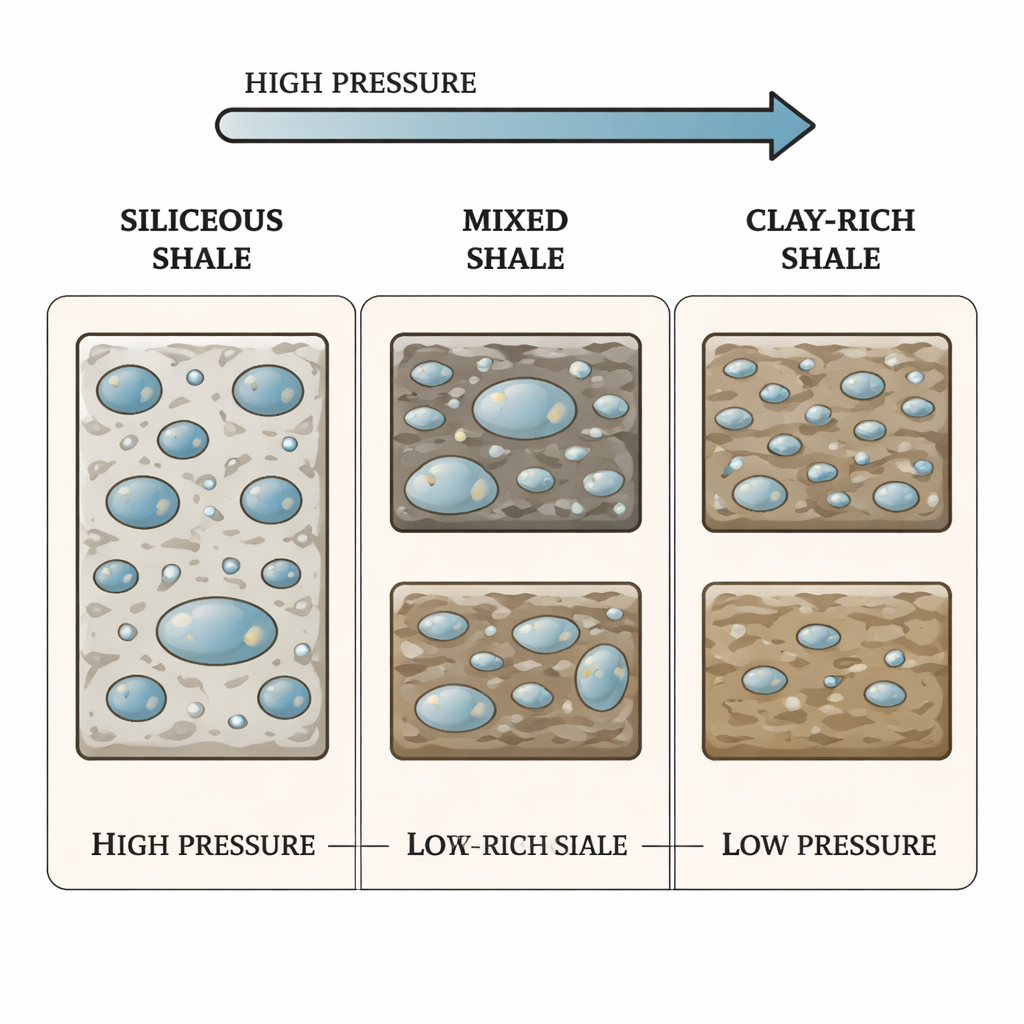
Depth, pressure, and rock type working together
By comparing many samples across depth and pressure, the authors show that no single factor – not depth, not pressure, not organic richness alone – can explain how much gas a deep shale will hold. Below about 3,000 meters, stronger compaction steadily reduces pore space, but overpressure can partially counteract this squeeze. Where overpressure is maintained and the rock is quartz-rich and organic-rich, pores and fractures survive better and gas is retained. Where the rock is clay-rich or has less organic matter, the same pressure history leads to far more severe pore loss. As pressure drops later in the basin’s history, the contribution of large pores to storage wanes, while smaller pores and rougher pore surfaces become relatively more important, although overall capacity still shrinks.
What this means for future shale gas
For a non-specialist, the key message is that deep shale gas potential is not just about drilling deeper or finding high pressure. The best deep reservoirs in the Longmaxi Formation are those siliceous, organic-rich layers that combine a strong mineral framework with abundant microscopic pores and fractures, and that have stayed overpressured for much of their history. Mixed and clay-rich shales generally lose both pore space and gas as they are squeezed and later depressurized. Understanding this subtle partnership between rock type and pressure evolution helps explorers target the layers most likely to deliver gas and avoid costly wells in rocks that, despite similar depths and ages, simply cannot hold on to their microscopic storage space.
Citation: Zhang, Y., Zhang, H., Zhang, L. et al. Pore-micro fracture structure, porosity and gas- bearing property of deep shale under lithofacies-formation pressure coupling. Sci Rep 16, 7303 (2026). https://doi.org/10.1038/s41598-026-38352-7
Keywords: shale gas, pore structure, formation pressure, Sichuan Basin, Longmaxi Formation