Clear Sky Science · en
Unravelling depth-dependent pedoclimatic controls on measurable soil organic carbon fractions across climatic gradients in Australian agricultural soils
Why Soil Carbon Matters to Everyday Life
Soils beneath farms quietly store more carbon than plants and the atmosphere combined, helping to keep climate change in check while supporting food production. This study asks a deceptively simple question: how do climate and soil conditions, from dry inland paddocks to wet coastal fields, control the way carbon is stored underground in Australian agricultural soils? By teasing apart different kinds of soil carbon and how they change with depth, the authors offer clues for how farmers and policymakers can manage land to both grow crops and lock away more carbon for the long term.
Two Ways Soil Holds On to Carbon
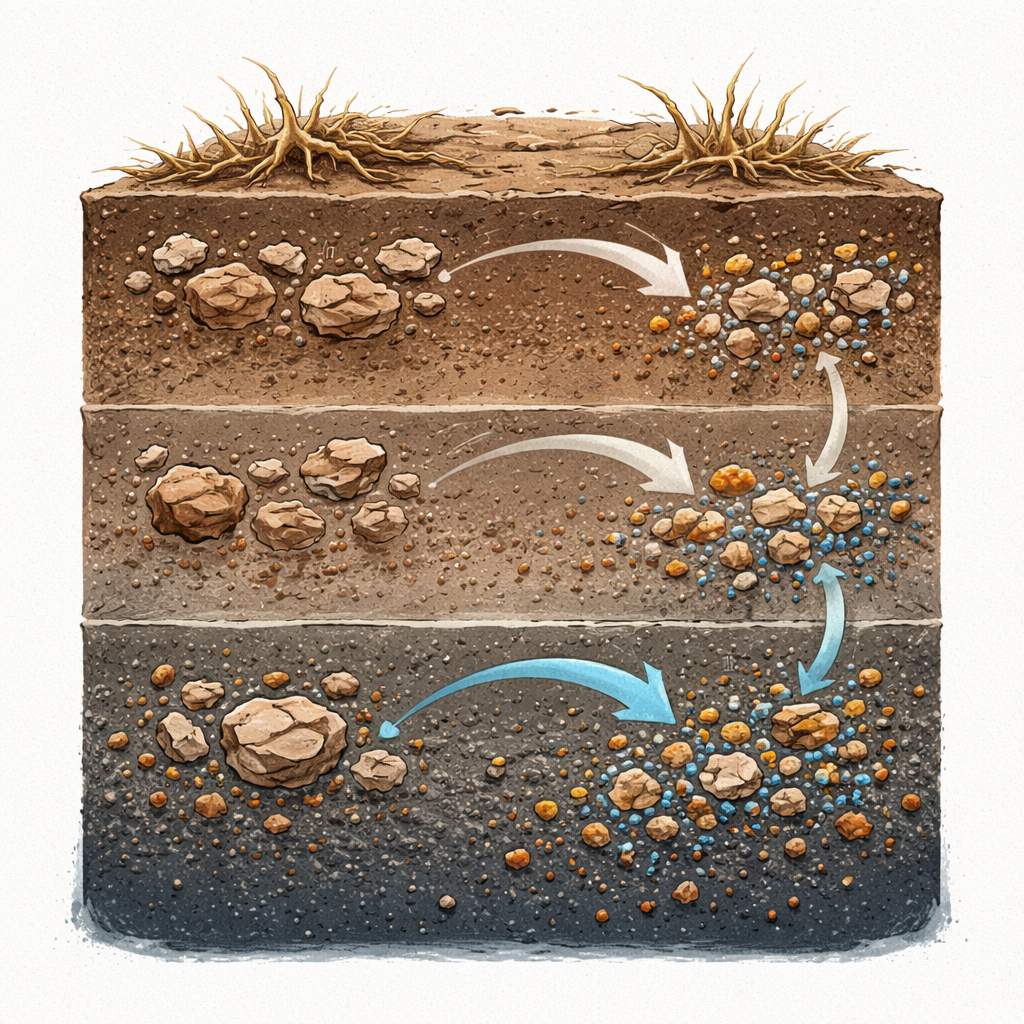
The researchers focus on two main carbon “banks” in soil that behave very differently over time. Particulate organic carbon is made of recognizable plant bits such as roots and crop residues. It tends to sit loosely between soil particles and can be broken down by microbes within years to decades, especially when soils are disturbed or warmed. Mineral-associated organic carbon, in contrast, is made of much finer material and microbial remains that are stuck to mineral surfaces such as clays and metal oxides. These tight bonds can protect carbon for decades to centuries. How much soil stores in each of these banks, and where with depth, can determine how stable that carbon is as climate and land use change.
A Continent-Sized Natural Experiment
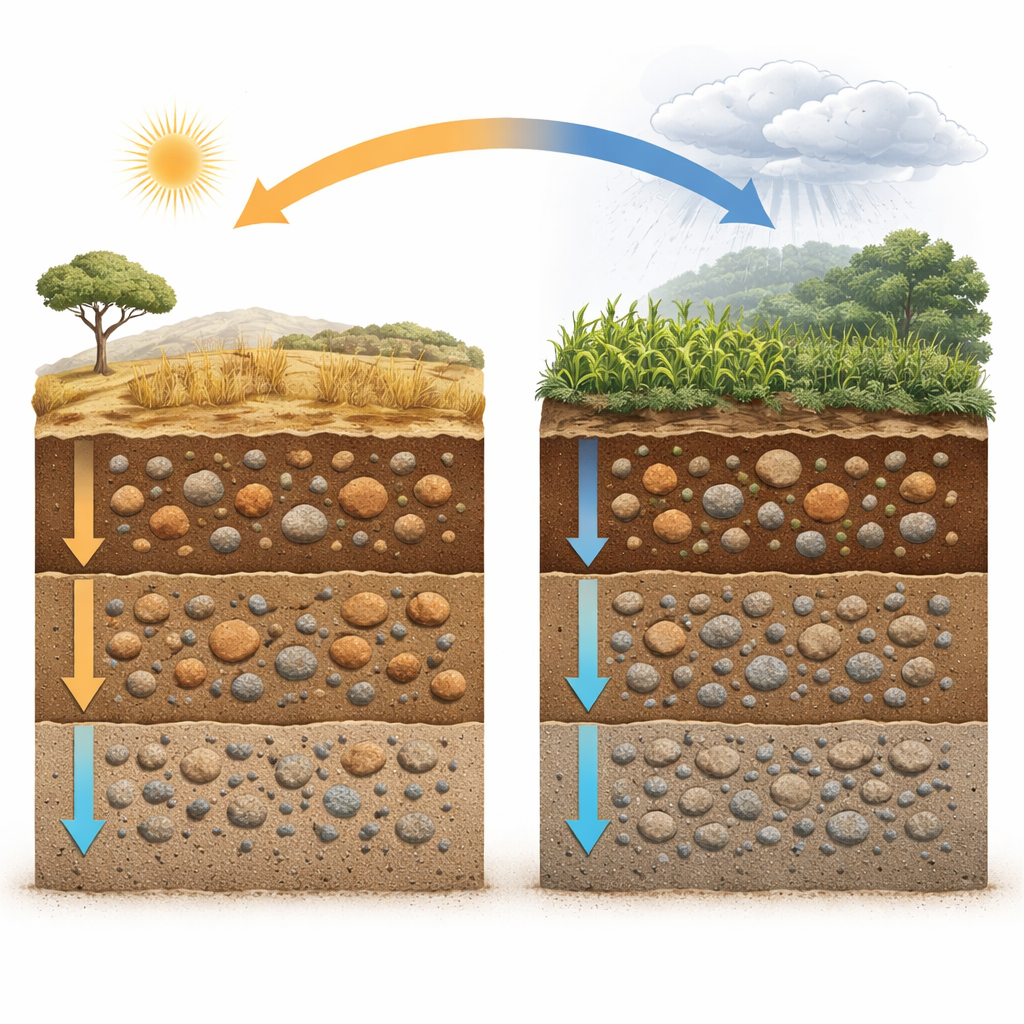
To see how climate and depth shape these carbon pools in real farms, the team drew on a national dataset from 2,256 paddocks across Australia, spanning dry, semi-dry, Mediterranean, semi-humid, humid, and very humid zones. They examined soils under two broad land uses: continuous cropping and modified pastures. For each site, they estimated stocks of particulate and mineral-associated carbon in three layers down to 30 centimeters. They also compiled information on total nitrogen, soil texture and chemistry, the abundance of key minerals, topography, and long-term temperature and rainfall. Using advanced machine-learning models combined with statistical pathway analysis, they then identified which factors best explained the ups and downs of each carbon pool in each climate zone and depth.
How Climate, Depth, and Land Use Shape Carbon
Across the board, both forms of soil carbon increased from the driest to the wettest regions, largely because greater water availability boosts plant growth and organic inputs. Carbon stocks also tended to decline with depth, but the pattern depended on land use and climate. In Mediterranean and semi-humid zones, pastures held more particulate carbon than cropping across all depths, reflecting continuous cover and minimal disturbance. In the driest and very wettest climates, pastures mainly boosted particulate carbon near the surface, while cropping sometimes matched or exceeded them deeper down. For mineral-associated carbon, continuous cropping often had an advantage in humid and very humid zones, especially in subsoils, suggesting that fertilized crops with deeper roots and residue inputs can feed more carbon into the stable mineral-bound pool at depth.
The Quiet Power of Nitrogen and Minerals
Among all the measured factors, total nitrogen emerged as the single strongest driver of both carbon pools in most climate–depth combinations, explaining up to half of the spatial variation. Nitrogen supports plant growth and microbial processing, so more nitrogen generally meant more soil carbon. However, the nitrogen level needed before carbon accumulation stopped being limited rose sharply from dry to very humid regions, roughly tripling in the surface layer. In drier zones, nitrogen mattered most near the surface; in wetter zones, its influence shifted deeper, where roots and moisture also penetrate. The study also shows that mineral make-up becomes more important with depth and humidity, especially for mineral-associated carbon. Certain forms of silica and iron and aluminum oxides strongly shaped how much carbon soils could bind to minerals, sometimes even outweighing nitrogen in deeper layers or in wet regions’ topsoils.
Designing Climate-Smart Soils for the Future
Put simply, the study finds that dry and wet farm landscapes need different strategies to build and protect soil carbon. In dry zones, the main bottleneck is getting enough organic material into the soil and keeping structure intact; practices that boost plant cover, improve water and nutrient retention, and reduce disturbance can help both particulate and mineral-bound carbon persist. In humid areas, where plant growth is already strong, the challenge is to turn vulnerable surface carbon into more stable, mineral-associated forms and to move more carbon into subsoils that are less exposed to erosion and rapid decay. There, combining deep-rooted plants, thoughtful fertilization, and possibly mineral amendments may be key. Together, these insights provide a mechanistic roadmap for tailoring soil management to local climate and depth, helping agriculture both adapt to and slow climate change.
Citation: Jing, H., Karunaratne, S., Pan, B. et al. Unravelling depth-dependent pedoclimatic controls on measurable soil organic carbon fractions across climatic gradients in Australian agricultural soils. Sci Rep 16, 8474 (2026). https://doi.org/10.1038/s41598-026-38349-2
Keywords: soil organic carbon, Australian agriculture, climate gradients, particulate vs mineral carbon, carbon sequestration