Clear Sky Science · en
Occurrence and concentration of caffeine and cadmium as micropollutants in the Red Sea coast, Egypt
Why your morning coffee ends up in the sea
Every day, huge amounts of invisible chemicals wash from cities and resorts into the ocean. Among them are familiar substances like caffeine from coffee and a toxic metal called cadmium. This study looked at how much of these two "micropollutants" are building up along Egypt’s Red Sea coast—a region prized for its coral reefs, tourism, and fisheries—to see what our daily habits may be doing to a fragile marine environment.
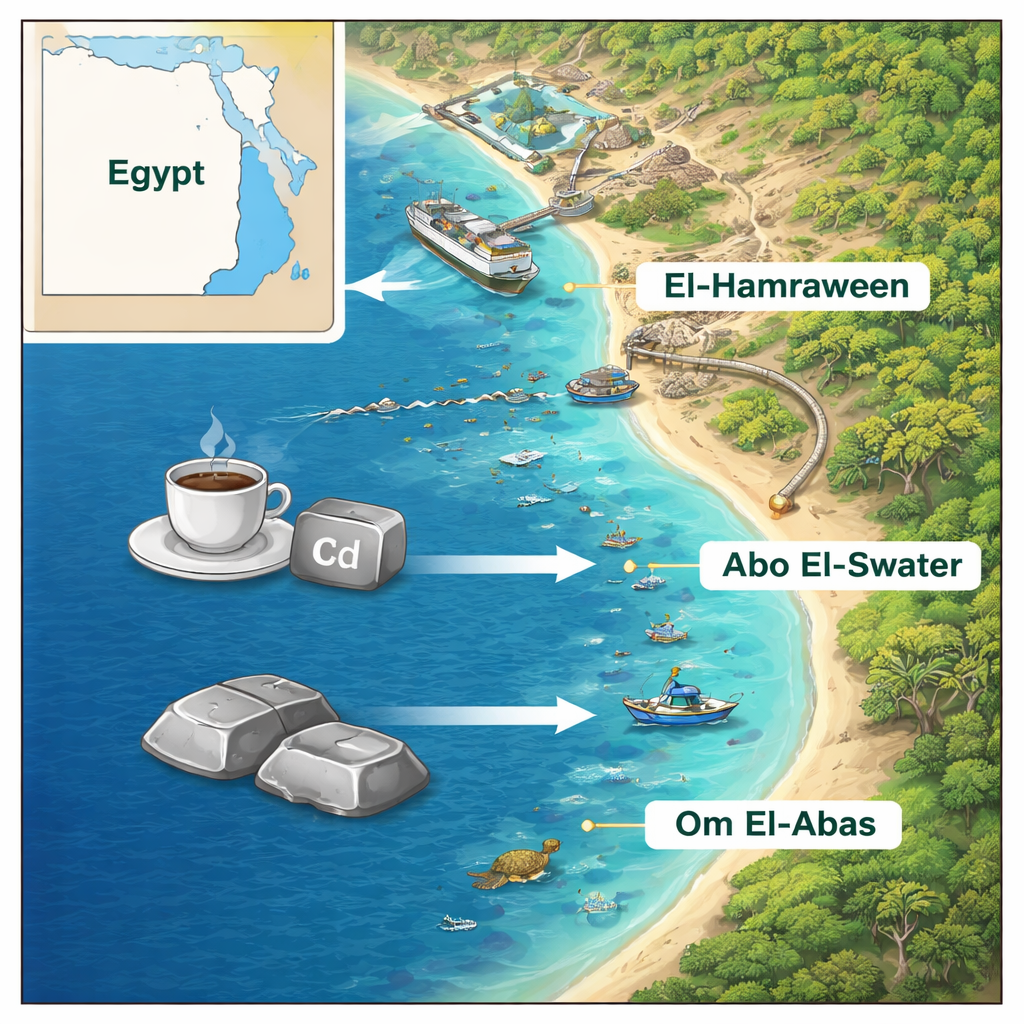
A closer look at three very different shores
The researchers focused on three sites that represent a gradient from heavily used to relatively protected coastline. El-Hamraween lies beside one of the oldest and largest phosphate ports on the Egyptian Red Sea, where ships, loading facilities, and industrial activity are common. Abo El-Swater, just a few kilometers away, is famous for its coral reefs, dive camps, and night diving. Om El-Abas, in contrast, is inside Wadi El-Gemal National Park, an area with mangroves, seagrass, and fewer direct pollution sources. At each place, the team collected seawater and sediment from both the low intertidal zone (closer to open water) and the high intertidal zone (closer to the dry shore) at the start of summer 2023.
Measuring what the eye cannot see
Back in the laboratory, the scientists measured basic water properties such as temperature, salt content, acidity (pH), dissolved oxygen, and how much material was dissolved in the water. They also sorted the sediments into fine, medium, and coarse grains, and determined how much organic matter and carbonate they contained. Caffeine in water and sediment was measured using a sensitive light-based sensor, while cadmium was measured with an instrument that detects metals by their light absorption when burned in a flame. Multiple samples and repeat readings were used to ensure accuracy, and the team applied statistical tools to see how all these factors varied among sites and between the two shore zones.
What they found in the water and sand
Caffeine was present everywhere they looked. In seawater, levels ranged from about 11 to 14 micrograms per liter—placing the Egyptian Red Sea among the more contaminated marine regions worldwide. Sediments also contained measurable caffeine, with higher amounts at El-Hamraween, where fine, organic-rich mud is common. Cadmium showed a similar pattern: concentrations in water were comparable among sites, but sediments near the phosphate harbor and nearby coast contained much more cadmium than the supposedly cleaner areas. Overall, the high intertidal zone closer to the shoreline tended to hold more caffeine and cadmium than the low intertidal zone, suggesting that pollutants arrive both from land and from waves that wash material ashore.
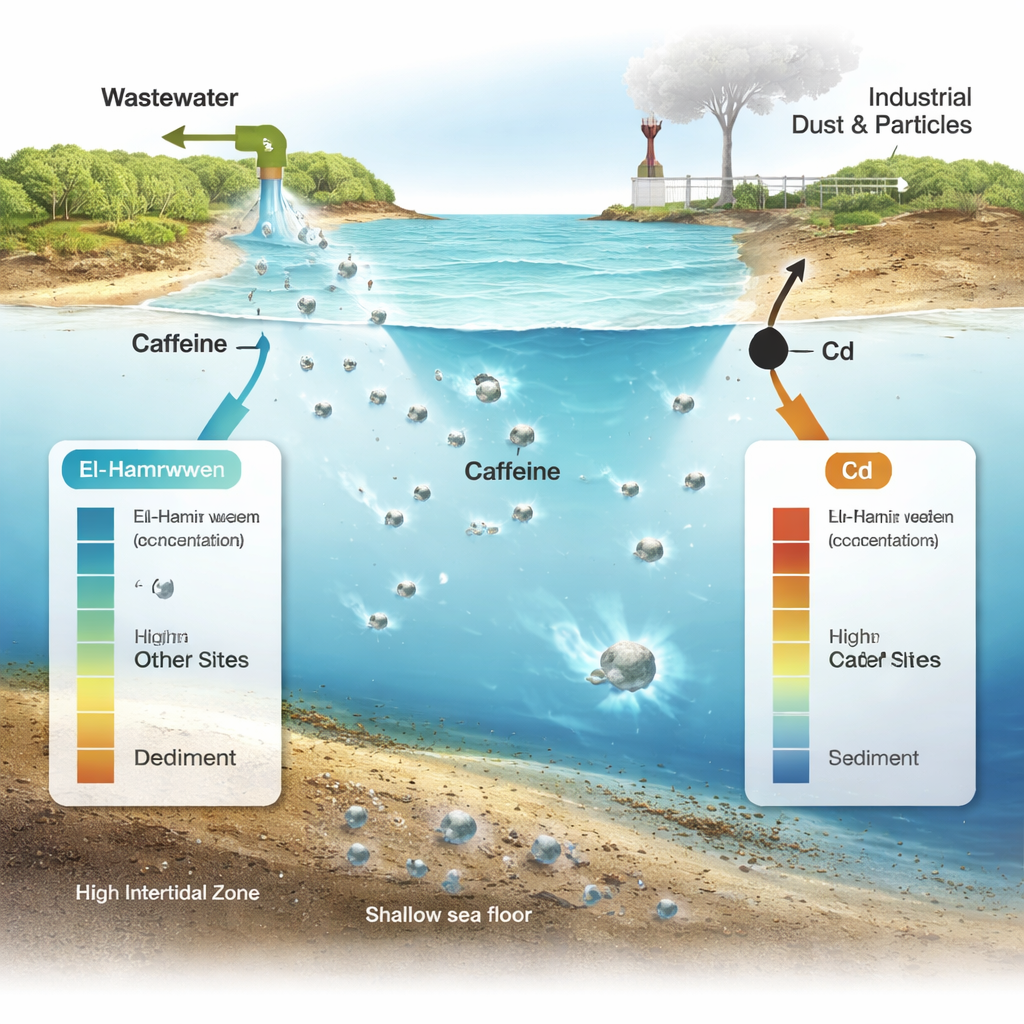
Links between coffee, heavy metals, and local conditions
The analysis revealed that caffeine levels in seawater were strongly tied to environmental conditions. Warmer, more oxygen-rich water with finer sediment particles tended to hold more caffeine, while waters with higher loads of dissolved solids and coarser sands held less. Caffeine in the sediments was positively linked to both dissolved caffeine and cadmium in the water, and fine, organic-rich sediments seemed to "grab" and store both substances. Cadmium in sediments was closely related to the amount of dissolved material in the water, reflecting how metal ions swap places with other naturally occurring salts and become locked into the seabed. Together, these patterns point to a tight connection between human activities, local geology, and the way pollutants move between water and sediment.
What this means for people and the Red Sea
For non-specialists, the takeaway is straightforward: the Red Sea off Egypt is receiving and holding onto significant amounts of both caffeine and cadmium, and the two pollutants tend to occur together. Sites near ports and busy coastal areas are especially affected, but even a protected park shows clear signs of contamination from human waste, floodwaters, and natural plant sources. Because cadmium is toxic and caffeine can interact with other chemicals in marine organisms, their combined presence may add extra stress to reefs, seagrass beds, and the food webs that support fisheries and tourism. The study concludes that reducing wastewater inputs, controlling industrial dust, and better managing coastal development are essential steps to protect this unique sea—and that more research is urgently needed on how everyday chemicals and heavy metals jointly affect marine life and, ultimately, human health.
Citation: El-Sokkary, S.G., Abd El-Wakeil, K.F. & Obuid-Allah, A.H. Occurrence and concentration of caffeine and cadmium as micropollutants in the Red Sea coast, Egypt. Sci Rep 16, 7476 (2026). https://doi.org/10.1038/s41598-026-38344-7
Keywords: caffeine pollution, cadmium, Red Sea, coastal water quality, pharmaceutical residues