Clear Sky Science · en
Myco-surface model for Fusarium solani growth and non-thermal plasma decontamination on building materials
Why moldy walls matter
Most of us think of mold on walls and ceilings as an ugly nuisance, but it is also a quiet threat to indoor air quality and the strength of a building. This study looks at one troublesome mold, Fusarium solani, and asks two practical questions: how fast does it spread on common wall materials, and can a gentle, electricity-based treatment called non-thermal plasma stop it without harsh chemicals? The answers could change how we prevent and clean up mold after leaks, floods, or long‑term dampness in homes and offices.
Common wall boards under the microscope
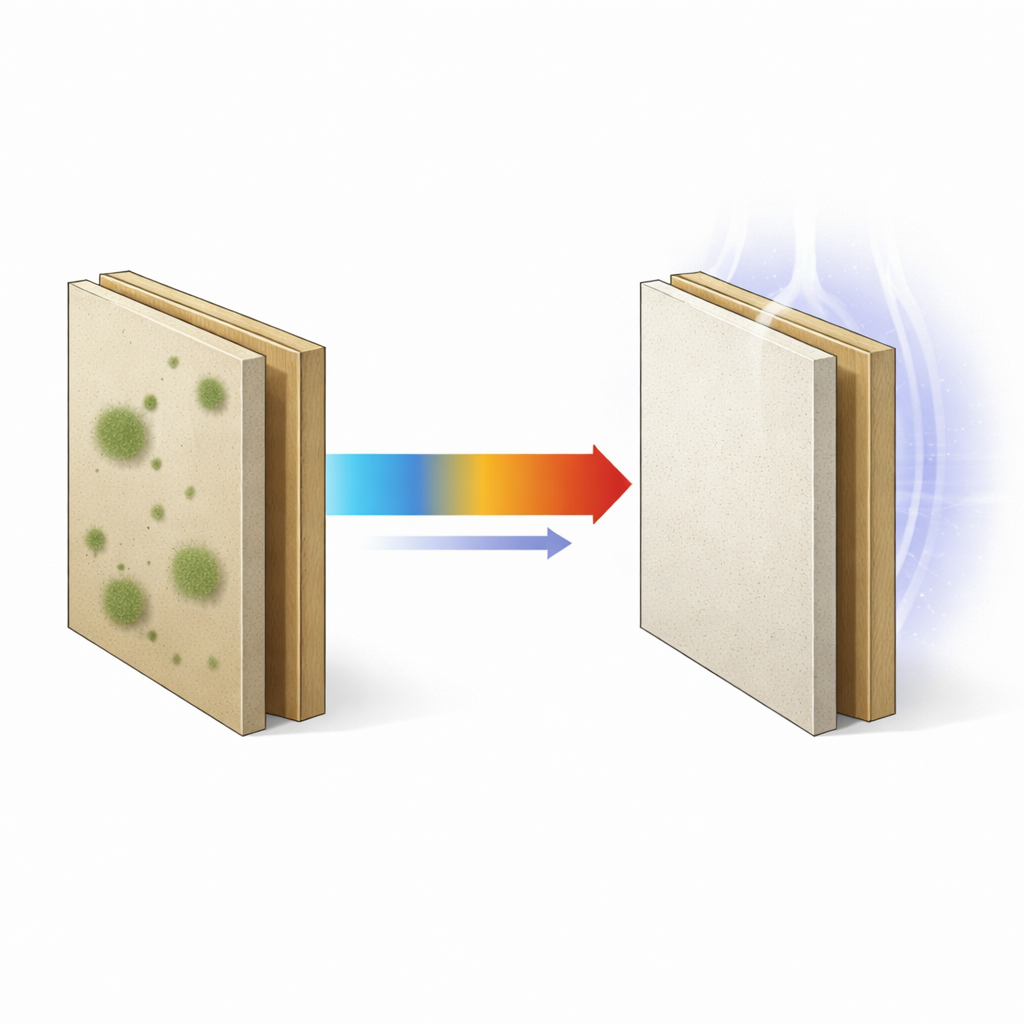
The researchers focused on two widely used construction products: plasterboard (gypsum board with paper facing) and wood fiberboard used for insulation. Under ideal, perfectly clean conditions, they found that F. solani barely grew on either material, even when moisture was present. In real buildings, however, dust and other grime supply extra nutrients, so the team mimicked this by sitting the boards on a nutrient‑rich gel that could slowly feed the mold from below. They then inoculated the surfaces with a known number of spores and incubated them at temperatures from chilly (5 °C) to quite warm (40 °C), taking regular photographs and using image analysis to measure how much of each board became covered over time.
A math-based picture of mold spread
To turn this time‑lapse photography into insight, the team used a “Myco-surface” model—a simple S‑shaped growth curve that tracks how rapidly mold spreads and how long it takes to reach half coverage of the surface. By fitting this curve to their data, they extracted two key numbers for each material and temperature: the growth rate and the growth delay. They then described how both numbers change with temperature using smooth mathematical functions, allowing them to predict mold behavior at temperatures they did not directly test. The result is a compact set of parameters that can be plugged into the model to forecast how quickly F. solani will colonize plasterboard or fiberboard under different indoor climates.
Which wall material molds faster?
The comparison between plasterboard and fiberboard was striking. Plasterboard supported much faster mold spread: at similar temperatures, growth rates were higher and delays were much shorter than on fiberboard. The authors point to the paper facing and starch‑based additives in plasterboard, combined with its close‑to‑neutral pH, as a kind of buffet for F. solani, which is well equipped with enzymes to break down cellulose and related compounds. Fiberboard, in contrast, contains more complex wood components such as lignin and tends to be more acidic when moist, conditions that are less favorable for this particular mold. Interestingly, for both materials the “sweet spot” for growth clustered around the high‑20s to around 30 °C, meaning that the type of surface mainly changes how fast the mold grows, not the temperature at which it is happiest.
Stopping mold with cold plasma
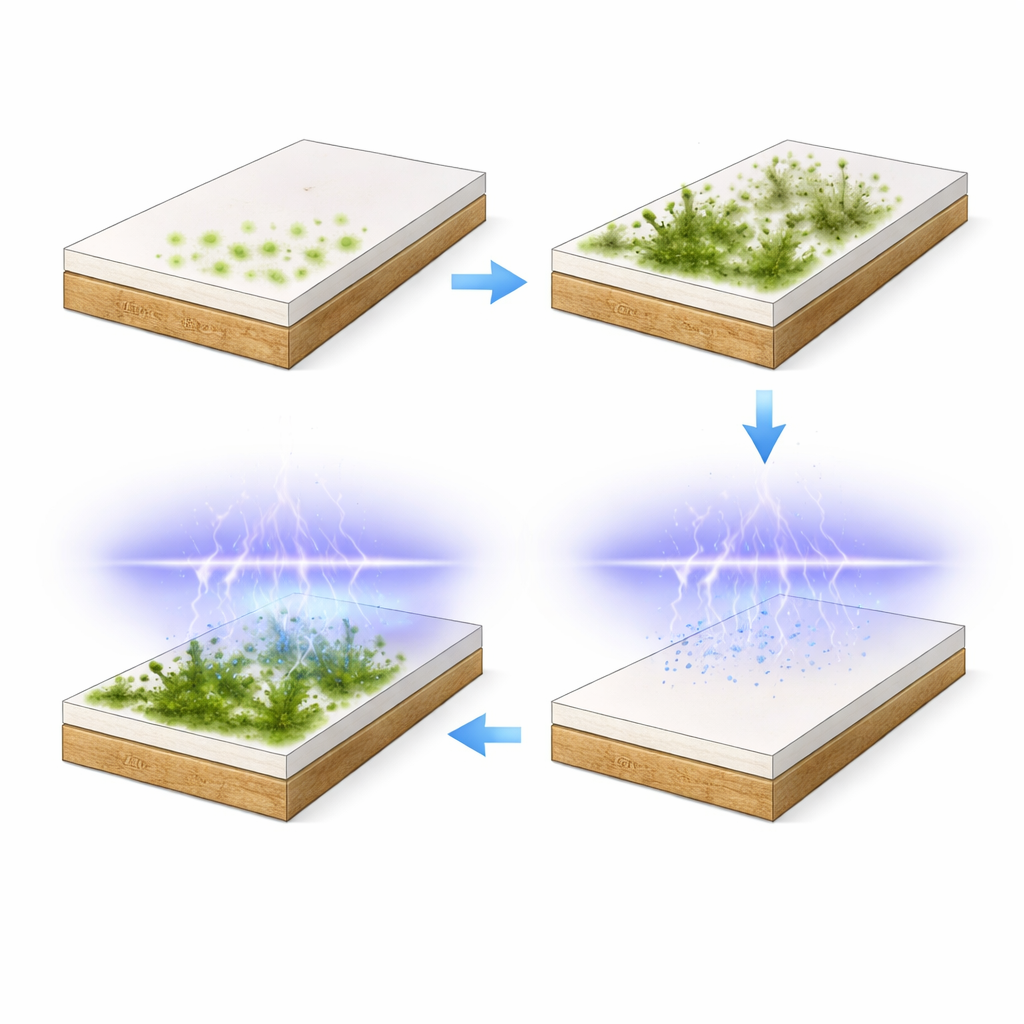
The second part of the study explored non-thermal plasma (NTP)—a gentle, room‑temperature ionized gas that produces reactive species capable of killing microbes without heating or leaving chemical residues. The team tested two NTP sources: a powerful diffuse coplanar surface barrier discharge unit and a weaker handheld corona device. They exposed inoculated boards for ten minutes at different times after seeding the mold (from immediately up to three days later) and then monitored growth as before. On wood fiberboard, the high‑power source completely halted F. solani at all tested stages, yielding no measurable growth. On plasterboard, it fully stopped freshly applied spores but, when the mold was already established, mainly slowed its advance by lengthening the delay before visible spread. The low‑power device had a milder effect, clearly changing growth behavior but achieving complete inhibition only in the very earliest stages.
What this means for buildings
For non‑specialists, the takeaway is twofold. First, among the two materials studied, plasterboard is the more mold‑friendly surface for F. solani, especially at warm room temperatures, and the new model provides a way to predict how fast contamination can escalate. Second, non‑thermal plasma shows real promise as a clean, non‑chemical method to control such mold, particularly if applied early and on more favorable substrates like fiberboard. While this work focused on one mold species and two materials, it lays the groundwork for smarter mold risk prediction and gentler remediation methods that could help protect both indoor air quality and the long‑term health of our buildings.
Citation: Lokajová, E., Jirešová, J., Zdeňková, K. et al. Myco-surface model for Fusarium solani growth and non-thermal plasma decontamination on building materials. Sci Rep 16, 8344 (2026). https://doi.org/10.1038/s41598-026-38339-4
Keywords: indoor mold, building materials, non-thermal plasma, Fusarium solani, plasterboard and fiberboard