Clear Sky Science · en
Histopathological examination of the effects of two different laser types on the osteochondral defect created in the rabbit temporomandibular joint
Light-Based Help for a Troubled Jaw Joint
The jaw joint, or temporomandibular joint (TMJ), is essential for speaking, chewing, and even yawning—so when it wears down, daily life can become painful and difficult. Because the smooth cartilage that cushions this joint has very little ability to heal itself, doctors are searching for ways to gently nudge it to repair. This study explores whether two kinds of low-energy medical lasers can encourage better healing in damaged jaw joints, using rabbits as a model.
Why Jaw Cartilage Is So Hard to Fix
The TMJ is unlike most other joints in the body. Instead of standard joint cartilage, it is lined with a tough fibrous tissue that contains relatively few cells and has no direct blood supply. That design is great for reducing friction when we move our jaws but poor for self-repair: when this tissue is injured by aging, arthritis, or trauma, it tends to deteriorate rather than bounce back. Standard treatments—such as painkillers, bite splints, and conservative therapies—can ease symptoms but usually do not rebuild the damaged tissue. More aggressive options, like surgery or full joint replacement, are reserved for severe cases and carry their own risks. 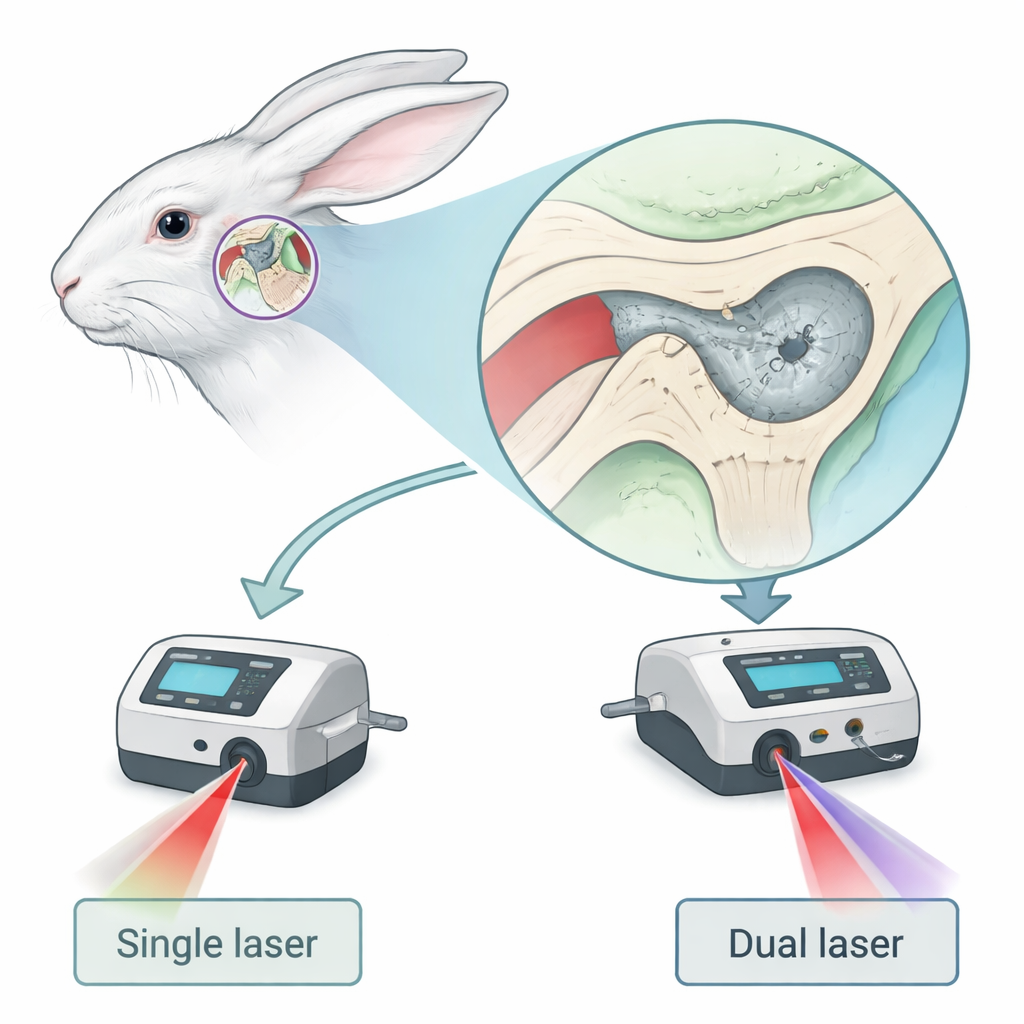
Testing Two Types of Gentle Light
Low-level laser therapy uses carefully controlled, low-energy light to stimulate cells without burning or cutting tissue. Earlier research suggests that this kind of light can boost cell metabolism, improve local blood flow, and support the formation of collagen—the main structural protein in cartilage and bone. In this study, researchers created a small standardized hole in the jaw joint surface of 22 rabbits to mimic an osteochondral defect, which involves both cartilage and the underlying bone. One group received no further treatment, serving as a control. A second group was treated with a common single-wavelength laser device, while a third group received a newer dual-wavelength laser that combines two different colors of light designed to penetrate more deeply and act on tissue in slightly different ways.
How the Damage and Healing Were Measured
After the laser treatments were completed, the rabbits were humanely euthanized and their jaw joints carefully removed and processed in a pathology laboratory. Thin slices of the joint surface were stained and examined under the microscope. The team scored four main features: how well the original defect had been filled in, how smoothly the transition zone between cartilage and bone had re-formed, how healthy and normal the joint cells looked, and how strongly the surrounding matrix—the supportive material between cells—took up special stains that reveal its quality. These scores are a standard way to judge how closely the repaired area resembles normal, healthy joint tissue.
What the Light Actually Achieved
Across most measures—how much of the hole filled in, the reconstruction of the cartilage–bone border, and the appearance of the cells themselves—both laser-treated groups tended to look better than the untreated control animals, but the differences were not strong enough to be declared statistically significant in this relatively small study. The clearest advantage appeared in the matrix staining, which reflects the richness and organization of the tissue’s internal scaffold. Here, the dual-wavelength laser group stood out: their joints were much more likely to receive an “acceptable” score, and statistical analysis suggested that this treatment increased the odds of good matrix quality manyfold compared with doing nothing. The single-wavelength laser performed in between the control and the dual-wavelength device. 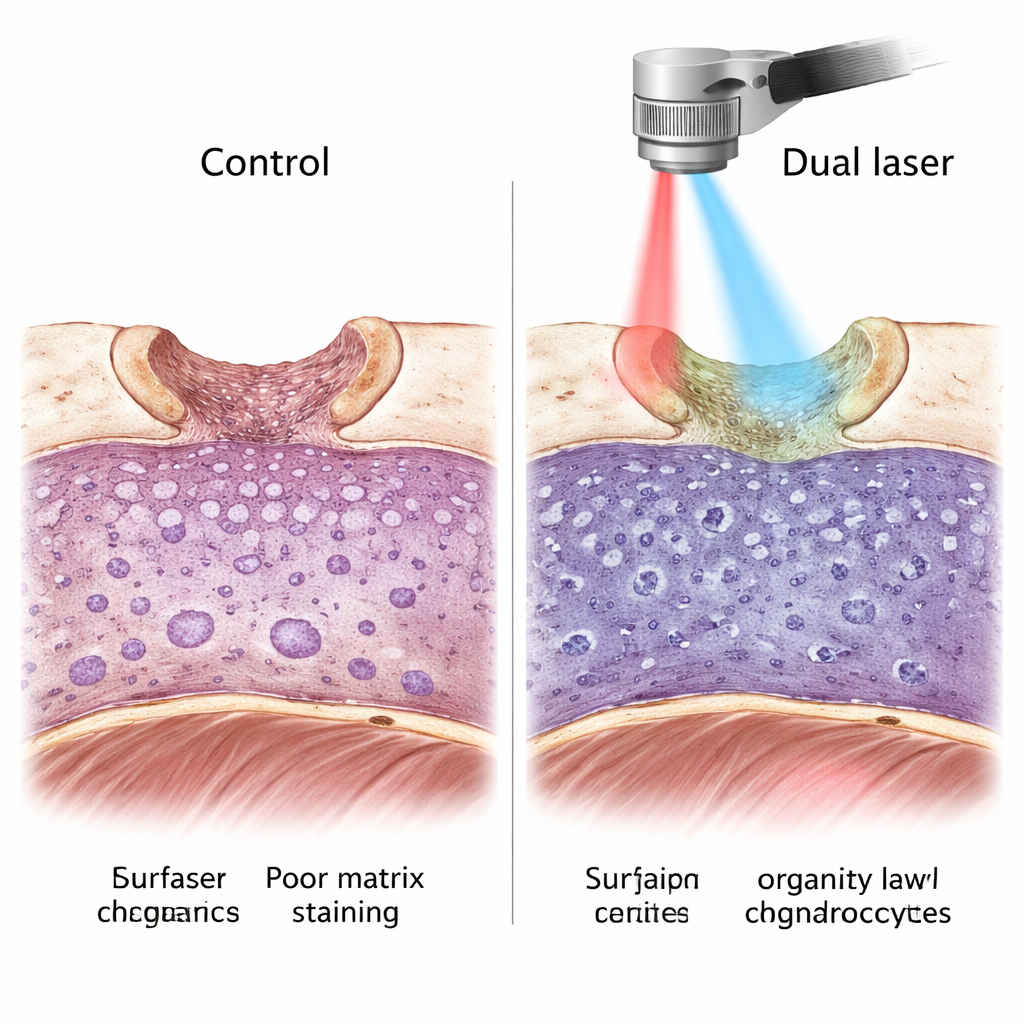
What This Means for Future Jaw Care
For non-specialists, the takeaway is that gentle, low-energy laser light appears to nudge damaged jaw joint tissue in the right direction, mainly by improving the quality of the tissue scaffold that supports cartilage and bone. The newer dual-wavelength laser showed the strongest signs of benefit, although it did not dramatically outperform the conventional laser in every category, and the study’s size and use of rabbits limit how directly we can apply the findings to people. Still, this research adds to growing evidence that carefully tuned light could become part of a less invasive toolkit for managing TMJ problems. Larger clinical studies in human patients will be needed to confirm whether dual-wavelength laser therapy can reliably reduce pain and support long-term joint health.
Citation: Akbulut, N., Karadayı, G., Akbulut, S. et al. Histopathological examination of the effects of two different laser types on the osteochondral defect created in the rabbit temporomandibular joint. Sci Rep 16, 6892 (2026). https://doi.org/10.1038/s41598-026-38332-x
Keywords: jaw joint, low-level laser therapy, cartilage repair, temporomandibular disorders, bone healing