Clear Sky Science · en
Synergistic effects of limestone calcined clay cement on alkalinity, mechanical performance, and vegetative compatibility of ecological concrete
Greener Cities from the Ground Up
As more cities look to add rooftop gardens, green walls, and planted riverbanks, a hidden obstacle lies beneath the soil: ordinary concrete is so alkaline that it can quietly poison young plants. This study explores a new type of “plant‑friendly” concrete that can still support buildings and slopes, but is also gentle enough to let grass and other vegetation thrive. If successful, it could help turn hard gray surfaces into long‑lasting green infrastructure without sacrificing safety or durability.
Why Regular Concrete Is Tough on Plants
Traditional ecological, or “planting,” concrete is designed with large pores so roots can penetrate and water can flow. But its main ingredient, ordinary Portland cement, creates a highly alkaline environment with pH values often above 12—far higher than most plants can tolerate. Past attempts to fix this have included soaking concrete in acidic solutions or using special low‑alkali cements. These methods can be cumbersome, risk damaging the material, or weaken the structure. The central challenge is to build concrete that is strong enough for engineering needs yet mild enough chemically to behave more like soil than caustic rock.
A New Blend of Rock and Clay
The researchers tested a newer cement blend called limestone calcined clay cement, or LC³. Instead of relying almost entirely on Portland cement, LC³ replaces a large portion of it with finely ground limestone and calcined (heat‑treated) clay, plus a small amount of gypsum and silica fume. By carefully varying how much limestone and calcined clay they used, and by designing concrete with three levels of porosity (22, 26, and 30%), the team cast blocks that mimic real ecological concrete used on rooftops and slopes. They then measured how alkaline the concrete became, how strong it was under compression, what kinds of microscopic crystals formed inside, and how well tall fescue grass could germinate and grow over 60 days. 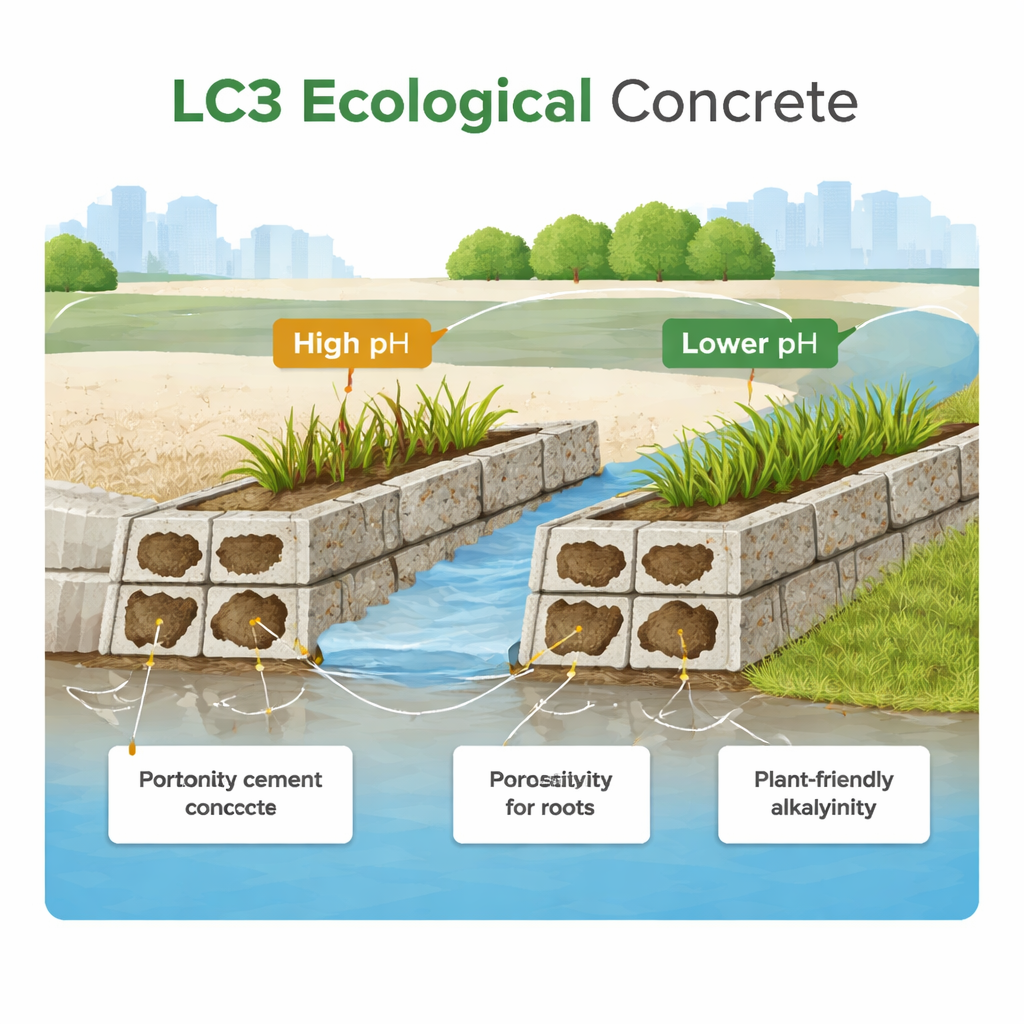
Strong Enough to Build With, Gentle Enough for Roots
The results show that LC³ concretes can reach or even exceed the strength of conventional mixes while dramatically lowering alkalinity. At a relatively low water content, some LC³ recipes achieved compressive strengths of about 13 megapascals at 22% porosity—comfortably above the 9 megapascals required by Chinese standards for vegetated concrete, and higher than the plain Portland‑cement control. At the same time, after 28 days of curing, the pore water pH in LC³ concretes dropped into a more plant‑friendly range of roughly 8.4 to 8.8, well below both the control and the regulatory upper limit for planting concrete. Importantly, the study found that strength and pH are not locked together: it is possible to design mixes that are both mechanically robust and chemically mild by tuning the replacement levels of limestone and calcined clay.
What Happens Inside the Concrete
To explain these improvements, the team looked closely at the material’s inner structure using X‑ray diffraction, thermal analysis, electron microscopy, and nuclear magnetic resonance. In LC³ mixes, the reactive calcined clay consumes much of the calcium hydroxide—a highly alkaline compound produced by cement—turning it into dense binding gels. Limestone works alongside, helping form additional stable phases that fill in pores. Compared with regular concrete, LC³ samples showed fewer large, connected pores and a lower overall porosity, meaning there are fewer pathways for alkaline ions to leach out. Microscopy images revealed that the best LC³ mixes form a continuous, tightly packed network of hydration products, while overly aggressive replacement (too much clay or limestone) leads to a looser structure and lower strength. 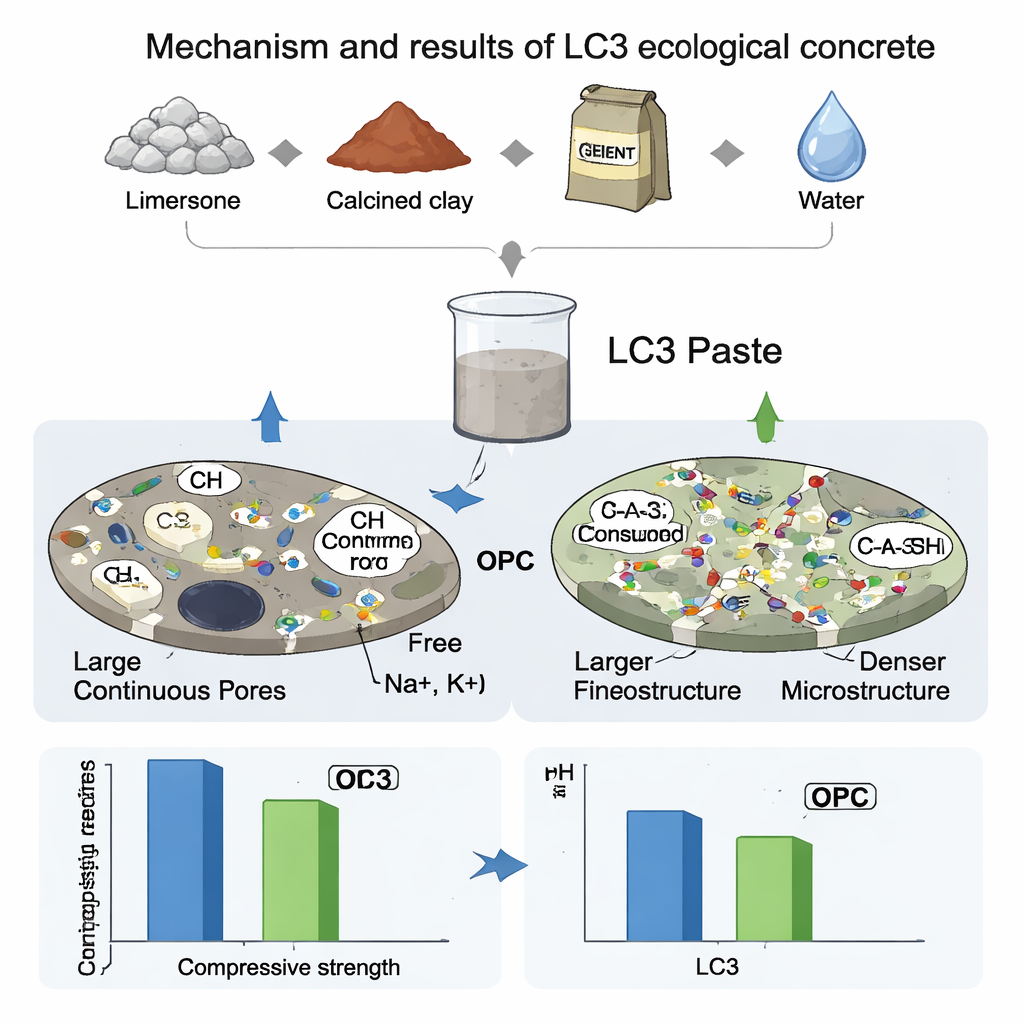
Putting It to the Plant Test
Tall fescue grass provided a real‑world check on how these materials behave outside the lab. On ordinary Portland‑cement concrete, seeds did sprout, but the seedlings soon yellowed and died within about 20 days, unable to cope with the harsh chemical environment and limited water storage. In contrast, all LC³ concretes supported healthy, long‑term growth. Seeds germinated faster in mixes with higher porosity—especially around 30%—because the extra interconnected voids held more water and air for the roots. In the best LC³ recipes, grass grew vigorously over the full 60‑day test, reaching heights above 20 centimeters and forming dense, root‑filled mats that fully occupied the concrete’s pores.
From Hard Surfaces to Living Infrastructure
For non‑specialists, the key takeaway is that simple changes in cement chemistry can make concrete behave less like a hostile, caustic substrate and more like a supportive host for plants—without sacrificing strength. By partially replacing conventional cement with limestone and calcined clay, LC³ ecological concrete lowers its inherent alkalinity and tightens its pore network, reducing the release of harmful ions while still bearing loads. When combined with well‑designed porosity, this allows grasses to germinate, root, and flourish directly within the concrete. Such materials could help cities and infrastructure projects adopt greener designs—from stabilizing slopes to lining riverbanks and rooftops—turning structural concrete into a durable base for living landscapes.
Citation: Fang, Y., Yang, C., Zeng, H. et al. Synergistic effects of limestone calcined clay cement on alkalinity, mechanical performance, and vegetative compatibility of ecological concrete. Sci Rep 16, 6914 (2026). https://doi.org/10.1038/s41598-026-38329-6
Keywords: ecological concrete, LC3 cement, green infrastructure, plant-friendly materials, sustainable construction