Clear Sky Science · en
Techno-economic optimization, sensitivity analysis and stability evaluation of a high-renewable hybrid microgrid for rural Bangladesh
Powering Villages Beyond the Grid
In many rural parts of the world, the lights still go out for hours at a time, stalling school lessons, stopping irrigation pumps, and disrupting everyday life. This article explores how a carefully designed mix of solar panels, wind turbines, biogas generators, batteries, and a limited grid connection can deliver steady, low-cost electricity to a village in rural Bangladesh. The work matters far beyond one community: it offers a blueprint for how densely populated, climate‑vulnerable countries can expand clean energy without relying solely on large power plants and long transmission lines. 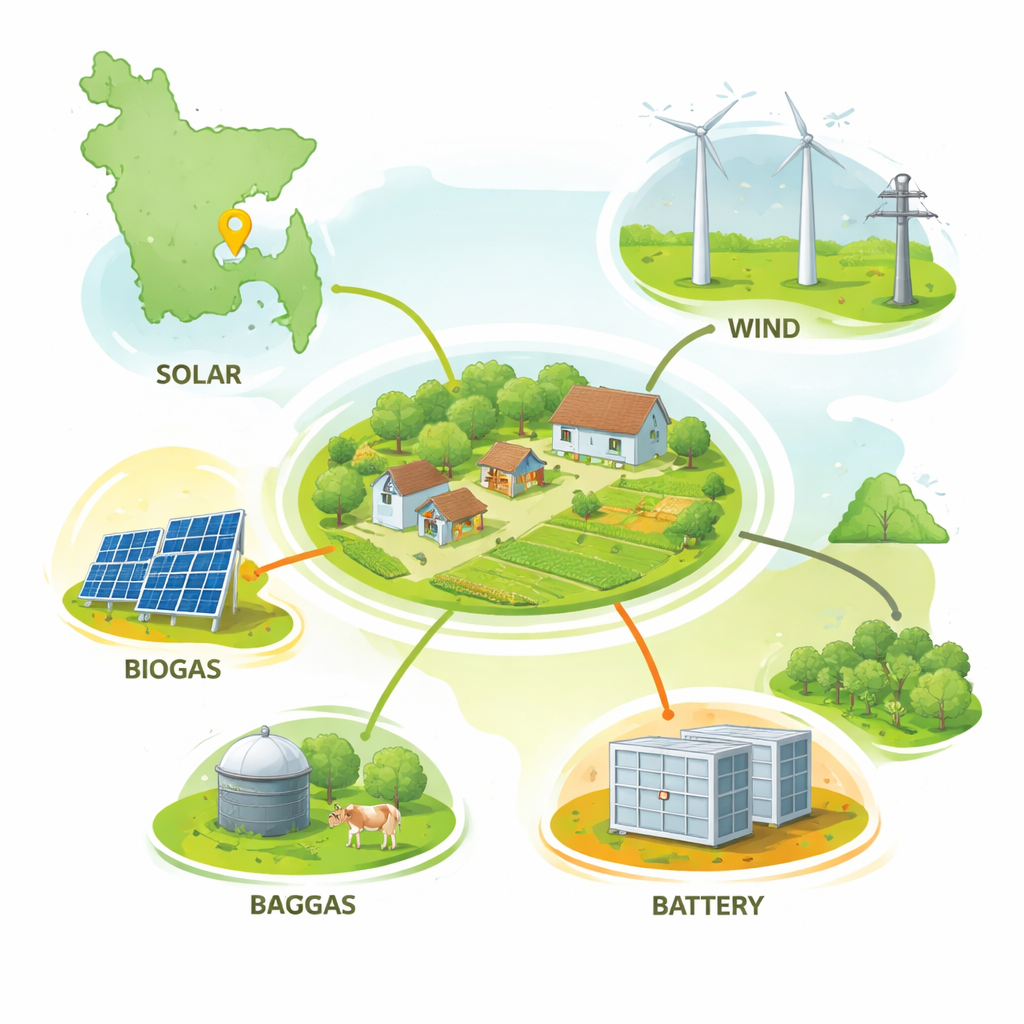
Why Rural Bangladesh Needs New Energy Solutions
Bangladesh has made impressive strides in bringing electricity to its people, yet many rural areas still face frequent blackouts and unstable voltage. Extending big power lines into every remote village is expensive and technically difficult, especially in flood‑prone regions. At the same time, the country has pledged to drastically increase the share of renewable energy in its power mix, but currently only a small fraction of generation comes from clean sources. This tension creates both a problem and an opportunity: how can villages get reliable electricity that is also affordable and climate‑friendly? The authors argue that village‑scale “microgrids” built around local sun, wind, and organic waste can answer this question.
Designing a Village-Scale Power System
The researchers focus on Nalia, a village in the Rajbari district that includes homes, a school, and irrigated farmland. Instead of assuming a simple, flat electricity demand, they build realistic hourly and seasonal profiles: evening peaks when families use lights and fans, daytime swings when the school is active, and strong seasonal shifts as irrigation pumps run harder in dry months. They then combine detailed weather records—solar radiation, wind speeds, temperature—and estimates of daily biomass from livestock and household waste. Using specialized software (HOMER Pro), they test hundreds of possible combinations of solar arrays, wind turbines, biogas generators, batteries, and the national grid, searching for systems that are both technically reliable and financially attractive.
The Winning Mix of Sun, Wind, and Waste
From 811 simulated designs, one configuration clearly stands out: a hybrid system that blends solar panels, wind turbines, a biogas generator powered by local organic waste, battery storage, and a two‑way link to the national grid. This setup supplies about 88 percent of the village’s electricity from renewable sources while keeping lights on for homes, computers running in classrooms, and pumps working in the fields. Over a 25‑year lifetime, the system’s overall cost of electricity is roughly two US cents per kilowatt‑hour—far lower than the grid‑only alternative modeled as a base case. Because the microgrid can feed surplus clean power back into the national network, it not only meets local needs but also becomes a small power plant that helps decarbonize the wider system. 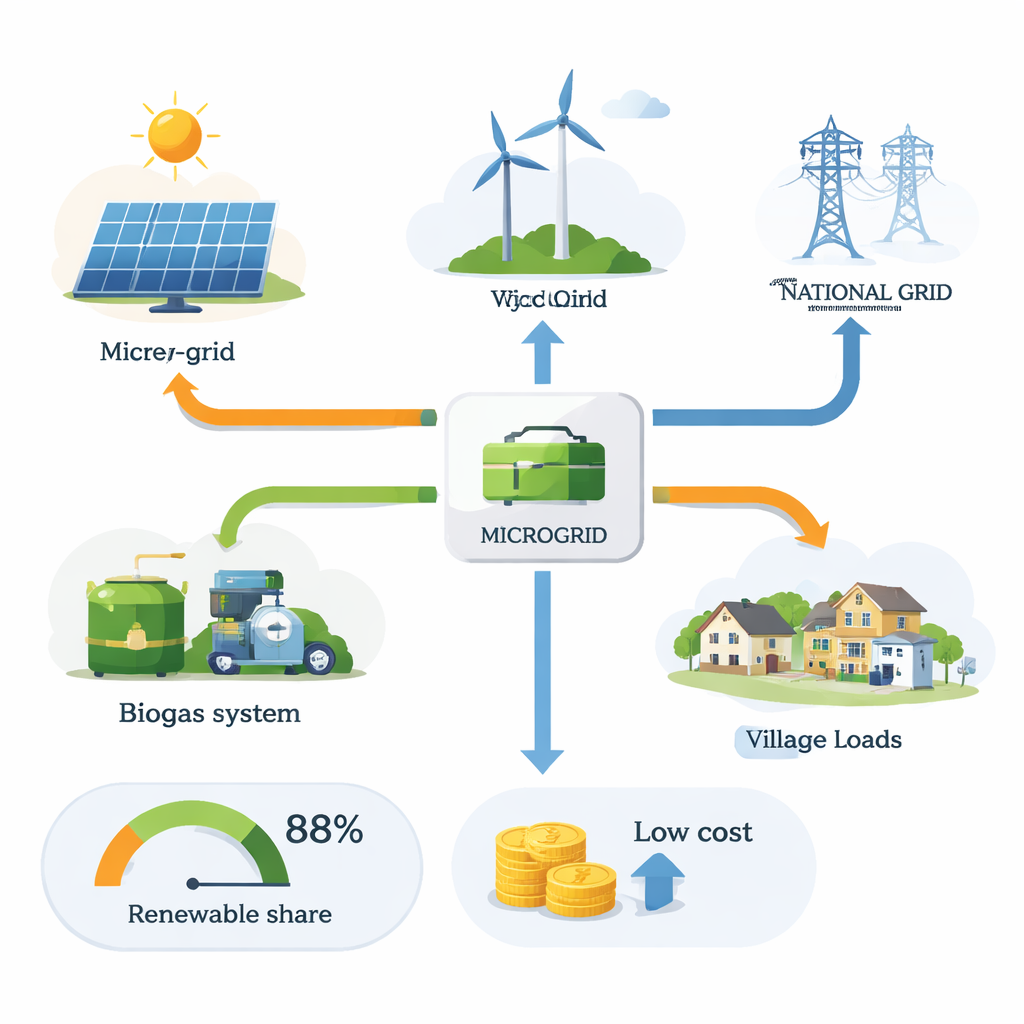
Testing Stability and What Drives the Price
Reliable power is not just about how much energy a system produces, but also how smoothly it handles constant ups and downs in demand and weather. To check this, the team uses a simplified computer model to examine how voltage and frequency at the village’s connection point respond when loads or renewable output suddenly change. The simulated responses stay well within both international standards and Bangladesh’s own grid code, suggesting the microgrid can ride through everyday fluctuations without upsetting the larger network. The authors also probe how sensitive the project is to changes in key factors such as solar equipment prices, wind speeds, and grid tariffs. They find that the economics are especially sensitive to the cost of solar panels and power electronics, as well as the strength of local wind resources, but remain robust across a wide range of likely conditions.
A Practical Pathway for Clean Rural Power
For non‑specialists, the main takeaway is straightforward: with smart design, rural villages do not have to choose between unreliable electricity and dirty, expensive power from diesel or distant plants. By combining solar, wind, and biogas with modest battery storage and a controlled grid link, the study’s microgrid delivers stable, affordable electricity while sharply cutting greenhouse gas emissions and air pollution. Because the approach is built on real village data and standard tools, it can be adapted to many other communities that share similar climates and resources. In this way, the work points to a practical route for countries like Bangladesh to expand energy access, support education and farming, and move toward a cleaner energy future all at once.
Citation: Biswas, D., Ali, M.F., Saha, M. et al. Techno-economic optimization, sensitivity analysis and stability evaluation of a high-renewable hybrid microgrid for rural Bangladesh. Sci Rep 16, 7695 (2026). https://doi.org/10.1038/s41598-026-38328-7
Keywords: rural electrification, hybrid microgrid, renewable energy, Bangladesh, solar and wind power