Clear Sky Science · en
Study on prediction and regulation of water resources carrying capacity under changing environment
Why future water security matters here
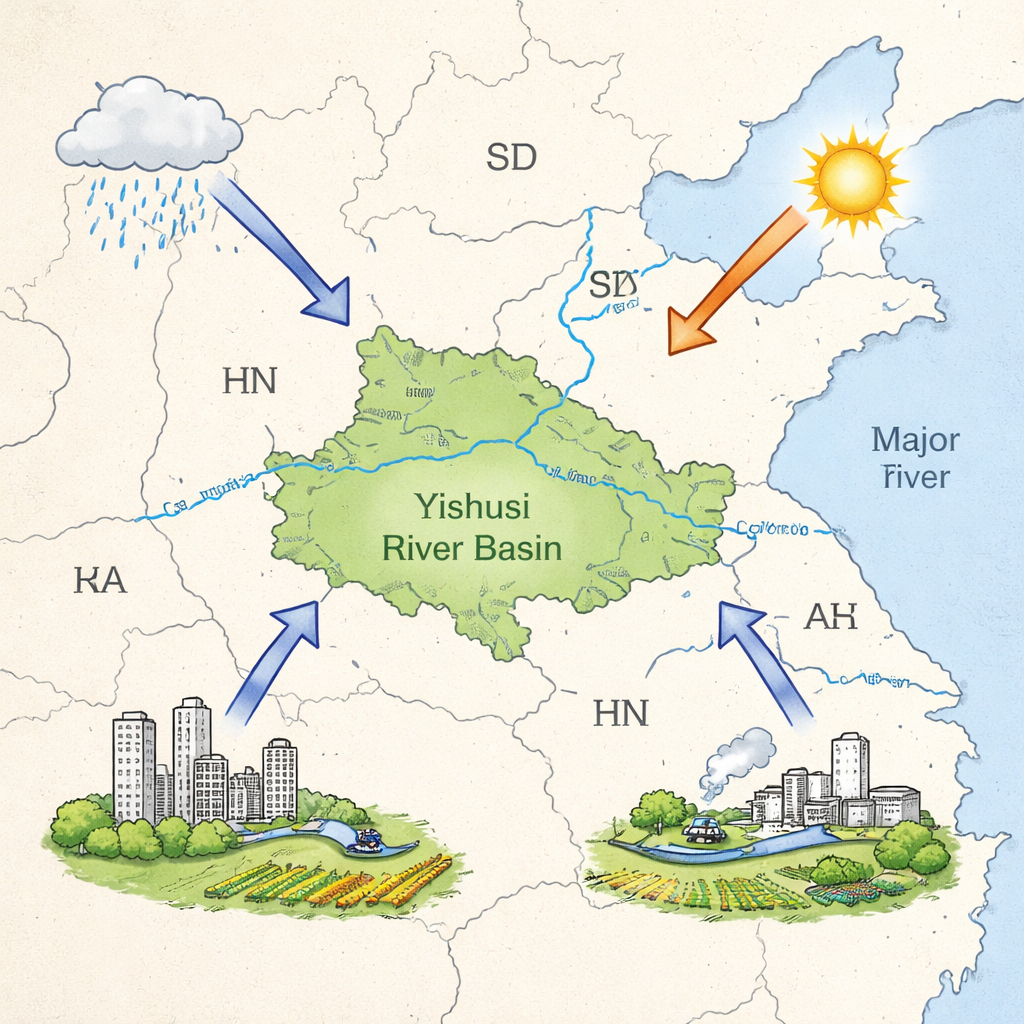
Rivers do more than carry water; they carry whole economies. In eastern China’s Yishusi River Basin, booming cities, expanding farms, and a shifting climate are putting intense pressure on limited water supplies and on the rivers’ ability to dilute pollution. This study asks a simple but crucial question with global relevance: how much more growth can a river basin support before its water system breaks down, and what practical steps can keep that from happening?
Taking the pulse of a hard‑working river
The Yishusi River Basin lies between the Yellow River and the East China Sea and spans parts of four provinces, including major cities and farmland. The authors treat the basin as a living system made up of water, people, the economy, and ecosystems. They define “water resources carrying capacity” as the maximum level of population and economic activity that available water quantity and water quality can reliably support. To capture this, they track how much clean water the basin can provide, how much society demands, and how the gap between the two changes under different futures shaped by climate and development.
Linking climate shifts to river flows
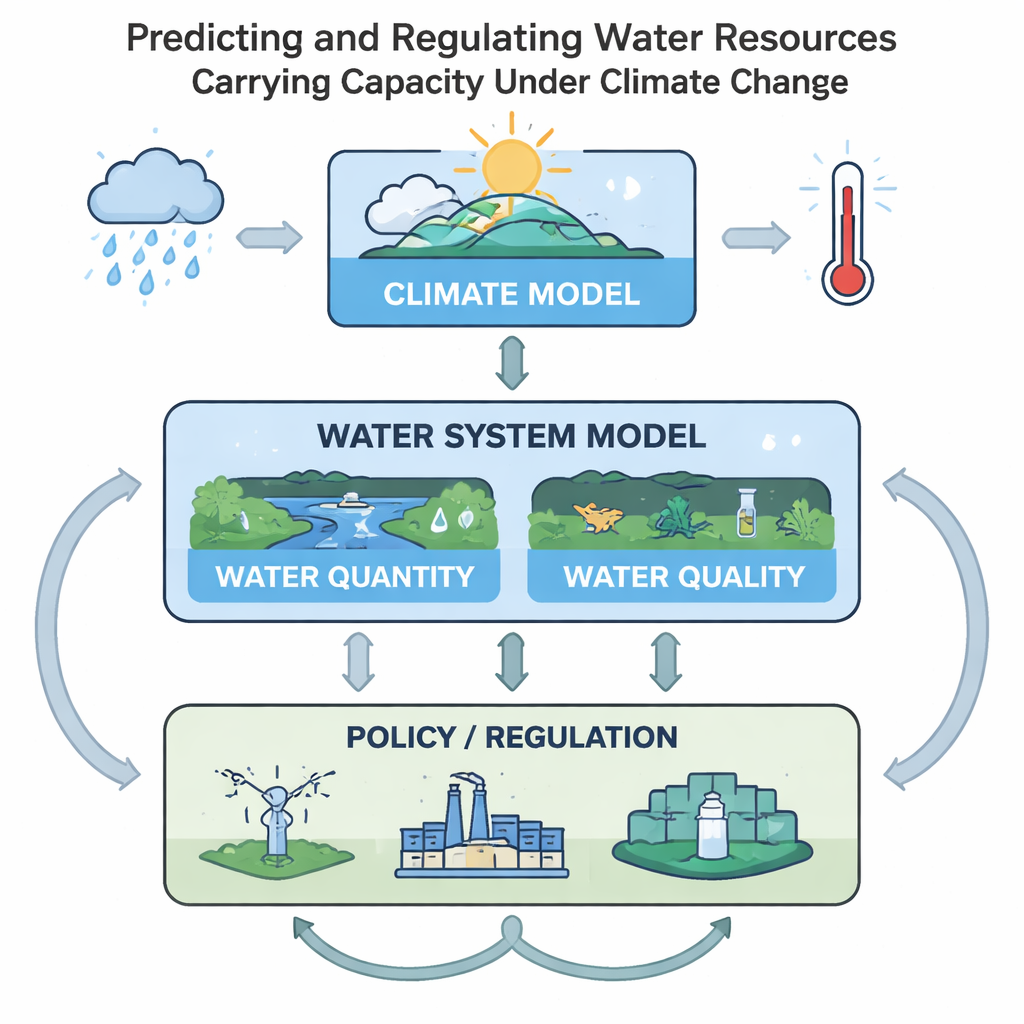
To understand how climate change will alter the basin’s water, the team combines global climate models with statistical tools. They first test 16 international climate simulations and select the four that best match more than half a century of local weather records. Then they use tailored mathematical models to translate changes in rainfall and temperature into changes in natural river runoff for each province within the basin. This approach respects real geographic differences—one province may become slightly wetter while another dries out or becomes more variable—even though all share the same river network.
Simulating a crowded future for water
Next, the researchers build a large computer simulation known as a system dynamics model. This digital “laboratory” follows water quantity and pollution levels from 2005 to 2050, including domestic, industrial, and agricultural use, along with wastewater treatment. They test six combined futures: three climate pathways, from low to high warming, crossed with today’s water supply network versus expanded diversions from the Yellow and Yangtze Rivers. Across all scenarios, the model shows natural river flows generally increasing, but not nearly enough to offset fast‑rising water demand and pollution loads.
Warning signs of overload
When the team compares demand with what the rivers can safely provide and dilute, they find the basin is already under heavy strain. By 2030, 2035, and 2050, water quantity is projected to be overloaded or severely overloaded under current supply plans in every climate scenario, meaning withdrawals would regularly exceed sustainable levels. Even with planned new water transfers, most futures still hover in the “overloaded” or “critically overloaded” range. Water quality tells a similar story: organic pollution remains manageable until mid‑century, but ammonia‑nitrogen—a marker linked to sewage and fertilizer—pushes many river reaches into critical or overloaded states well before 2050.
Testing fixes before they are built
Rather than stop at warning signs, the study experiments with solutions inside the model. For water quantity, it adjusts levers such as how much water crops use per hectare, how efficiently factories use water, and how much cities consume per person. For water quality, it systematically varies urban and rural sewage treatment rates and per‑person pollution discharges using an experimental design that reveals which combination cuts pollution most. The most effective strategies center on saving irrigation water, improving industrial efficiency, and sharply boosting sewage treatment—especially in fast‑growing provinces. With ambitious, basin‑wide efficiency and treatment upgrades, the simulations show the system can be brought back from severe overload to a “critical” but manageable state.
What this means for people and policy
For non‑specialists, the message is straightforward: more rain alone will not rescue stressed rivers if water use and pollution continue to grow unchecked. This study shows that careful planning, grounded in realistic models, can identify concrete steps—such as better irrigation, cleaner industry, and expanded wastewater treatment—that keep regional development within what the river can bear. While focused on one Chinese basin, the approach offers a blueprint for any region trying to secure its water future under a changing climate.
Citation: Li, E., Yan, B., Yang, J. et al. Study on prediction and regulation of water resources carrying capacity under changing environment. Sci Rep 16, 7349 (2026). https://doi.org/10.1038/s41598-026-38325-w
Keywords: water scarcity, river basin management, climate change impacts, water pollution, sustainable water use