Clear Sky Science · en
Bioengineering approaches to dynamic impact analysis for cranial fracture interpretation in arcaheology
Why broken skulls from the past still matter
When archaeologists uncover human skulls marked by cracks, dents or shattered areas, those injuries may be the only clues to how a person died and whether violence was involved. Yet until recently, the physics of how skulls break has mostly been studied for modern medicine and accident research, not for reading the deep human past. This study brings together dozens of experiments on real human cadavers to build a bridge between engineering labs and archaeological digs, helping us tell a deadly fall from a deliberate blow.
From crash tests to ancient graves
The authors compiled data from 234 human cadavers that were subjected to 329 carefully controlled blunt impacts. These tests, originally carried out for fields like traffic safety and forensic science, used devices such as drop towers and air-powered hammers to strike the head at known speeds and with known weights. For each impact, researchers recorded physical details like the force of the blow, the energy absorbed by the skull, and the speed of impact, along with what kinds of fractures appeared and where on the head they formed. By pooling these scattered results into one large database, the team could search for consistent patterns that might later be recognized on ancient human remains.
What matters most in a blow to the head
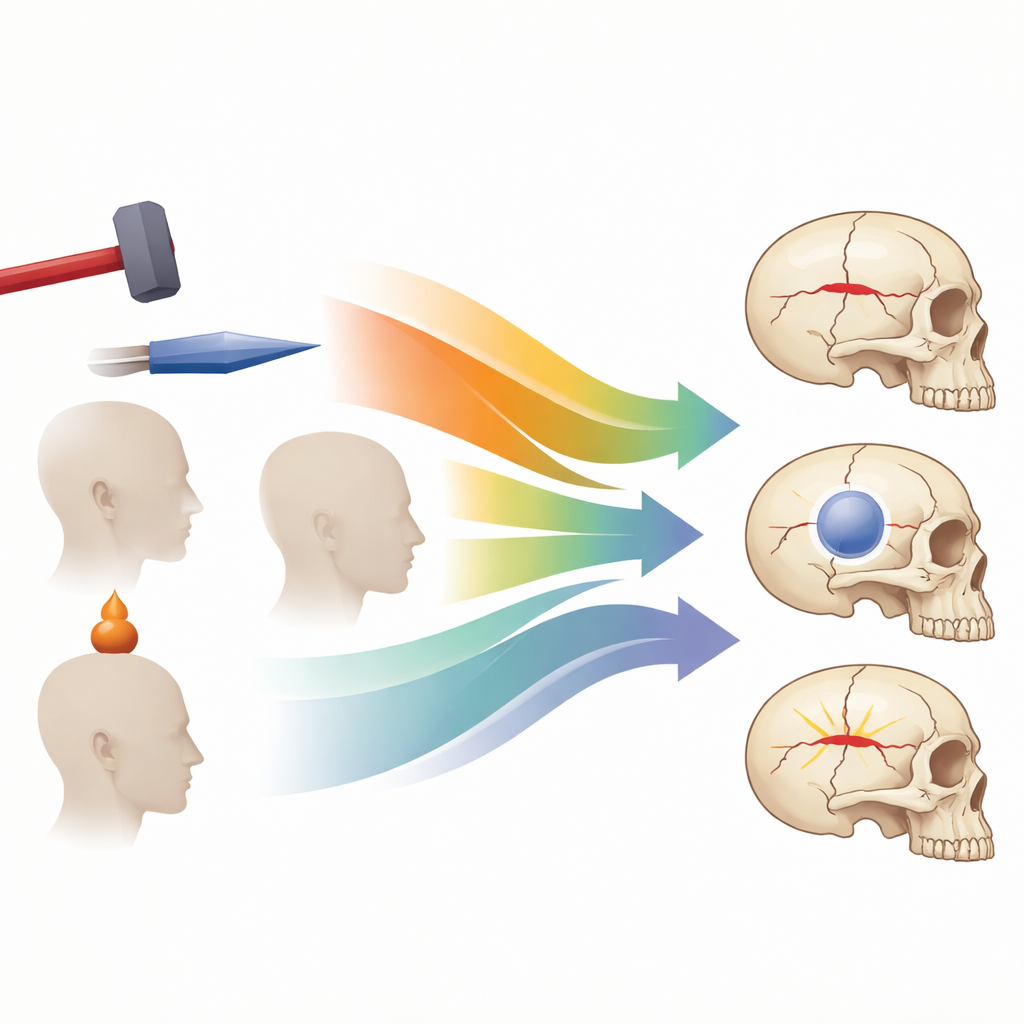
A key result of the meta-analysis is that impact energy—the amount of energy actually taken up by the head—is a better guide to fracture severity than the momentary peak force alone. Across several major experimental series, absorbed energy showed clear, statistically strong links with how fast the impactor was moving and how heavy it was, while peak force often varied in confusing ways. The skull behaves in a complex, non‑linear fashion: at modest forces it bends and absorbs energy, but at higher forces it stiffens and can no longer dissipate energy efficiently. Because peak force mostly captures the instant when the bone finally gives way, it does not faithfully reflect how the blow was delivered. Energy, by contrast, integrates both speed and mass and better captures the true violence of the impact. The combined data also suggest a rough lower limit: no fractures were recorded when forces were below about 2,000 newtons, pointing to a preliminary fracture threshold within that range.
Shape of the blow, shape of the break
Beyond how hard a blow was, the shape and size of the striking surface left distinctive signatures on the skull. When the impactor had a broad surface—similar to a floor, wall or wide blunt object—most resulting fractures were long, relatively simple cracks known as linear fractures. These made up nearly 90 percent of breaks in these tests. Such patterns match what is commonly seen in accidental falls, suicides and some assaults, where the head hits or is pushed against large surfaces. In contrast, when the blow came from a small, focused surface—more like a hammer face or narrow club—the outcomes were much more varied: small notches, sunken depressed areas and even a rare perforating injury, alongside some linear cracks. Critically, these focused blows were strongly tied to shattered "comminuted" fractures, where bone breaks into several pieces clustered around a localized depression.
The skull beneath the skin
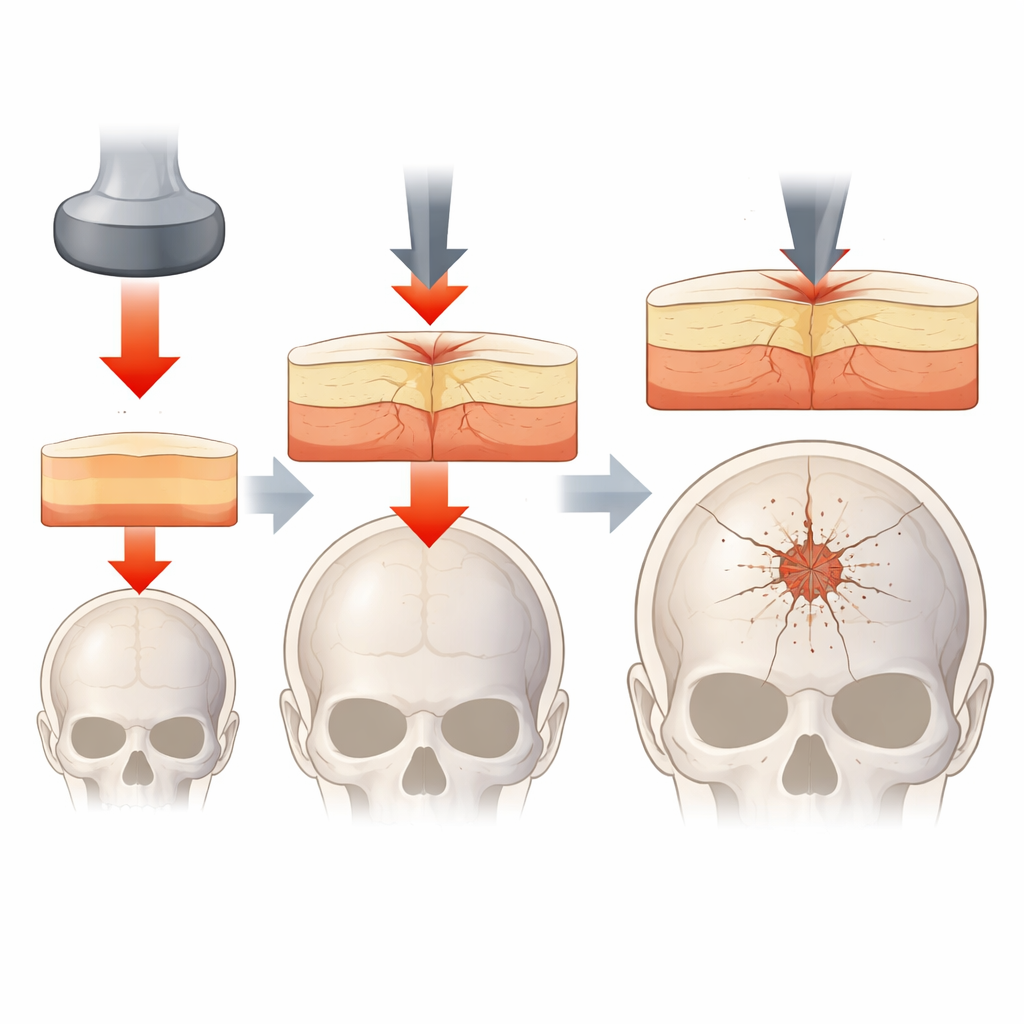
The study also probed how head anatomy shapes injury risk. By comparing measurements of bone thickness and scalp thickness to recorded impact outcomes, the authors found that thicker bone clearly raised the force needed to break the skull, confirming that the bony shell itself is the main structural barrier against trauma. In contrast, soft tissues overlying the skull—skin, connective tissue and hair—showed little or inconsistent influence on whether a fracture occurred or how much energy was absorbed. This means that for archaeological skulls, where soft tissue is long gone, measurements of bone thickness alone can still provide meaningful information about how resistant the head would have been to a given impact. Local anatomical differences between frontal, parietal and other regions remain important, but the central message is that the bone is the key player.
Reading violence in the archaeological record
For archaeologists and forensic specialists working with ancient remains, the practical payoff of this work is a clearer set of visual and measurable clues. A skull showing broad, sweeping linear fractures may point to lower‑energy events or impacts against wide surfaces, which can occur in both accidents and assaults. By contrast, sharply defined depressed areas with many small fragments, especially when clustered, strongly suggest high‑energy, focused blows—the kind most often linked to interpersonal violence and homicide. Combined with estimates of bone thickness and the newly summarized fracture thresholds, these fracture patterns give researchers a more rigorous, physics‑based toolkit for reconstructing how someone was injured, even tens of thousands of years after the event.
Citation: Rodríguez-Iglesias, D., Pantoja-Pérez, A., De La Rosa, Á. et al. Bioengineering approaches to dynamic impact analysis for cranial fracture interpretation in arcaheology. Sci Rep 16, 8327 (2026). https://doi.org/10.1038/s41598-026-38313-0
Keywords: cranial trauma, archaeology of violence, fracture mechanics, forensic anthropology, blunt force injury