Clear Sky Science · en
Development of a smartphone based spectrometer for high-resolution urinalysis
Checking Kidney Health from Your Pocket
Kidney disease often creeps up silently, showing few symptoms until serious damage has already occurred. Regular lab tests can catch problems early, but they require clinics, equipment, and trained staff that many people simply cannot reach. This study introduces SpectraPhone, a slim add-on for a smartphone that turns its camera and flash into a tiny lab instrument, able to measure key markers in urine that signal kidney trouble. By making high-quality urine tests as easy as snapping a photo, the device could bring early kidney screening to homes, village clinics, and remote communities around the world. 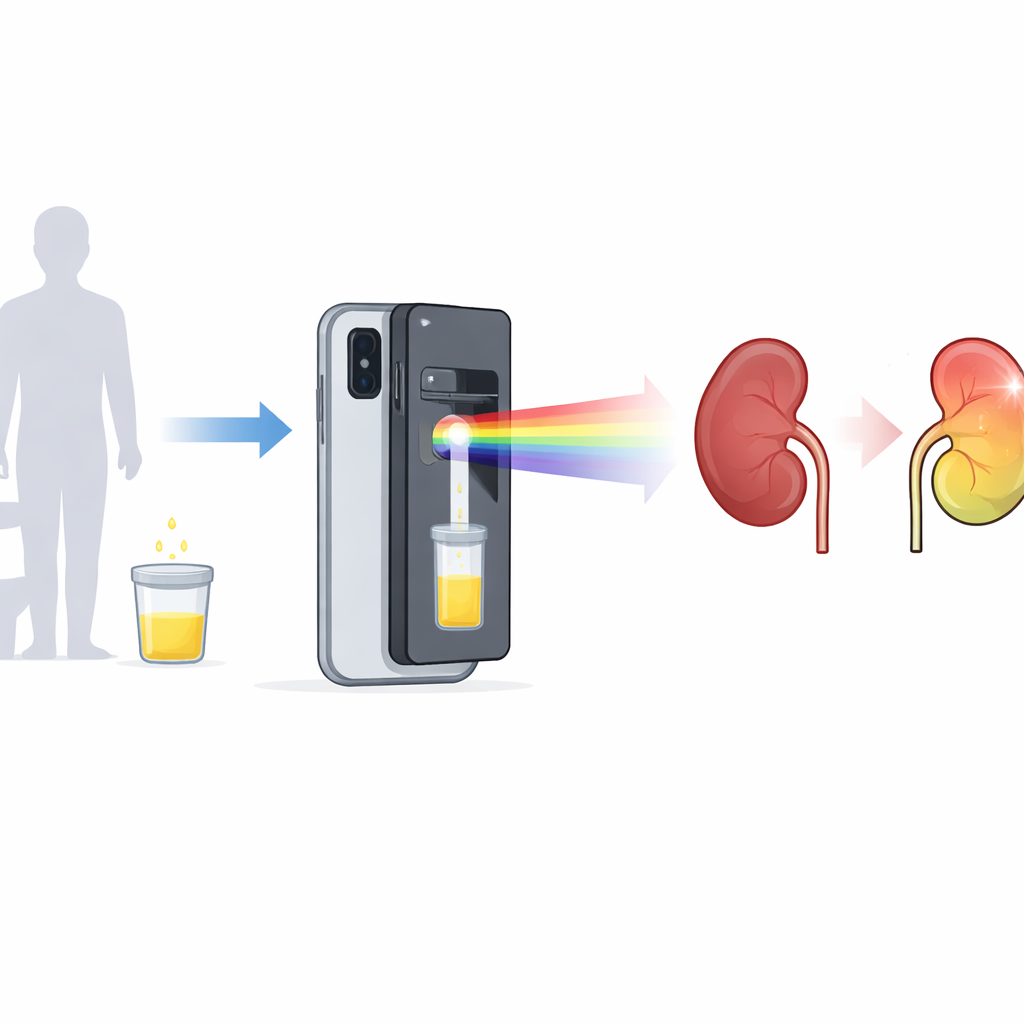
Why Kidney Trouble Is Hard to Catch
Chronic kidney disease affects around one in ten adults worldwide, yet most people who have it do not know until the illness is advanced and treatment options are limited. Standard tests depend on well-equipped laboratories that can measure blood and urine chemistry with high precision. Simpler tools exist, such as dipstick strips that change color when dipped in urine, but these only provide rough yes-or-no answers. The authors show that both eyeballing urine color and using commercial dipsticks fail to distinguish between low and high levels of blood in urine, a warning sign called hematuria. Even very small amounts of blood can make a dipstick look like a severe case, making it impossible to track subtle changes over time.
Turning a Phone into a Tiny Lab
The SpectraPhone system turns a common smartphone into a compact spectrometer—a device that examines how a sample affects different colors of light. The attachment adds only a couple of centimeters of thickness to the phone and contains inexpensive parts: acrylic light guides, small lenses, a mirror, a diffraction grating, and a 3D-printed case. Light from the phone’s flash is guided through a small clear container of urine, spread into a rainbow by the grating, and captured by the camera sensor. Careful optical design blocks stray light and keeps all components fixed in place, making the device sturdy enough for everyday use. The companion app records unprocessed high-resolution video, allowing the system to capture more than two thousand distinct colors between deep violet and red with very low noise.
Reading Hidden Signals in Urine
On its own, the spectrum of urine does not obviously reveal how many blood cells or how much protein it contains—subtle shifts are buried in thousands of data points. To pull out these hidden signals, the researchers used statistical techniques that look for patterns across many colors at once. For samples spiked with known amounts of red blood cells, they computed second derivatives of the spectra to highlight small shape changes, then fit a regression model that linked these patterns to cell counts. This model could estimate blood levels with errors of only a few dozen cells per microliter over a range up to 3200 cells, matching clinical needs and vastly outperforming simple color checks. 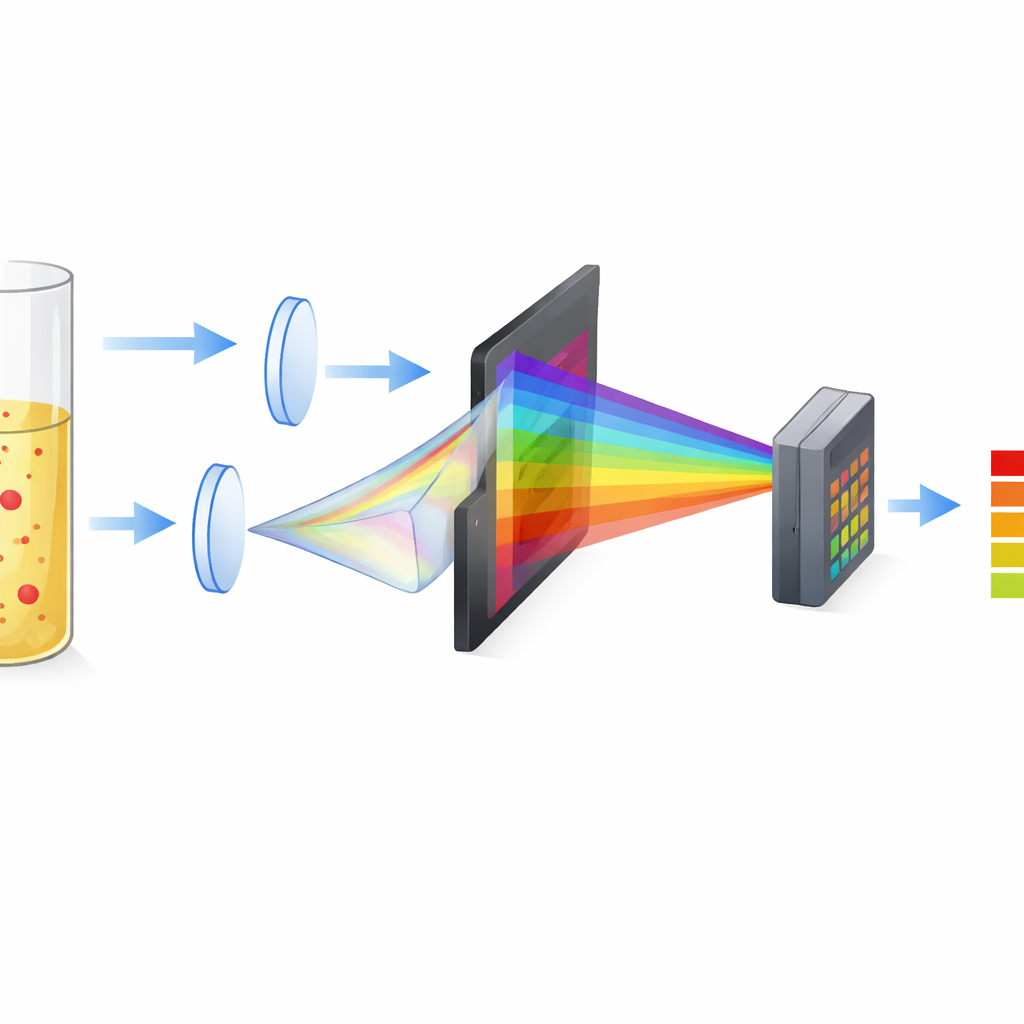
Measuring Protein with and without a Dye
The team applied a similar approach to albumin, a key protein whose presence in urine, called albuminuria, signals kidney damage. Raw spectra again looked fairly featureless, but after a mathematical normalization step, consistent differences emerged between concentration levels. A learning algorithm then identified the wavelengths most informative for albumin, achieving highly accurate predictions across a broad range of clinically relevant values. To push performance even further, the researchers added a common dye, bromophenol blue, which turns more strongly colored when it binds to albumin. With this simple extra reagent, the system’s errors dropped to a few milligrams per deciliter—better than many existing point-of-care tools and well within clinical standards for detecting worrisome protein levels.
From Prototype to Everyday Tool
In plain terms, the study shows that a low-cost phone attachment can match laboratory-grade precision for two crucial urine markers of kidney disease, using only the phone’s own camera and flash. SpectraPhone overcomes the fuzziness of dipsticks, delivering specific numeric estimates instead of vague color blocks, and it does so in a format that could be carried in a pocket. The authors note that more work is needed with real patient samples and a wider range of phones, but their results suggest a future in which people anywhere can check their kidney health as easily as taking a photo—catching problems early enough to prevent or slow serious disease.
Citation: Song, K., Mandel, I., Cobb, J. et al. Development of a smartphone based spectrometer for high-resolution urinalysis. Sci Rep 16, 8517 (2026). https://doi.org/10.1038/s41598-026-38307-y
Keywords: kidney disease, urine testing, smartphone health, spectroscopy, point-of-care diagnostics