Clear Sky Science · en
Adaptive MPPT control for reliable transitions between grid connected and islanded operations in PV battery microgrids
Smarter solar power for everyday reliability
As homes, businesses, and communities add more rooftop panels and solar farms, keeping the lights on when clouds roll in—or when the main grid fails—becomes a real challenge. This study explores how to make solar-plus-battery systems behave more like a steady, well‑tuned power plant, automatically adjusting to sunshine, demand, and grid outages so that users experience reliable, high‑quality electricity.
Why solar needs a brain, not just panels
Solar panels are clean and increasingly affordable, but they are also fickle: their power swings with changing sunlight and temperature. To squeeze the most energy out of them, electronic controllers constantly search for each panel’s “sweet spot” of voltage and current, called the maximum power point. Conventional search methods are simple but tend to overshoot and wobble, wasting energy and reacting too slowly when a cloud suddenly passes. At the same time, modern microgrids—which combine solar panels, batteries, and local loads—must decide, moment by moment, how much power comes from the sun, how much from the battery, and how much from or to the main grid, all while keeping the local voltage and frequency rock‑steady.
A hybrid solar microgrid under the microscope
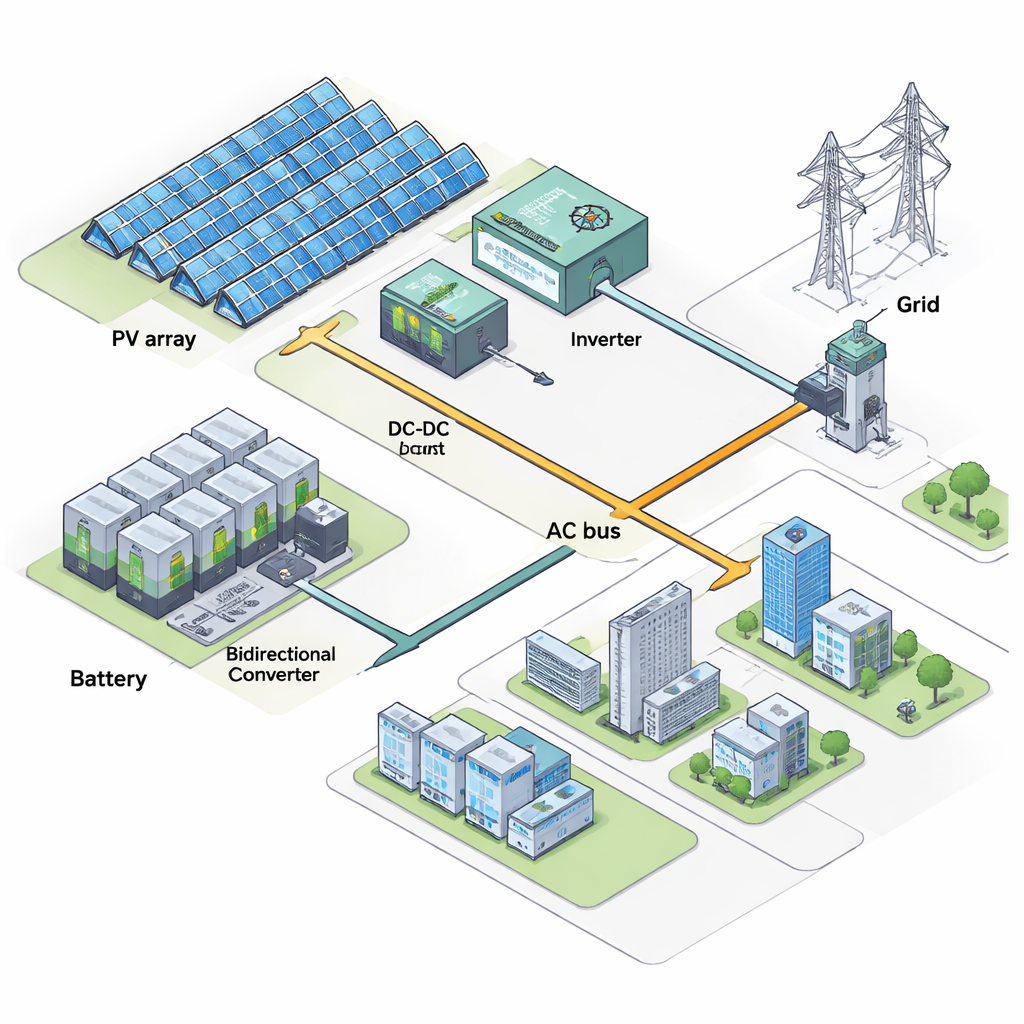
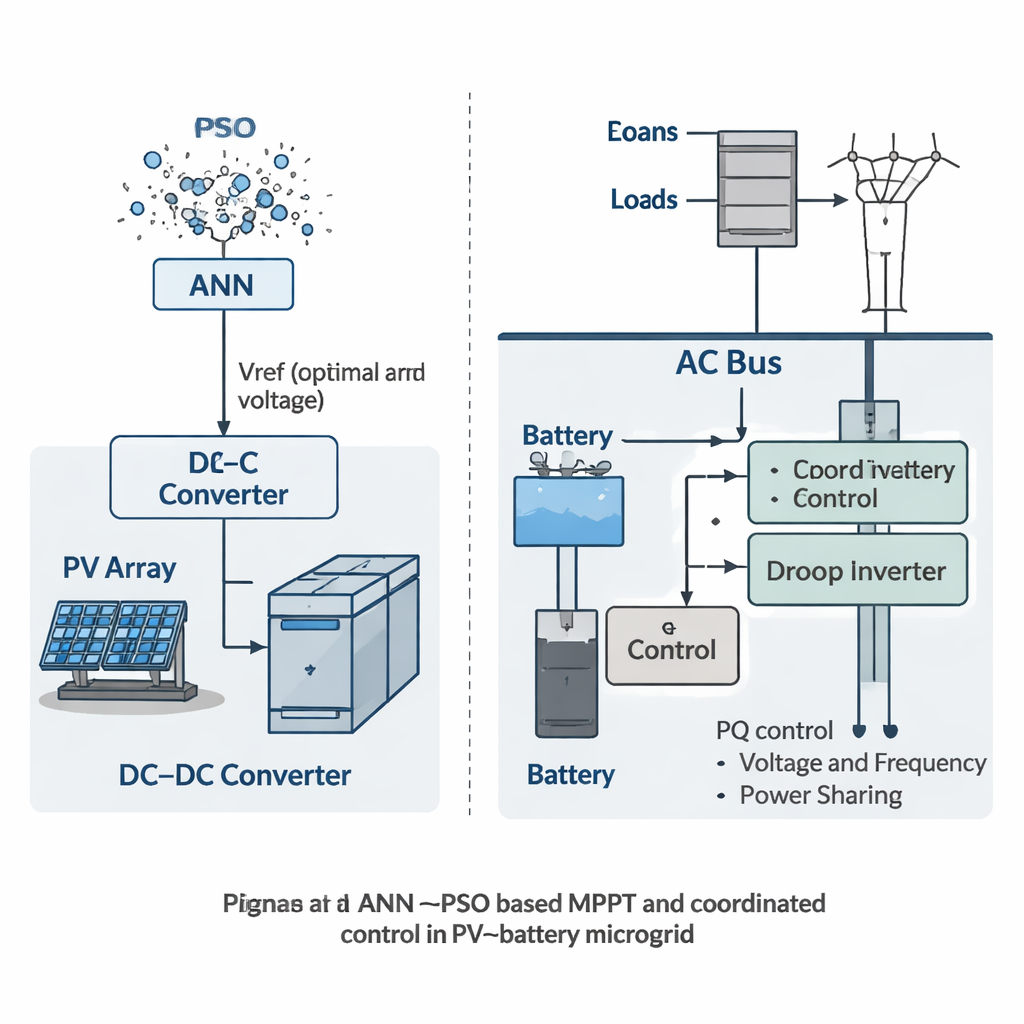
The authors study a one‑megawatt solar farm tied to a large lithium‑ion battery in an AC microgrid. The solar array connects through a DC‑DC “boost” converter and a three‑phase inverter to a common AC bus that serves the loads and links to the main grid. The battery connects through its own bidirectional converter so it can both absorb and supply power. A central feature of the setup is an adaptive controller that can operate in two main modes. When the microgrid is connected to the wider utility network, a power‑flow (PQ) controller lets the grid set the voltage and frequency. When the microgrid is islanded—running on its own during a fault or planned disconnection—a droop controller in the battery unit takes over, shaping voltage and frequency while sharing power between solar and storage.
Teaching the system to chase maximum solar power
To improve how the solar farm finds and follows its maximum power point, the researchers combine two forms of artificial intelligence. An artificial neural network (ANN) learns from data how panel voltage should be adjusted for different levels of sunlight and temperature. A particle swarm optimization (PSO) routine—loosely inspired by the way flocks or swarms search for food—tunes the internal weights of that neural network so it learns quickly and avoids poor solutions. The trained ANN predicts the best operating voltage; this becomes a reference for the converter, which then nudges the panels toward that point. In simulations based on 1000 randomly generated weather conditions, this ANN–PSO pairing reduced error in the learned behavior and converged to good settings in only a few hundred training steps.
Keeping lights steady through grid cuts and cloud shadows
The real test comes when the microgrid faces sudden changes in sunlight, load, or grid connection. Using detailed MATLAB/Simulink models, the authors compare their ANN–PSO method with three other well‑known tracking strategies. Under a mix of bright sun, reduced load, and then sharp drops in sunlight, the ANN–PSO controller consistently captured more of the available solar power, with tracking efficiencies near 98% and very small power ripple. At the same time, the coordinated PQ–droop control kept the microgrid’s AC voltage close to its 420‑volt target and held frequency within the tight window suggested by interconnection standards. When the system was deliberately switched from grid‑connected to islanded operation and then back again, a resynchronization unit aligned phase and frequency before reconnection, avoiding the sharp voltage distortions and inrush currents that can damage equipment.
What this means for future solar communities
From a layperson’s perspective, the main outcome is a solar‑plus‑battery setup that behaves far more smoothly and predictably. By giving the microgrid an AI‑enhanced “brain” that both hunts efficiently for maximum solar power and manages hand‑offs between the grid and local storage, the approach makes it easier to run neighborhoods, campuses, or remote facilities largely on solar energy without flicker or unexpected outages. In practice, this means better use of every ray of sunlight, longer‑lived hardware, and more resilient local power—key ingredients for reaching clean‑energy and smart‑infrastructure goals.
Citation: Siddaraj, U., Yaragatti, U.R., Paragonda, L.R.S. et al. Adaptive MPPT control for reliable transitions between grid connected and islanded operations in PV battery microgrids. Sci Rep 16, 7613 (2026). https://doi.org/10.1038/s41598-026-38300-5
Keywords: solar microgrid, maximum power point tracking, battery energy storage, artificial intelligence control, grid integration