Clear Sky Science · en
Predictive modeling of conductivity for carbon black nanocomposites: influence of filler features, interfacial effects and network portion
Why tiny black particles can turn plastics into wires
Everyday products—from flexible phone cases to pressure sensors in shoes—often rely on plastics that can carry electricity. A common way to make an insulating plastic conductive is to mix in carbon black, a fine powder of nearly spherical carbon particles. Yet two plastics with the same amount of carbon black can behave very differently: one may conduct electricity well, while the other remains almost an insulator. This article explains a new, physics-based model that helps engineers predict and control that jump from “off” to “on.” 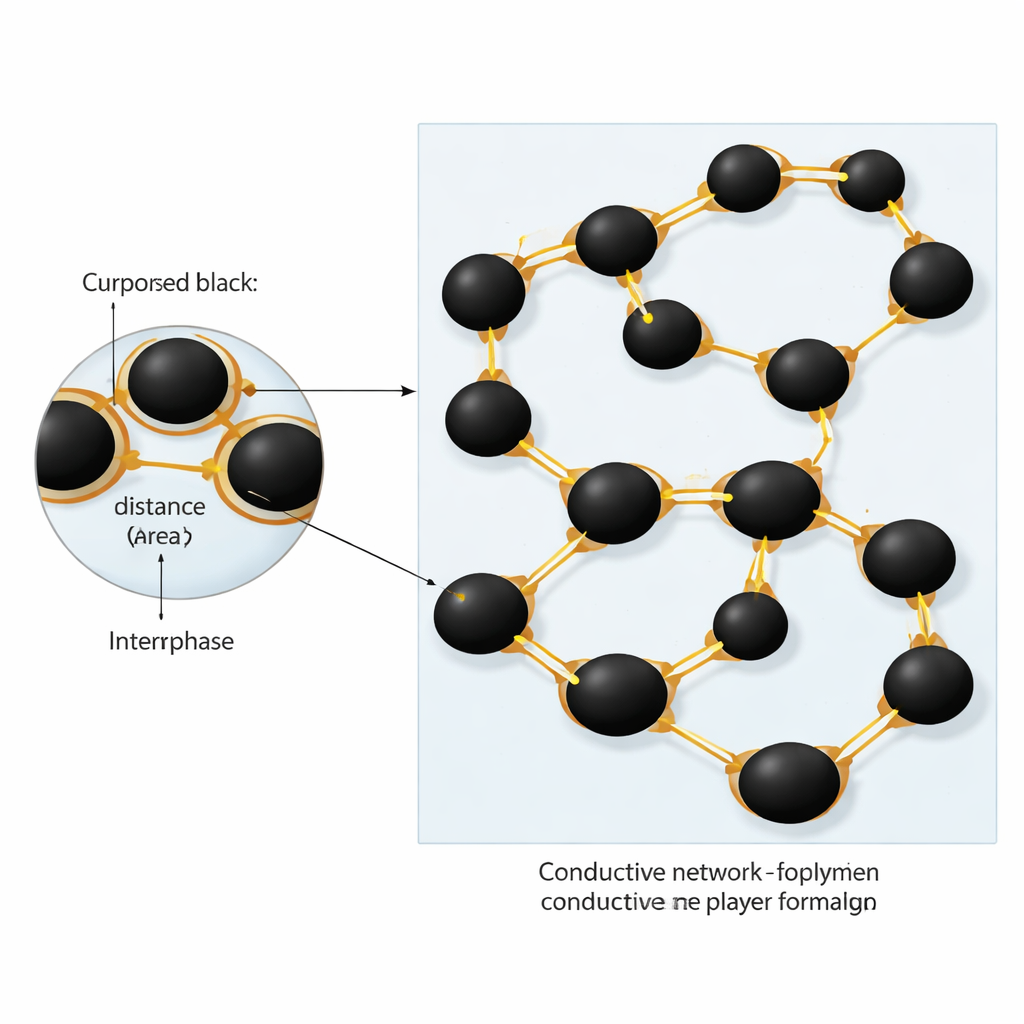
From scattered grains to a connected pathway
When carbon black is mixed into a polymer, the particles rarely stay isolated. They clump into tiny aggregates and, at high enough loading, link up into a continuous network. Once this network spans the material, electrons can travel from one side to the other and the composite becomes conductive. The critical point at which this happens is called the percolation threshold. Below it, particles form small, disconnected clusters and the plastic behaves like an insulator. Above it, many clusters suddenly merge into a system-wide pathway, and conductivity can rise by orders of magnitude with only a small increase in carbon black content.
The hidden role of the “in-between” regions
The particles do not touch in a simple, rigid way. They are surrounded by a thin interphase region, where the polymer’s structure and properties are altered by its contact with carbon black. Electrons can move through this interphase more easily than through untouched polymer. They can also cross tiny gaps between neighboring particles by quantum tunneling—slipping through an ultra-thin insulating barrier rather than going around it. The authors show that the thickness and conductivity of this interphase, the distance across these gaps, and the effective area where tunneling can occur are just as important as how much carbon black is added. If the interphase is too resistive or too thin, or if gaps are even a little too wide, the material can remain almost perfectly insulating. 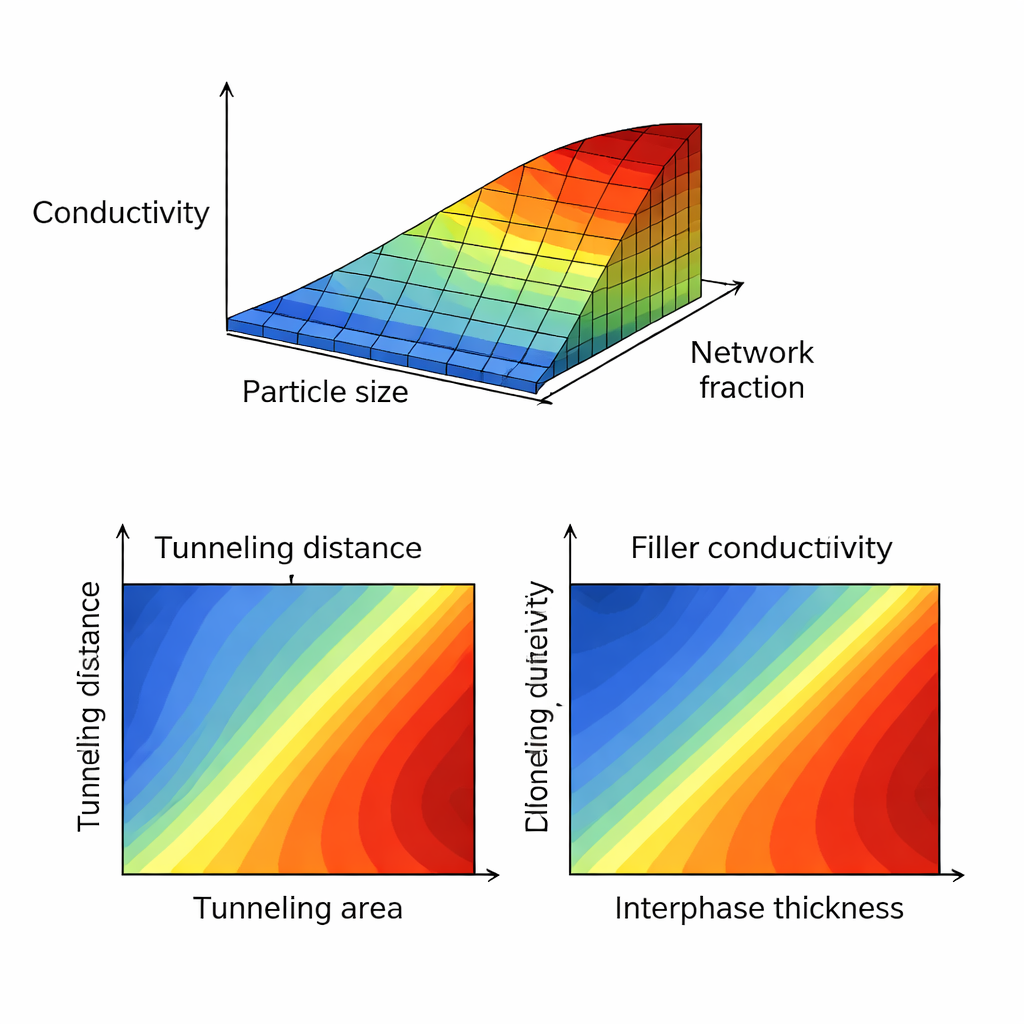
A unified map linking structure to performance
To bring these effects together, the study builds a single mathematical framework that couples three ingredients: how particles form networks (percolation), how electrons tunnel across tiny gaps, and how easily they move through the interphase. The model uses measurable or designable quantities such as particle radius, interphase thickness, tunneling distance and area, the intrinsic conductivity of carbon black, and surface tensions that govern how well particles mix with the polymer. Instead of relying purely on curve-fitting, the authors keep a clear physical meaning for each term and then test the model against experimental data from four very different polymer–carbon black systems. In each case, the predicted conductivity closely matches measured values as the amount of carbon black is varied, giving confidence that the framework captures the essential physics.
What the model reveals about making better materials
By running numerical experiments, the authors explore how tuning each feature shifts the composite from insulating to conductive. Small carbon black particles that form well-connected networks can push conductivity to around 1 S/m at modest loadings, while larger particles or poorly connected networks drop the material back toward insulating behavior. The model shows that conductivity is especially sensitive to two levers: the polymer’s tunneling resistivity (how hard it is for electrons to tunnel through the tiny gaps) and the interphase conductivity. When the interphase conducts poorly or tunneling resistivity is high, the composite stays effectively off, no matter how conductive the carbon black itself is. In contrast, short tunneling distances, wide tunneling contact areas, a thicker interphase, and highly conductive carbon black can raise conductivity to several S/m, even without extreme filler contents.
Turning complex physics into practical design rules
For non-specialists, the main takeaway is that adding “more carbon black” is not a simple dial for electrical performance. The same loading can yield a nearly dead sensor or a highly responsive one, depending on nanoscale details in the spaces between particles. This work offers a kind of design map: choose smaller particles that can form dense networks, encourage a thicker and more conductive interphase, keep the gaps between particles as thin as possible, and favor processing steps or material choices that reduce tunneling barriers. Within its limits—moderate filler levels and roughly spherical particles—the model turns a tangle of microscopic effects into clear guidelines for engineering plastics that conduct electricity reliably, enabling lighter, cheaper, and more versatile electronic materials.
Citation: Boomhendi, M., Vatani, M., Zare, Y. et al. Predictive modeling of conductivity for carbon black nanocomposites: influence of filler features, interfacial effects and network portion. Sci Rep 16, 6894 (2026). https://doi.org/10.1038/s41598-026-38296-y
Keywords: carbon black nanocomposites, electrical conductivity, percolation threshold, electron tunneling, polymer composites