Clear Sky Science · en
Health status monitoring of cutting arm of anchor excavator based on digital twin
Watching Heavy Machines Stay Safe
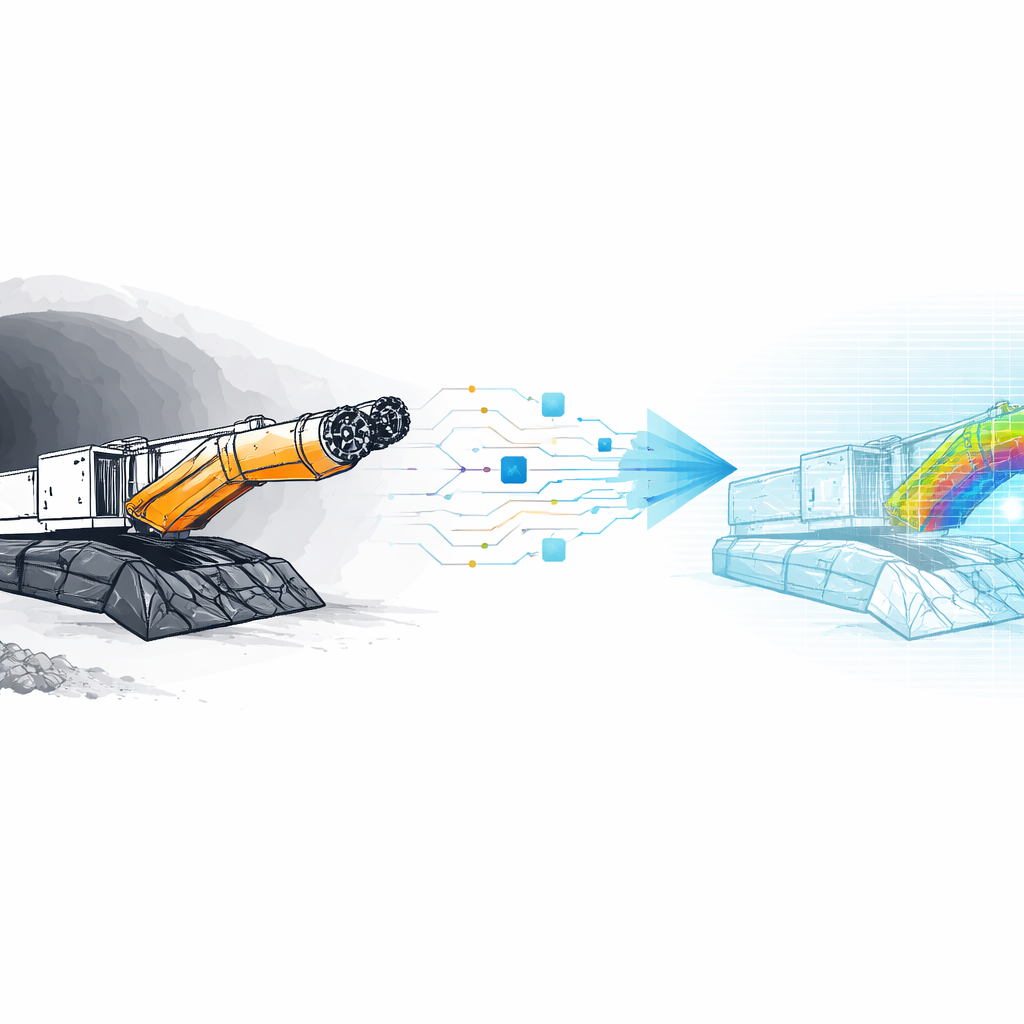
Deep underground, powerful road-digging machines carve tunnels through rock so people can reach coal and other resources. If a critical part breaks without warning, work stops, repairs are costly, and workers may be at risk. This study shows how a virtual copy of a tunneling machine’s cutting arm – a “digital twin” – can watch the machine in real time, predict when key parts are stressed or wearing out, and help keep operations safer and more efficient.
Why Tunnel Machines Need Smarter Care
Modern coal mines rely on integrated machines that both cut the tunnel face and install roof anchors to keep the rock stable. These machines work in cramped, harsh tunnels, facing changing rock layers and heavy loads. Their cutting arms see repeated bending and twisting as they lift, cut forward, pull down, and cut along the floor. Traditionally, engineers use detailed computer simulations to understand these forces, but such calculations can take many hours. That is far too slow to guide decisions while the machine is actually running, leaving operators to depend on rough rules of thumb and delayed inspections.
Building a Virtual Twin of the Cutting Arm
The researchers set out to give the cutting arm a virtual counterpart that behaves like the real thing but can respond in seconds instead of hours. They began by simplifying a real tunneling machine and building a one-eighth-scale test model. Using this scaled design, they carried out detailed computer simulations of the cutting arm under its main operating steps: lifting, cutting into the coal wall, pulling down, and undercutting along the floor. These simulations showed how forces travel from the spinning drum into the arm and down into the machine body, and where the arm’s metal experiences the highest stresses.
Teaching a Fast Stand-In to Mimic Slow Calculations
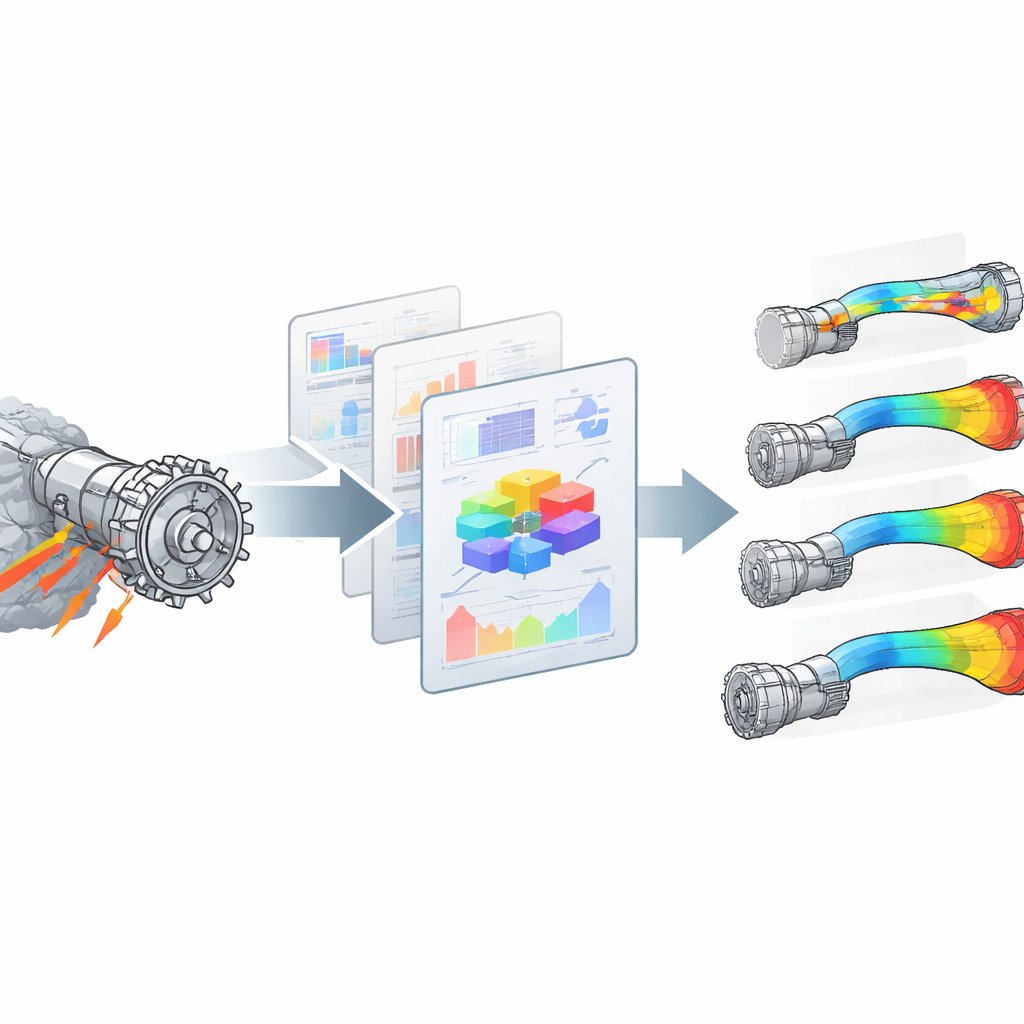
Because running full simulations for every moment of operation is too slow, the team trained a “surrogate” model – a mathematical stand-in that can predict stress patterns almost instantly. They carefully sampled many operating conditions, such as different cutting forces, arm angles, and cylinder positions, and used the resulting simulation data to teach the surrogate model how stress changes across the arm. Advanced sampling and learning techniques helped the model focus on the most critical, high-stress regions while keeping the number of training cases manageable. Tests showed that the surrogate’s predictions closely matched the original simulations, with only small differences in maximum stress under a wide range of conditions.
From Stress Maps to Remaining Life
Once the fast stand-in could provide real-time stress maps, the team linked it to methods from fatigue analysis, which estimate how repeated loading gradually damages metal. By tracking the stress history during each cutting cycle and applying well-known damage rules, the digital twin can estimate how much usable life remains in the cutting arm. To bring this to life, the researchers built a monitoring platform in the Unity 3D software environment. There, a 3D model of the machine’s cutting arm is colored like a weather map, showing where stresses are highest and how the predicted remaining life changes as the machine goes through its lifting, cutting, and undercutting motions.
Testing the Twin Against the Real World
The team then put their ideas to the test on a physical bench-top setup that mimics the cutting mechanism. They attached strain gauges – tiny devices that measure stretching in the metal – at key points on the arm and ran a series of lifting and loading experiments. When they compared these measurements with the surrogate model’s predictions, the overall trends matched well, and the differences in stress values were generally within acceptable limits. Some sudden, irregular events were harder to capture, highlighting that more training data and better handling of rare conditions could further improve accuracy.
What This Means for Safer Tunneling
By combining detailed physics, fast stand-in models, and an interactive 3D display, this work shows that a digital twin can monitor a tunneling machine’s cutting arm in real time. Instead of waiting hours for heavy simulations or relying on occasional inspections, mine operators can see how hard the arm is working, how close it is to its limits, and when maintenance should be scheduled. The approach greatly cuts calculation time while keeping errors small enough for practical use, offering a path toward smarter, safer, and more reliable underground excavation.
Citation: Xie, C., Chen, X., Liu, Z. et al. Health status monitoring of cutting arm of anchor excavator based on digital twin. Sci Rep 16, 8139 (2026). https://doi.org/10.1038/s41598-026-38290-4
Keywords: digital twin, tunneling machine, structural health monitoring, surrogate model, fatigue life