Clear Sky Science · en
A novel rotor harmonic winding-based high efficient self-excited brushless wound rotor synchronous machine with improved torque features
Why a New Kind of Motor Matters
Electric motors are hidden inside almost everything that moves in modern life, from factory robots to electric cars and home appliances. Many of today’s most efficient motors rely on permanent magnets made from rare-earth materials that are costly and vulnerable to supply disruptions. This paper presents a different approach: a compact motor design that delivers strong twisting force, or torque, without using permanent magnets or fragile brush contacts, potentially making high-performance electric drives cheaper, more durable, and easier to maintain.
Motors Without Expensive Magnets
Standard high-efficiency motors often use powerful permanent magnets mounted on a spinning core. These magnets provide a constant magnetic field, which helps the motor run efficiently at its rated load but wastes energy at light loads and complicates control over a wide speed range. They also depend on rare-earth metals, whose price and availability can swing sharply. An alternative is the wound-rotor synchronous motor, where the rotor’s magnetic field is created by copper coils instead of magnets. Traditional versions of these machines, however, need brushes and slip rings to feed current into the spinning rotor, adding wear, sparks, losses, and maintenance.
Brushless Designs and Their Limits
Researchers have spent years trying to build motors that combine the controllability of wound rotors with the low-maintenance benefits of brushless designs. Many proposed brushless wound-rotor machines use extra windings and multiple power electronics modules to sneak energy into the rotor without direct electrical contacts. Often they rely on carefully shaped magnetic fields that contain small ripples, or harmonics, which can induce currents in special rotor coils. While these schemes work, they tend to be complex, requiring extra inverters, additional stator windings, or permanent magnets, all of which raise cost and can still fall short on torque density.
Using Hidden Magnetic Ripples More Cleverly
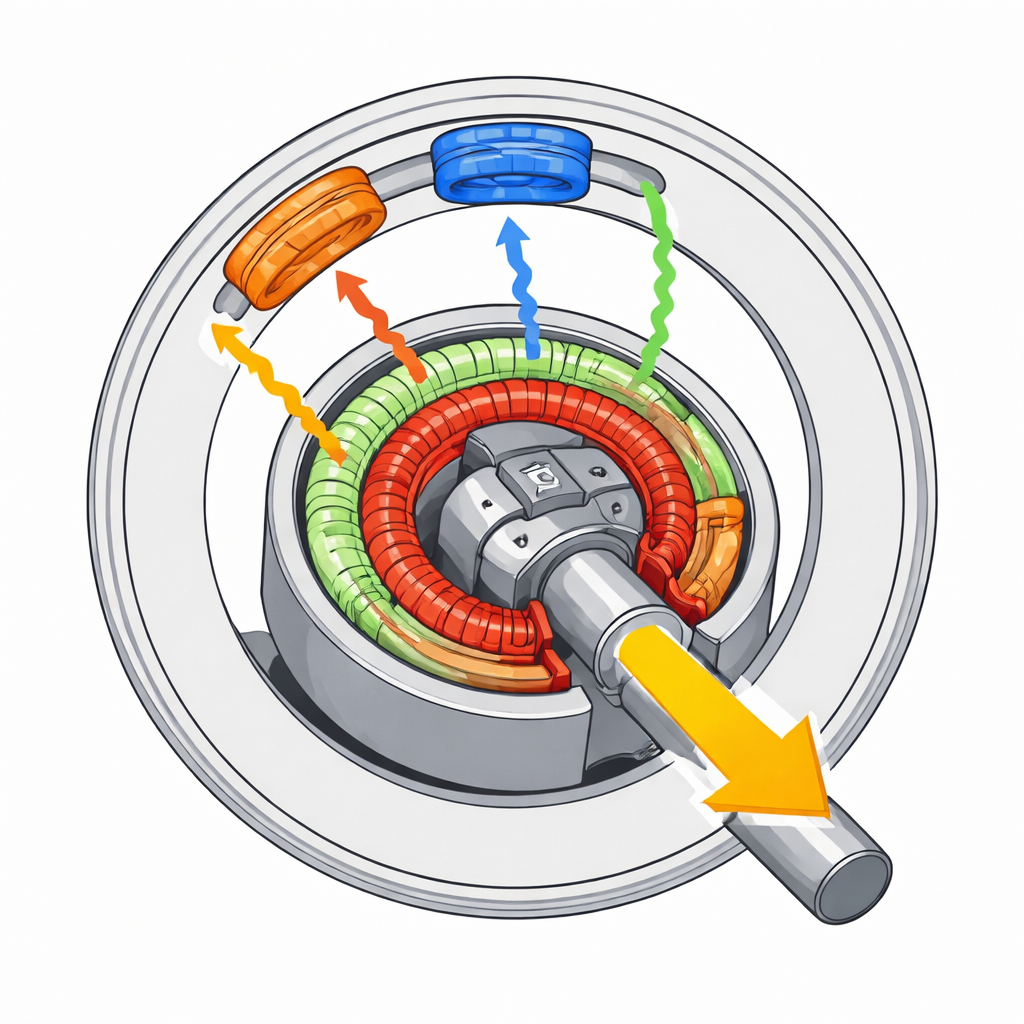
The authors build on a recent idea that uses an already-present “subharmonic” ripple in the stator’s magnetic field to generate power inside the rotor. Instead of adding more hardware on the stationary side, they focus on redesigning the rotor itself. In earlier designs, only half of the available rotor slots were filled with a special harmonic winding that picks up this subharmonic field and feeds a rectifier, which then supplies direct current to the main rotor field winding. The new approach simply puts the unused space to work by adding a second, identical harmonic winding into the empty rotor slots, and connecting the two through a capacitor so their alternating currents stay in step.
How the New Rotor Boosts Torque
When three-phase current from a single inverter flows in the stator coils, it creates both the main rotating field and a strong subharmonic component. This subharmonic sweeps past the two harmonic windings on the rotor, inducing alternating currents in each of them. These two currents combine and pass through a small rectifier mounted on the rotor, which converts the combined signal into a steady direct current for the main field winding. Because there are now two harmonic windings instead of one, more current is harvested from the same stator input, strengthening the rotor’s magnetic field without any extra external power hardware. Computer-based finite element simulations of an 8-pole, 12-slot prototype show that the average field current in the new design rises by nearly 30 percent compared with the earlier single-winding version.
Performance Gains Under Realistic Conditions
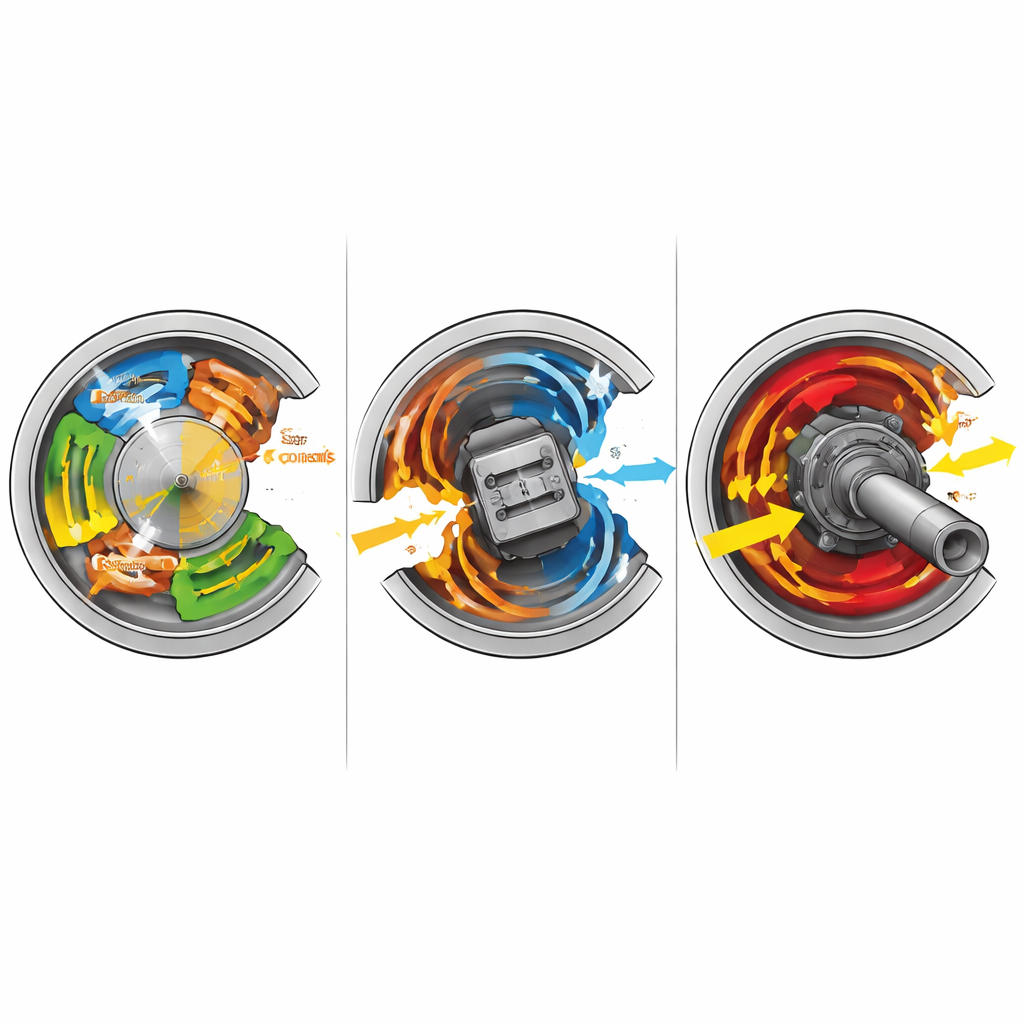
The stronger rotor field directly translates into more torque and power. Under the same operating speed and the same stator current, the new machine produces an average torque of about 10.25 newton-meters, compared with 8.39 newton-meters for the reference design—an increase of 22.15 percent. The output power rises by the same proportion, while the efficiency climbs slightly to nearly 93 percent. Importantly, the torque ripple, a measure of how smoothly the motor turns, remains very small (below one percent), meaning the added winding does not introduce unwanted vibrations. Magnetic flux levels in the iron core stay below the saturation limit, indicating that the improved performance does not come at the cost of overheating or undue material stress.
What This Means for Future Electric Drives
In simple terms, the researchers have shown that a clever rearrangement of copper inside the rotor can squeeze significantly more useful push out of a motor without changing its outer size, power supply, or stator design. By filling unused rotor space with a second harmonic winding and using built-in magnetic ripples as a free energy transfer channel, their brushless wound-rotor machine achieves higher torque, smooth operation, and slightly better efficiency—while completely avoiding expensive permanent magnets and high-maintenance brushes. Such motors could become attractive options for electric vehicles and other high-torque applications where cost, reliability, and supply security are as important as raw performance.
Citation: ul Haq, M.A., Farooq, H., Liaqat, R. et al. A novel rotor harmonic winding-based high efficient self-excited brushless wound rotor synchronous machine with improved torque features. Sci Rep 16, 9267 (2026). https://doi.org/10.1038/s41598-026-38287-z
Keywords: brushless wound-rotor motor, high-torque electric machines, permanent-magnet-free drives, self-excited rotor winding, electric vehicle traction