Clear Sky Science · en
Impact of mare milk-derived small extracellular vesicles on proliferation, phagocytosis, and migration in RAW264.7 macrophage
Why Horse Milk May Matter for Your Immune System
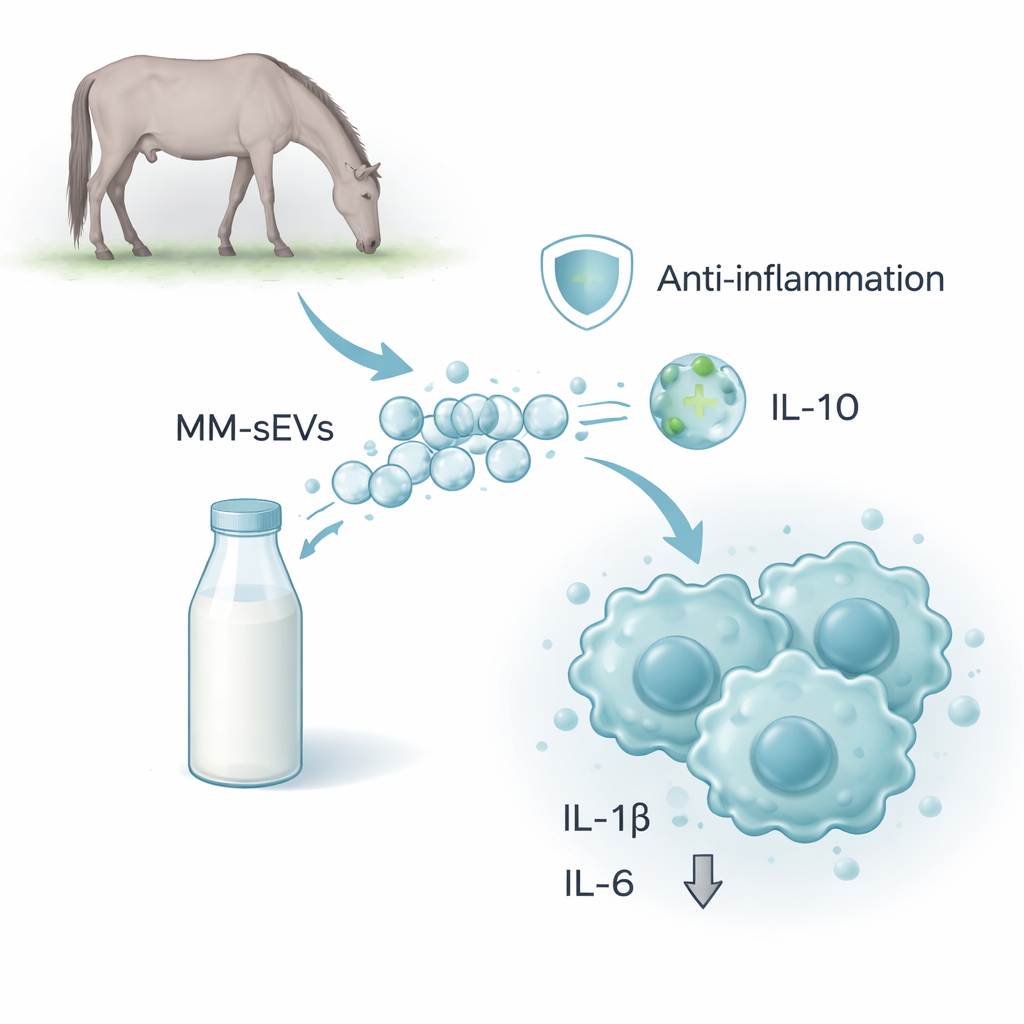
Mare’s milk—milk from horses—has long been valued in Central Asia as a soothing, health‑giving drink. Modern science is now beginning to uncover why. This study looks at tiny natural particles in mare’s milk, called small extracellular vesicles, that act like microscopic delivery packages. By examining how these packages affect immune cells in the lab, the researchers explore whether mare’s milk could one day be used to gently steer inflammation in the body, supporting gut health and other immune‑related conditions.
Tiny Packages with Powerful Cargo
All mammal milks contain more than just fat, sugar, and protein. They also carry miniature bubbles of membrane, loaded with proteins and genetic messages, that help cells communicate. The team focused on such particles from mare’s milk, known as MM‑sEVs. Compared with cow’s milk, mare’s milk is closer to human milk in several key ingredients and is especially rich in natural antimicrobial factors. This raised the possibility that its microscopic bubbles might carry a distinctive set of immune‑shaping molecules. Yet, despite growing interest in milk‑derived vesicles from cows and humans, those from horse milk had barely been explored.
Finding and Identifying the Milk Bubbles
Before the scientists could test what these vesicles do, they had to pull them out of the complex mixture that is raw milk. They compared four different separation methods, all based on spinning or filtering the milk so that heavier or larger components settle out at different stages. One improved spinning method gave the highest number of particles, while a column‑based approach produced fewer vesicles but with cleaner, more intact structures—better suited to functional experiments. Using electron microscopy, particle tracking, and protein markers, the team confirmed that the isolated material matched the size and shape expected for genuine extracellular vesicles, rather than random debris or fat droplets.
Decoding the Molecular Messages
Next, the researchers cataloged what is inside these mare milk vesicles. They identified more than 1,500 different proteins and 360 small RNA molecules known as microRNAs. Many of these were linked to immune activity, inflammation control, and tissue repair. Some proteins were involved in how immune cells recognize targets or engulf particles, while others were connected to pathways known from gut diseases and infections. A standout protein, called RHOA, sits at the center of networks that guide how immune cells move and swallow foreign material. Several of the abundant microRNAs, including miR‑155 and miR‑148a, have been implicated in calming excessive inflammation in the intestine and other organs.
How the Vesicles Change Immune Cell Behavior
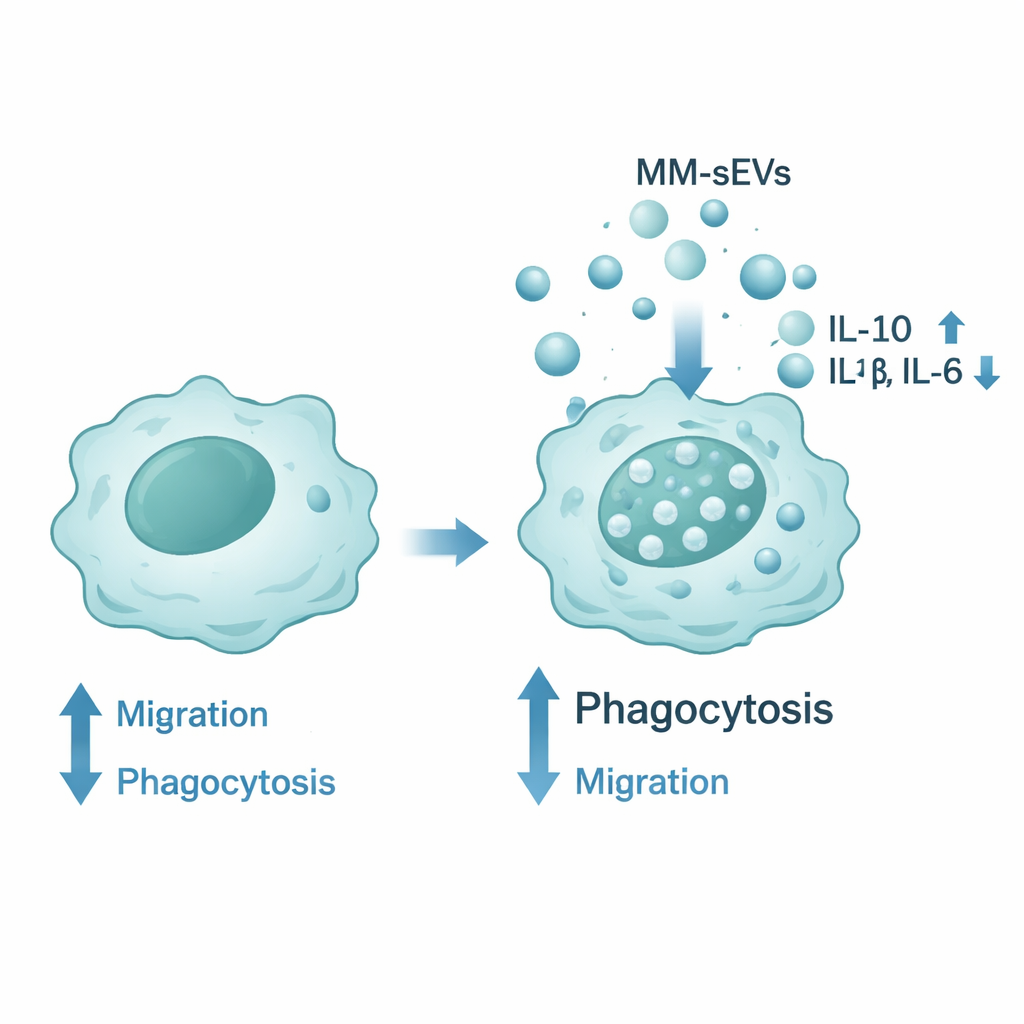
To see how these messages play out, the team added mare milk vesicles to a well‑studied mouse immune cell line that behaves like macrophages—the body’s professional “big eaters.” When these cells were exposed to the vesicles and then challenged with a bacterial component that normally triggers strong inflammation, several changes emerged. The cells ramped up production of IL‑10, a molecule often described as a “brake” on inflammation, while dialing down classic inflammatory signals such as IL‑1β, IL‑6, IL‑12p40, and TNF‑α under certain conditions. At the same time, the macrophages became better at swallowing test particles—suggesting boosted cleanup ability—yet were less eager to migrate, a behavior that can be linked to runaway inflammatory responses.
What This Could Mean for Future Health Uses
Taken together, the findings suggest that tiny vesicles in mare’s milk can nudge immune cells toward a more balanced state: more efficient at clearing material, less prone to overshooting with inflammatory signals, and less likely to swarm aggressively. The work was done in cultured mouse cells, not in people, so it is far too early to treat mare’s milk as a medicine. Still, by mapping both the cargo and the effects of these natural nano‑packages, the study lays groundwork for using mare milk–derived vesicles as gentle, food‑based tools to support immune health or complement therapies for inflammatory diseases in the future.
Citation: Wang, S., Lan, Q., Badama, S. et al. Impact of mare milk-derived small extracellular vesicles on proliferation, phagocytosis, and migration in RAW264.7 macrophage. Sci Rep 16, 6944 (2026). https://doi.org/10.1038/s41598-026-38285-1
Keywords: mare milk, extracellular vesicles, immune modulation, macrophages, inflammation