Clear Sky Science · en
Exploring the interplay of lattice distortion, magnetic ordering, and dielectric behavior in Dy2NiFeO6−δ synthesized via solution chemistry
Why this strange crystal matters
Electronics of the future will increasingly rely on materials that can juggle several roles at once—storing charge like a capacitor, responding to magnetic fields like a tiny magnet, and doing it all in compact, energy‑efficient devices. This study explores a newly made crystal called Dy₂NiFeO₆−δ, a member of the "double perovskite" family, that naturally ties together structure, magnetism, and electrical behavior. Understanding how its atoms are arranged, how they carry charge, and how their tiny magnetic needles interact could help engineers design smarter components for sensors, memory, and spin‑based electronics.
Building a new kind of crystal
The researchers created Dy₂NiFeO₆−δ using a solution‑based "sol–gel" process rather than the traditional solid‑state route. In simple terms, they dissolved metal salts containing dysprosium, nickel, and iron into water, added organic helpers to bind the metals evenly, and then gently heated the mixture until it formed a gel. This gel was baked in two stages at very high temperatures to burn off organics and coax the atoms into an ordered crystal. X‑ray diffraction measurements confirmed that the atoms settled into a slightly distorted, monoclinic structure—a bent version of the ideal cube‑like perovskite—while electron microscopy revealed nanometer‑sized grains that tend to clump together because of their high surface energy and magnetic interactions. 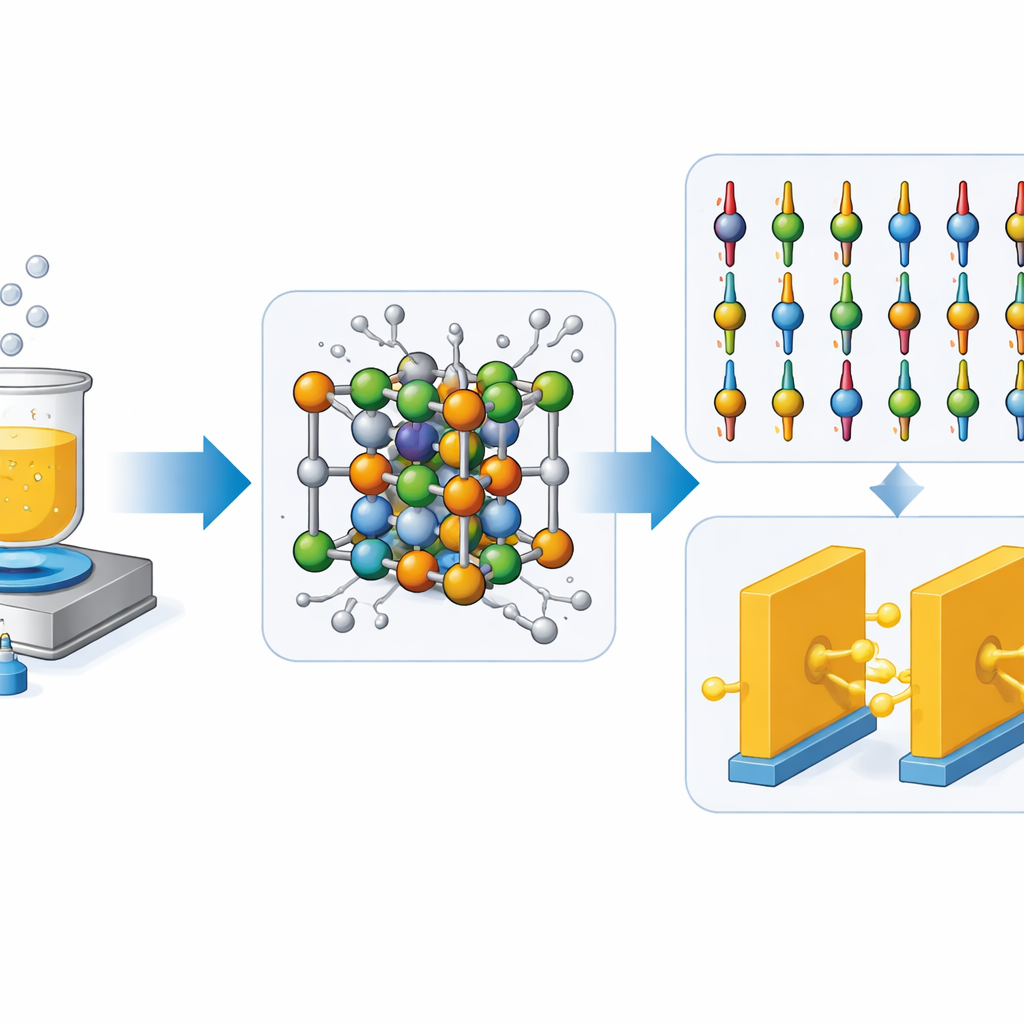
Hidden defects and their role
To see which chemical states the elements adopted and whether the lattice contained missing oxygen atoms, the team used X‑ray photoelectron spectroscopy. The measurements showed dysprosium in a trivalent state, nickel mostly as Ni²⁺, and iron present in a mix of Fe²⁺ and Fe³⁺. From these charge balances, they inferred that the crystal is short of some oxygen atoms—an effect described by the small "δ" in its formula. These oxygen vacancies are not mere flaws: in oxides like this, missing oxygens often act as waypoints for moving charge and can subtly twist the interactions between magnetic atoms. Here, they create a landscape that encourages electrons to hop between metal ions and help shape both the electrical and magnetic responses of the material.
Electric behavior under changing signals
The team then pressed the powder into pellets and measured how well they stored and lost electrical energy across a huge range of frequencies and temperatures. At low frequencies, the material shows a high dielectric constant, meaning it can store substantial electrical energy, but this value steadily drops as the signal oscillates faster. This pattern is consistent with charge piling up at internal interfaces—between grains and at their boundaries—and then failing to keep pace at higher speeds. The associated energy loss falls quickly at low frequencies and then flattens out, matching a so‑called quasi‑DC conduction process where slow, hopping‑type charge motion dominates. Conductivity measurements back up this picture: at higher temperatures and higher frequencies, electrons hop more easily between neighboring sites, giving a modest activation energy that is typical of short‑range hopping helped by oxygen vacancies. 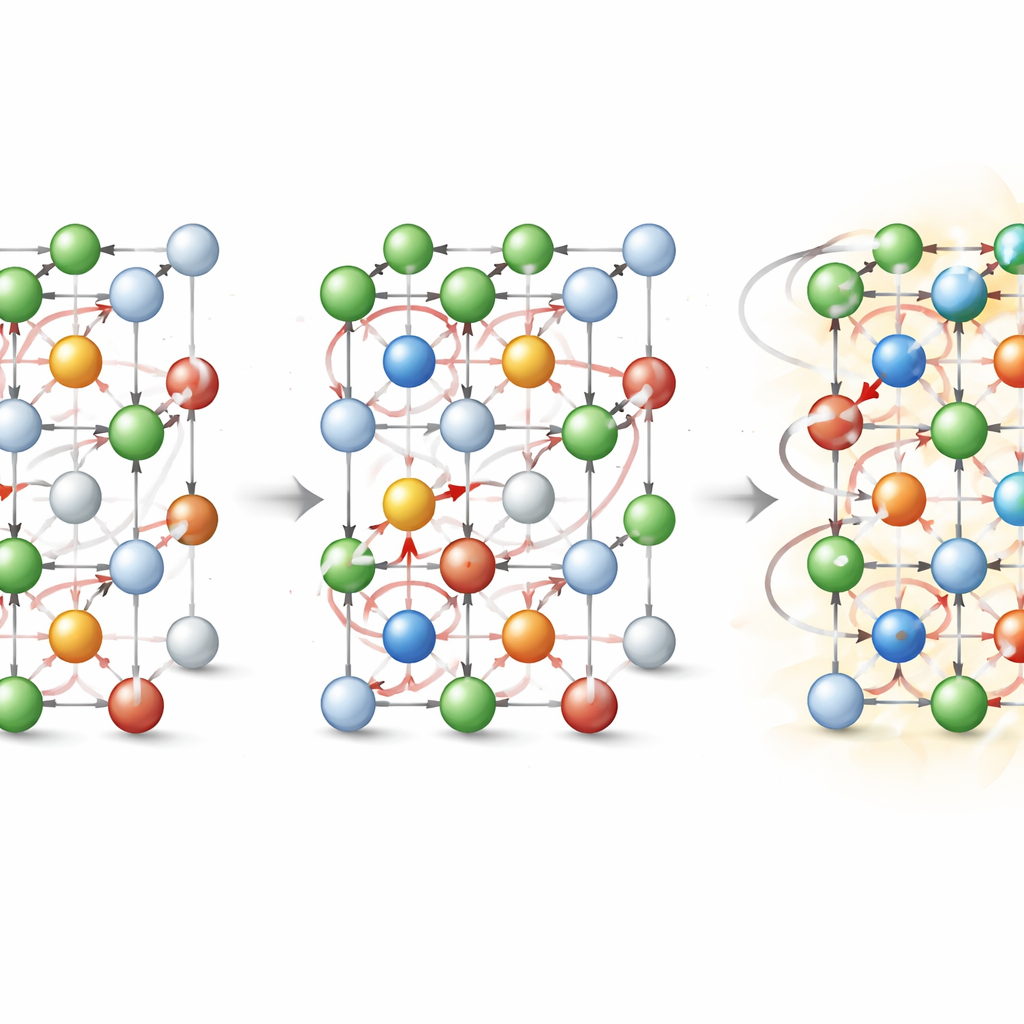
Magnetic twists at low and room temperatures
When the sample is cooled in weak magnetic fields, its magnetization reveals a rich sequence of magnetic states. Around 107 kelvin (about –166 °C), the material undergoes a clear transition where neighboring magnetic moments switch from a disordered state to an ordered, largely antiparallel arrangement, known as antiferromagnetism. Below roughly 50 kelvin, the magnetization grows and shows signs of "frozen" or glass‑like behavior: many tiny magnetic regions become locked in disordered orientations, producing weak ferromagnetism and sluggish responses. Even at room temperature, the loops traced out when the field is swept back and forth show a small but finite magnetic memory and resistance to flipping, indicating that short‑range magnetic clusters and spin tilts survive long after long‑range order has melted away. These features arise from the interplay between dysprosium’s strong 4f moments and the 3d moments of nickel and iron, mediated by the shared oxygen atoms and the same vacancies that guide charge.
Why this crystal is promising
Put together, the structural distortions, controlled oxygen deficiency, and intricate magnetic interactions make Dy₂NiFeO₆−δ a genuinely multifunctional material. It combines sizable, tunable dielectric behavior with hopping‑based electrical conduction and a mixture of antiferromagnetic, weakly ferromagnetic, and spin‑glass‑like states across different temperatures. Although the team has not yet directly measured how its electric and magnetic properties influence each other under applied magnetic or electric fields, the observed behavior strongly hints at useful coupling between them. That combination, achieved without using cobalt (a strategic and often costly element), points to Dy₂NiFeO₆−δ as a promising platform for future magnetoelectric components and spintronic devices that store and process information using both charge and spin.
Citation: Punj, S., Dhruv, D.B., Singh, J. et al. Exploring the interplay of lattice distortion, magnetic ordering, and dielectric behavior in Dy2NiFeO6−δ synthesized via solution chemistry. Sci Rep 16, 9709 (2026). https://doi.org/10.1038/s41598-026-38284-2
Keywords: double perovskite, multiferroic oxide, spintronic materials, oxygen vacancies, dielectric relaxation