Clear Sky Science · en
Enhancing SOC accuracy in electric vehicle batteries via trapezoidal integration and capacity degradation compensation
Why smarter battery gauges matter
Drivers of electric cars depend on the battery gauge just as much as they once relied on the fuel needle. If that gauge is wrong, an EV can unexpectedly run out of power, or the car may be overly cautious and hide usable range. This paper looks at a simple way to make that battery "fuel gauge"—technically, the state of charge or SOC—more accurate without adding expensive computers or complex models. By slightly refining the math used in today’s battery management systems, the authors show that everyday EVs can predict range more reliably over many hours of driving.
How EVs count electrons today
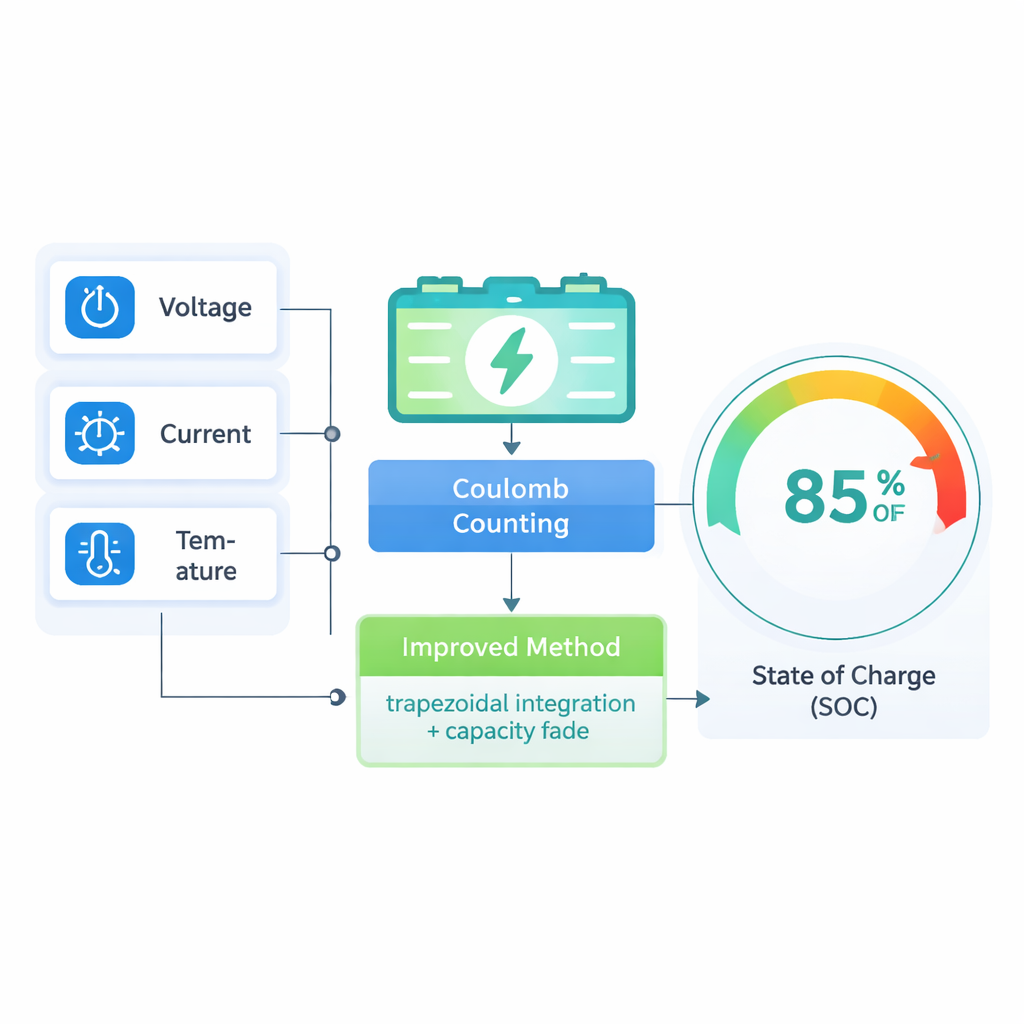
Most electric vehicles track their remaining energy using a method called Coulomb counting. In essence, the battery management system watches how much current flows in and out of the battery over time, like counting every electron that leaves or returns. The calculation is simple: start from a known charge level, subtract the current that flows during driving, and add it back during charging or regenerative braking. This approach is popular in commercial cars because it runs in real time on inexpensive electronics. However, small errors in current measurement, the assumption that the battery’s capacity never changes, and the way the math is implemented cause these estimates to drift over long trips, particularly when driving involves frequent switching between acceleration and regeneration.
A small tweak to the math with big effects
To cut this drift, the authors replace the usual “rectangular” integration step—the numerical recipe that adds up current over time—with a slightly more refined “trapezoidal” step. Instead of using only the current value at the start of each minute, the method averages the current at the start and end of that minute before updating SOC. This one extra averaging operation per step barely increases the processing load, even for low-power microcontrollers, but it better captures rapid changes in current during driving and braking. The result is less numerical error accumulating in the background, especially when the current flips sign as the car transitions between drawing power and recovering it.
Accounting for batteries that age
The second improvement acknowledges a basic reality: battery packs do not keep their full rated capacity forever. Heat, time, and repeated charging and discharging gradually reduce how much energy can be stored. Standard Coulomb counting typically assumes a fixed, “as new” capacity, which slowly causes the gauge to overestimate how much charge remains. In the improved method, the authors introduce a simple correction factor that shrinks the effective capacity to mimic a modestly aged cell. In their tests, they assume a 2% loss, but the same idea could be tied to more detailed health measurements. By computing SOC with this reduced capacity, the estimate better reflects what the battery can actually deliver, rather than what the label once promised.
Testing the approach on a realistic drive cycle
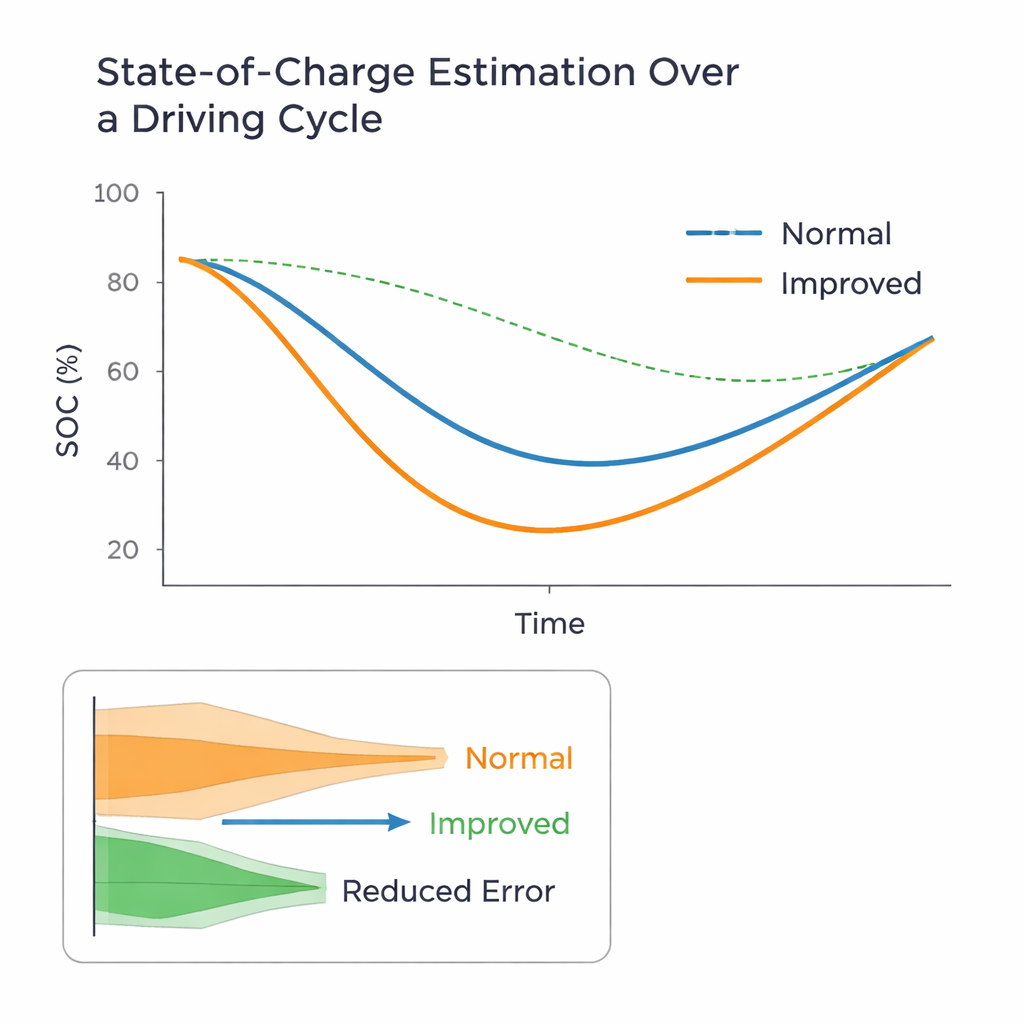
The team evaluates both the conventional and improved methods on a simulated 240-minute drive cycle for a lithium-ion cell widely used in EV packs. The current profile includes two hours of steady discharge followed by two hours of gentler charging that stand in for regenerative braking. Throughout this cycle they track voltage, current, and temperature, and compute a highly accurate reference SOC using ideal integration. They then compare the two estimators using common error measures such as mean absolute error, overall drift from the reference, and how the SOC differences are distributed over time. Across the board, the trapezoidal-plus-degradation method produces smoother SOC curves, lower error bands, and less sensitivity to changes in current and temperature than the basic approach.
What this means for everyday driving
For a layperson, the key message is that you can get a noticeably smarter EV range estimate with only minor upgrades to the existing math running inside today’s battery controllers. The study shows that by averaging consecutive current readings and modestly adjusting for capacity fade, the battery gauge drifts less than one percentage point in most situations over several hours. That translates to more trustworthy range predictions, safer control of charging and regenerative braking, and more confident use of the battery’s full capability—all without resorting to heavy data-driven models or expensive processors. In short, careful numerical housekeeping can make your EV’s “fuel gauge” more honest about how far you can really go.
Citation: Kulkarni, S.V., Gupta, S., Arjun, G. et al. Enhancing SOC accuracy in electric vehicle batteries via trapezoidal integration and capacity degradation compensation. Sci Rep 16, 6854 (2026). https://doi.org/10.1038/s41598-026-38281-5
Keywords: electric vehicle batteries, state of charge, battery management systems, lithium-ion degradation, Coulomb counting