Clear Sky Science · en
Spatial paradox between urban center expansion and vitality loss in Guangzhou, China
Why Bigger Cities Don’t Always Mean Better Cities
Many fast-growing cities around the world are racing outward, building new business districts, housing estates, and transport lines. It is easy to assume that as the city spreads, its social and economic “buzz” automatically grows too. This study of Guangzhou, a megacity in southern China, shows that the story is more complicated. Using big data from satellite images, population maps, and millions of online reviews, the authors find a striking paradox: the city’s center keeps expanding, while the everyday energy of some long-established downtown neighborhoods is quietly fading. 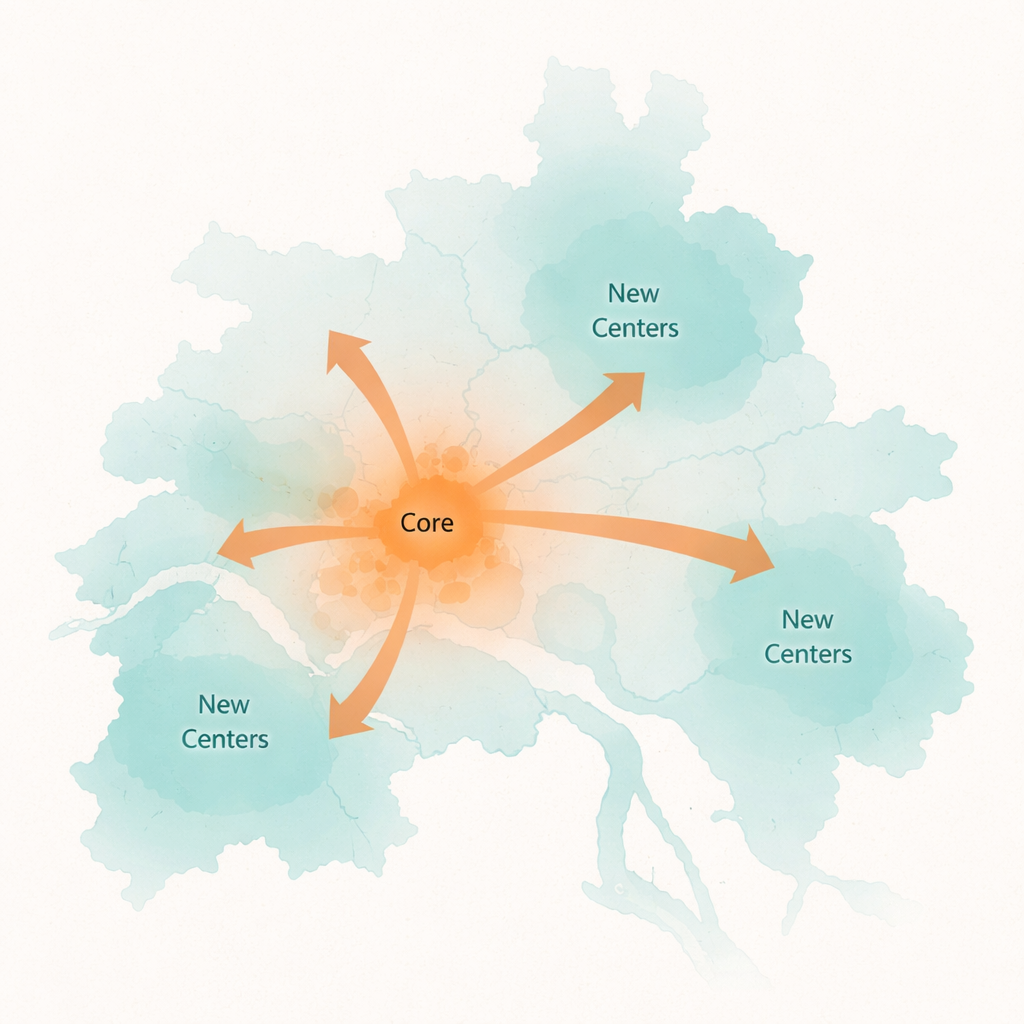
Following the City’s Footprints Over a Decade
The researchers tracked how Guangzhou’s main activity centers changed between 2013 and 2023. In the early years, the city’s core was still fairly compact. By 2018 and especially 2023, strong growth pushed urban centers outward into districts like Panyu, Baiyun, Huangpu, and Nansha. New subway lines, highways, and business parks helped draw companies and residents to these fringe areas. On a map, Guangzhou shifted from a city dominated by one historic core to a “many-center” pattern, with several hubs sharing the load of jobs, shopping, and services.
Measuring the City’s Everyday Energy
Instead of relying only on official statistics, the study uses multiple digital traces of city life. Nighttime satellite images capture the brightness of artificial lights, a rough indicator of economic activity. Global population grids show how many people live in each part of the city. Most unusually, the authors analyze nearly 20 million consumer reviews from Dianping, China’s leading local review platform. Where there are many active shops, frequent comments, and positive ratings, they infer higher “urban vitality” — the mix of commerce, social interaction, and street life that makes a neighborhood feel alive. Deep-learning techniques and spatial statistics help fuse these data sources into detailed citywide maps.
When Growth and Liveliness Fall Out of Step
From 2013 to 2018, expansion and vitality mostly moved in the same direction. Central districts such as Liwan, Yuexiu, Tianhe, and Haizhu became even more vibrant as people and businesses flocked in. Meanwhile, newly growing fringe zones gained energy without clearly draining the old core. After 2018, however, the pattern flips. The physical footprint of urban centers keeps spreading outward, but some of Guangzhou’s traditional heartland districts begin to lose steam. Commercial vacancies creep up, residents move away or age in place, and spending power weakens. Statistical maps reveal “mismatch” zones where the city is officially treated as a key center but local vitality is flat or falling. 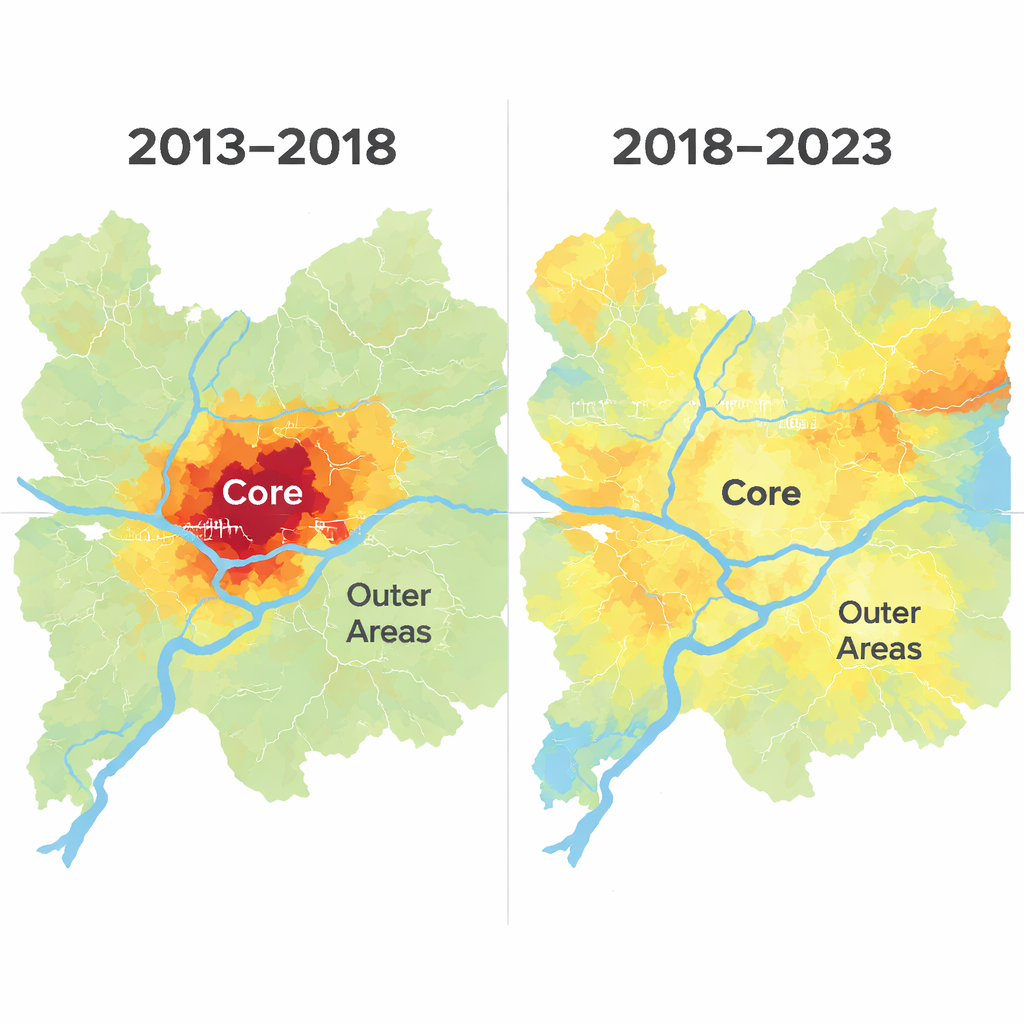
Why Old Centers Can Grow Quiet
The study suggests several reasons why expansion can hollow out long-established cores. As housing prices and congestion rise in central areas, both families and smaller shops look for more space and lower costs in new districts. Big new malls and office complexes on the edge of town concentrate spending and jobs, leaving traditional mixed-use streets behind. At the same time, shifts in Guangzhou’s wider economy — especially the decline of older manufacturing and export industries — hit lower-skilled workers hardest. Their reduced income and job security translate into fewer outings, fewer purchases, and fewer reviews, which show up as lower vitality in the data.
What This Means for Future City Building
For non-specialists, the main lesson is simple: a city that grows outward is not necessarily becoming healthier on the inside. Bigger does not automatically mean better. Guangzhou’s case shows that new centers can prosper while older downtown districts quietly lose the very buzz that once defined them. The authors argue that planners and officials need to pair expansion with “core renewal” — investing in public spaces, diverse small businesses, culture, and everyday services in historic neighborhoods, while balancing jobs and housing across old and new areas. Only by treating vitality as more than just buildings and lights can cities avoid becoming large but lifeless, and instead grow in ways that keep their streets, shops, and communities truly alive.
Citation: Chen, Y., Zhang, L., Lu, X. et al. Spatial paradox between urban center expansion and vitality loss in Guangzhou, China. Sci Rep 16, 7078 (2026). https://doi.org/10.1038/s41598-026-38279-z
Keywords: urban vitality, city expansion, Guangzhou, spatial mismatch, big data urban studies