Clear Sky Science · en
Anticancer and antioxidant activities of Pelargonium graveolens L., Mentha longifolia L., and Chrysanthemum frutescens L. under salt stress
Why salty soil and healing plants matter
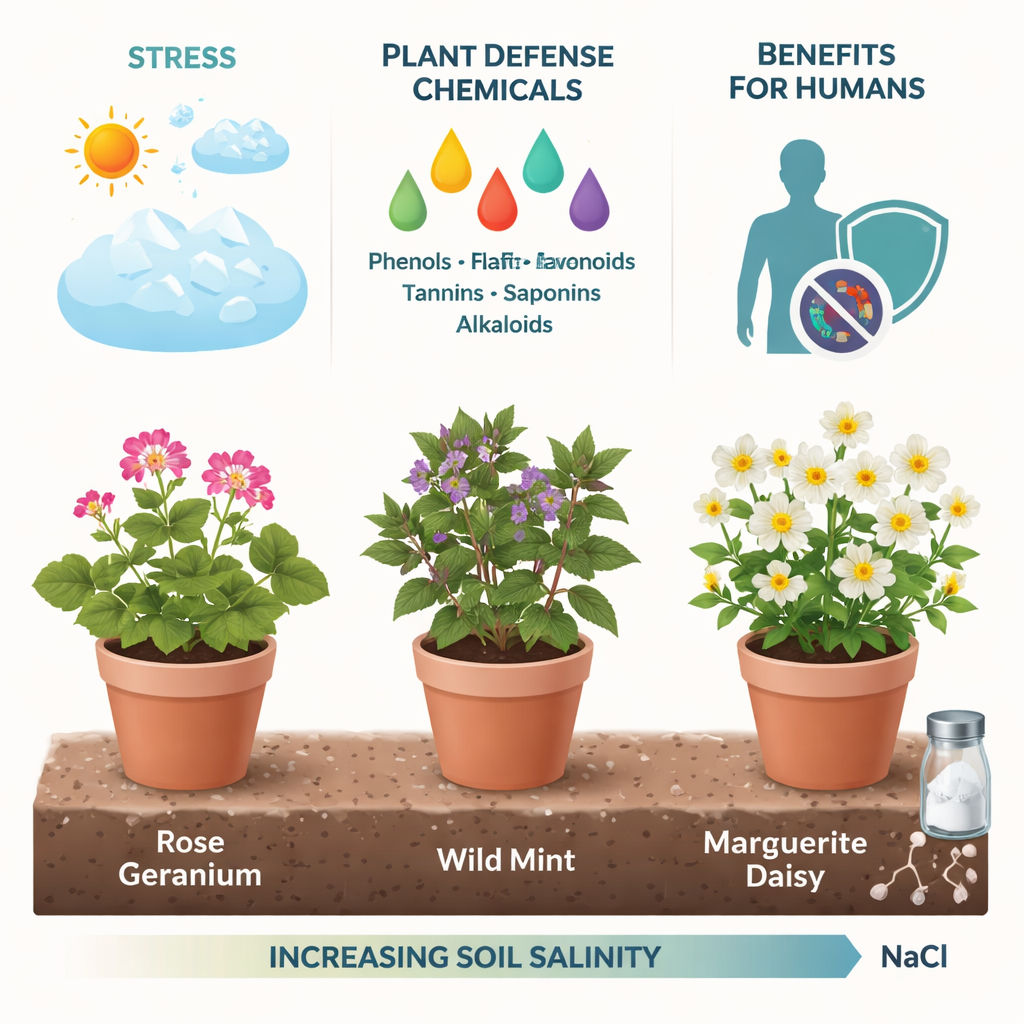
As farmland around the world becomes saltier, many crops struggle to survive. Yet some hardy aromatic plants not only cope with salty conditions, they also ramp up natural chemicals that can protect human health. This study explored how three well-known medicinal plants—rose geranium, wild mint, and marguerite daisy—respond to salty irrigation water, and whether the concentrated oils from their leaves can fight harmful free radicals and cancer cells in the lab.
Testing three familiar healing herbs
The researchers focused on Pelargonium graveolens (rose geranium), Mentha longifolia (wild mint or horsemint), and Chrysanthemum frutescens (marguerite daisy). These species are already used in traditional remedies and in the fragrance and food industries. Plants were grown in pots and watered with four levels of salt (from fresh water up to a fairly strong salt solution) for two months. Afterward, the team dried the above-ground parts, prepared alcohol- and water-based extracts, and distilled the essential oils. They then measured key groups of plant chemicals—such as phenols, flavonoids, tannins, saponins, and alkaloids—that are often linked to antioxidant and medicinal effects.
Salt stress as a chemical booster
Surprisingly, salty conditions did not simply damage these plants; instead, they triggered them to produce more of many protective compounds. In all three species, moderate to high salt levels led to marked increases in phenols and flavonoids, especially in the alcohol extracts. For example, rose geranium and wild mint roughly doubled their phenol content at certain salt levels, and marguerite daisy showed similar boosts. Saponins and alkaloids, two other bioactive groups with known roles in immunity and cancer prevention, also rose under salt stress. In parallel, the total antioxidant capacity of the extracts increased, and wild mint in particular showed very strong ability to neutralize a standard free radical in a common lab test.
From plant chemicals to cancer cell tests
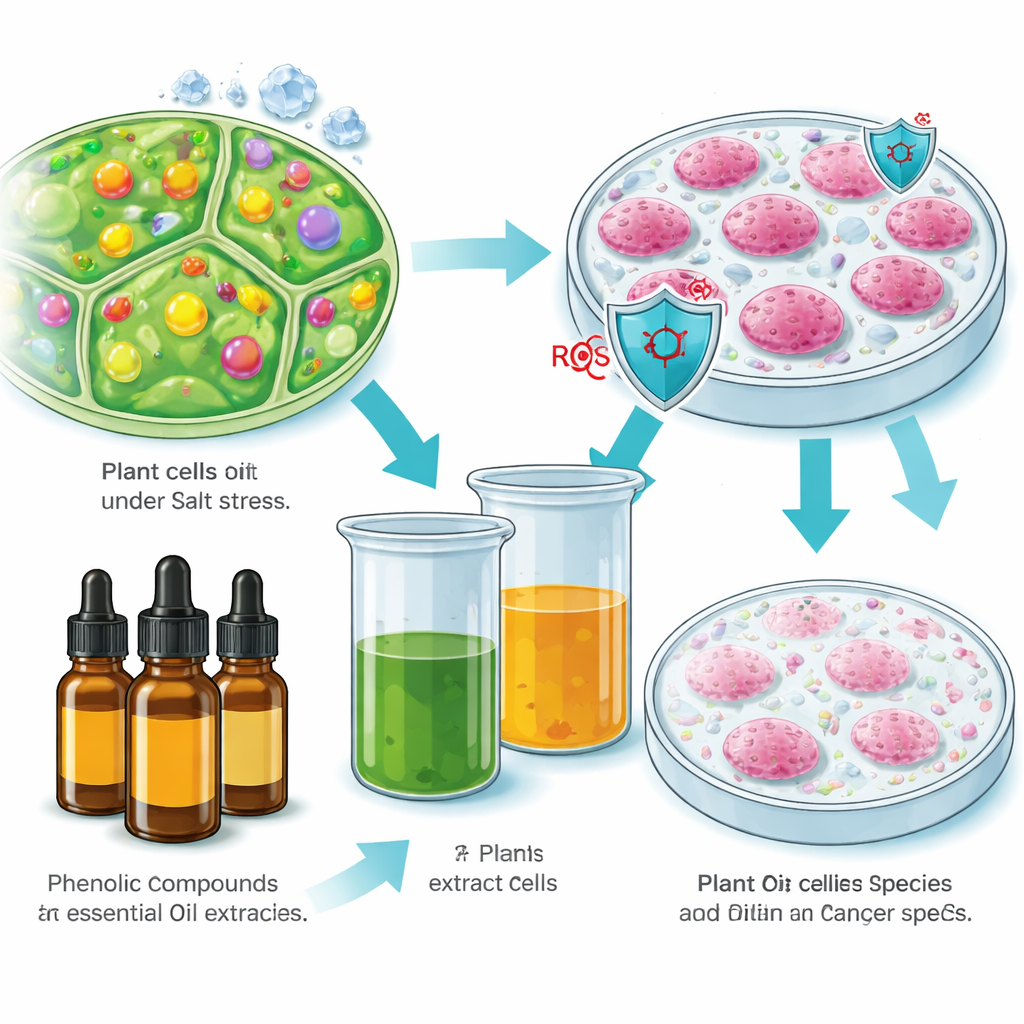
The essential oils were then analyzed in detail, revealing dozens of components whose amounts shifted with salinity. In rose geranium, salt boosted molecules like citronellol, geraniol, linalool, and several others that have reported anti-inflammatory, antimicrobial, and anticancer actions. Wild mint’s oil became richer in menthone, α-pinene, myrcene, and related compounds, while marguerite daisy oil saw rises in limonene, α-farnesene, α-bisabolol, and more. To see whether these chemical changes mattered for human health, the team exposed two types of cultured cancer cells—liver (HepG2) and colon (HCT-116)—to the different oils. Rose geranium oil, especially from plants watered with modest salt levels, showed the strongest killing effect on both cancer cell lines, requiring less than one microgram per milliliter in some cases. Wild mint oil was also potently toxic to cancer cells at specific salt treatments, while marguerite daisy oil showed moderate, but still meaningful, effects.
Antioxidant power under harsh conditions
The same essential oils were tested for their ability to quench free radicals, highly reactive molecules tied to aging and many chronic diseases. Again, salt stress tended to sharpen the oils’ performance rather than weaken it. Wild mint oil stood out: at the highest salt level, its antioxidant activity in the lab was comparable to that of pure vitamin C, a gold-standard antioxidant. Rose geranium oil also became much more effective as salt increased, linking its enhanced antioxidant strength to its strong anticancer effects in cell culture. Even though the overall yield of essential oil per plant changed little with salinity, the quality and biological punch of the oils clearly shifted.
What this means for people and salty fields
For non-specialists, the take-home message is that certain aromatic herbs do more than just tolerate salty soil—they respond by enriching their natural “chemical shield,” which can be tapped for human health. Under salt stress, rose geranium and wild mint in particular produced extracts and oils with stronger antioxidant and anticancer activity in laboratory tests. While these findings do not mean that using these oils will cure cancer, they highlight salty land as a potential resource for growing high-value medicinal plants rather than just a problem for food crops. Future work will need to test safety on healthy cells and explore how to isolate or combine the most active ingredients, but this research points toward turning an environmental stress into a tool for producing more powerful plant-based remedies.
Citation: Samy, A., Helal, N.M., El-Araby, M.M. et al. Anticancer and antioxidant activities of Pelargonium graveolens L., Mentha longifolia L., and Chrysanthemum frutescens L. under salt stress. Sci Rep 16, 7478 (2026). https://doi.org/10.1038/s41598-026-38277-1
Keywords: medicinal plants, salt stress, essential oils, antioxidants, anticancer activity