Clear Sky Science · en
An improved MobileNet based on a modified poor and rich optimization algorithm for lithium-ion battery state-of-health estimation
Why Smarter Battery Checkups Matter
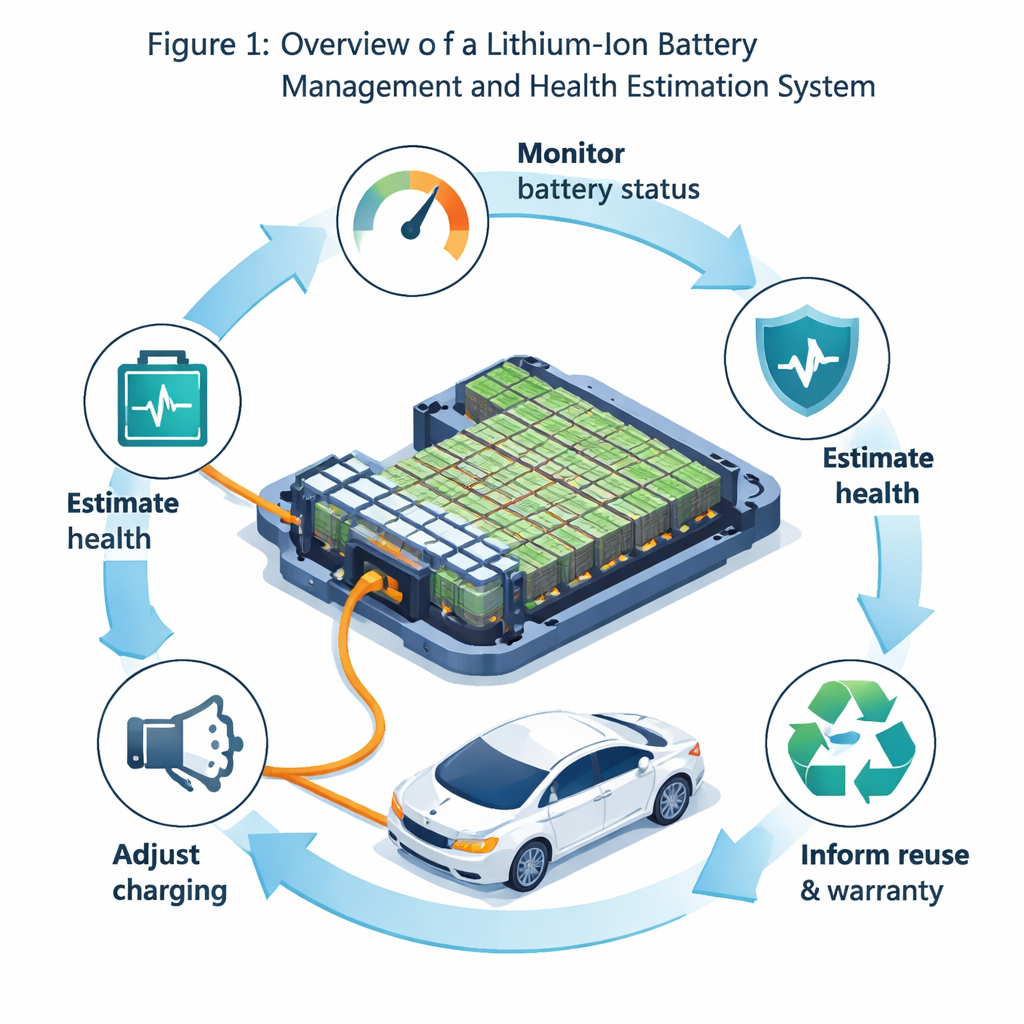
Lithium-ion batteries quietly power our phones, laptops, electric cars, and even parts of the electric grid. But like people, batteries age, and if their health is misjudged, the results can range from annoying loss of range to dangerous failures and fires. This paper introduces a new way to "check the pulse" of batteries using a compact artificial intelligence model that runs fast enough for real-world battery management systems, while estimating battery health with remarkably low error.
Keeping Track of a Battery’s True Condition
Battery packs are overseen by a Battery Management System, or BMS, which continuously watches voltage, current, and temperature to keep everything within safe limits. One of its hardest jobs is estimating State-of-Health (SOH) – essentially, how much useful life a battery has left compared with when it was new. SOH cannot be measured directly during normal use, so it must be inferred from those routine signals. Traditional physics-based models can be accurate, but they tend to be complex, slow, and sensitive to the exact battery design and operating conditions. Data-driven approaches based on machine learning promise more flexibility, yet many powerful deep-learning models are too heavy to run on small, low-power chips inside vehicles or stationary storage systems.
From Raw Signals to Subtle Signs of Aging
The authors start by carefully processing real test data from lithium-ion cells in several well-known research datasets, including NASA’s widely used battery aging experiments. During each charge–discharge cycle, they record voltage, current, and temperature once per second over thousands of cycles. From these raw signals, they extract features that are especially sensitive to aging. For example, they analyze the shape of the voltage curve during constant-current charging and compute incremental capacity curves, which highlight tiny shifts in how much charge flows at each voltage. As batteries wear out, these curves subtly change shape and position, providing a kind of fingerprint of internal degradation. The result is a clean, normalized set of one-dimensional time series that can be fed into a neural network.
A Lean Neural Network Tailored to Battery Signals
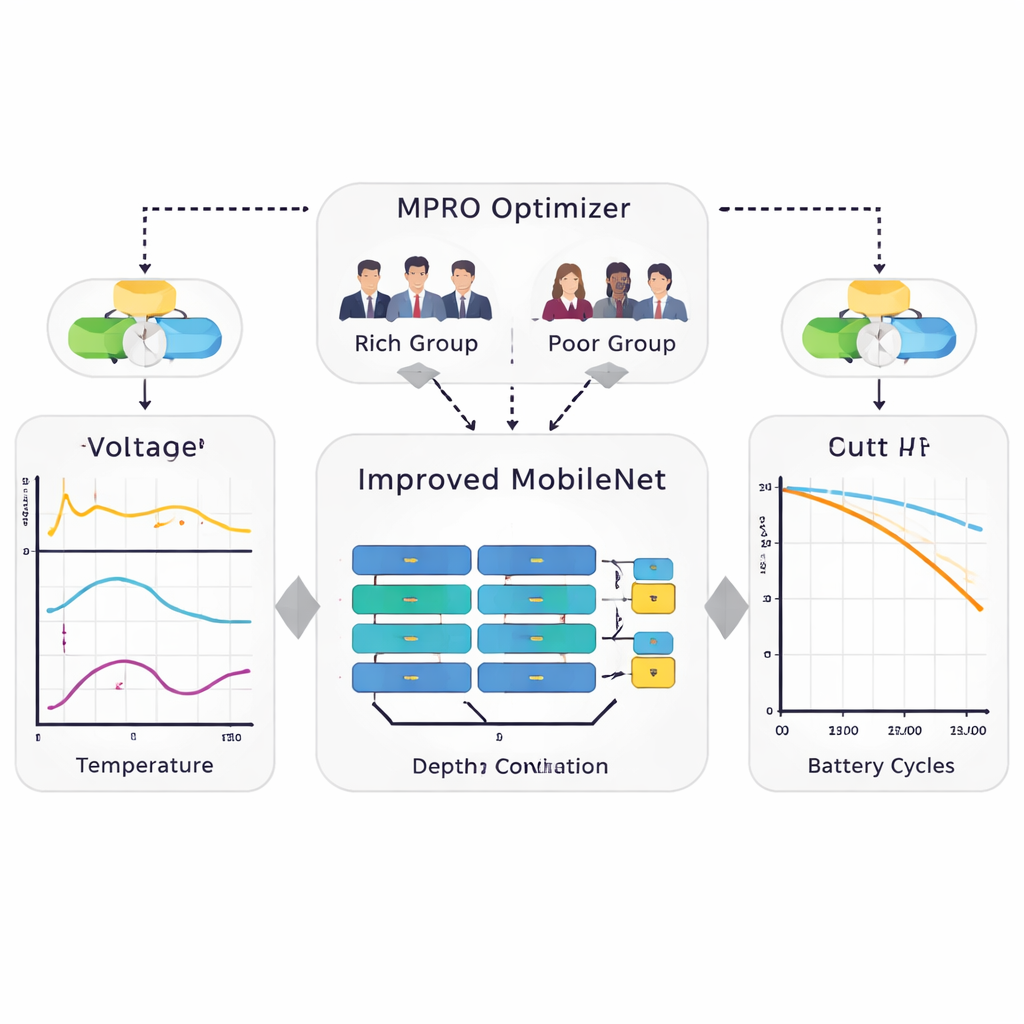
To turn these signals into SOH estimates, the study adapts a family of lightweight image-recognition networks known as MobileNet. Instead of working with pictures, the authors redesign the model around one-dimensional convolutions that scan along time, so it can pick up patterns in how voltages and currents evolve during a charge. They also add small attention blocks called "Squeeze-and-Excitation" units, which help the network focus on the most informative parts of the signal, such as voltage regions that shift noticeably with aging. Finally, they reshape the output so the network predicts a continuous SOH value rather than a category, and they train it to minimize the difference between predicted and true health. Despite these refinements, the model remains small: about 1.1 million parameters and an average prediction time of only a few milliseconds.
Letting an Algorithm Tune the Knobs
Deep learning models have many design choices, or hyperparameters: learning rate, number of filters, dropout strength, and more. Instead of hand-tuning these, the authors use a metaheuristic optimizer called Modified Poor and Rich Optimization (MPRO). Inspired by interactions between wealthier and poorer groups in a society, this algorithm maintains a population of candidate hyperparameter sets and iteratively improves them. The "rich" candidates move away from the "poor" ones, while the "poor" shift toward patterns seen among the successful. The paper enhances this scheme with chaotic mathematical maps that improve exploration of the search space. For each candidate, the MobileNet model is trained and judged by its error on validation data, and MPRO gradually converges on a configuration that balances accuracy and simplicity.
How Well Does It Work in Practice?
Tested on multiple batteries and three independent datasets (NASA, CALCE, and Oxford), the combined MPRO-Improved MobileNet system estimates SOH with an average root-mean-square error of roughly half a percentage point on NASA data, beating several strong alternatives, including larger Transformer-based neural networks, recurrent networks, random forests, and support vector machines. Even the worst individual prediction error remains close to one percentage point, a level of precision that is valuable for managing warranties, planning battery replacement, and avoiding unsafe operation. Importantly, the model keeps this performance while using much less memory and computation than heavier deep-learning methods, making it practical for deployment on embedded BMS hardware in electric vehicles and grid storage systems.
What This Means for Everyday Battery Use
For non-specialists, the key message is that this work shows how a smart but efficient AI can reliably track how "old" a battery really is, using only data that a standard battery system already measures. Better SOH estimates allow car makers and grid operators to stretch battery life safely, schedule maintenance before problems arise, and decide when used batteries are still good enough for a second life in less demanding roles. While the method still needs field testing in noisier, real-world conditions, it marks a step toward battery systems that understand their own condition with near-clinical precision, quietly improving safety, performance, and sustainability behind the scenes.
Citation: Hajlaoui, R., Shalaby, M., Alfilh, R.H.C. et al. An improved MobileNet based on a modified poor and rich optimization algorithm for lithium-ion battery state-of-health estimation. Sci Rep 16, 7689 (2026). https://doi.org/10.1038/s41598-026-38275-3
Keywords: lithium-ion batteries, state of health, battery management systems, deep learning, MobileNet