Clear Sky Science · en
Study on deformation characteristics and support technology of roadway in deep complex stress field
Why deep mine tunnels matter to all of us
Much of the electricity and industrial fuel we rely on still comes from coal mined far below the Earth’s surface. As mines go deeper to reach remaining seams, the tunnels that carry workers, equipment and coal must withstand enormous pressures from the surrounding rock. When that rock deforms or collapses, the result can be costly repairs, lost production, or deadly accidents. This study explores why deep mine roadways in complicated underground layouts deform so severely, and presents a new way to keep these lifelines stable and safe.
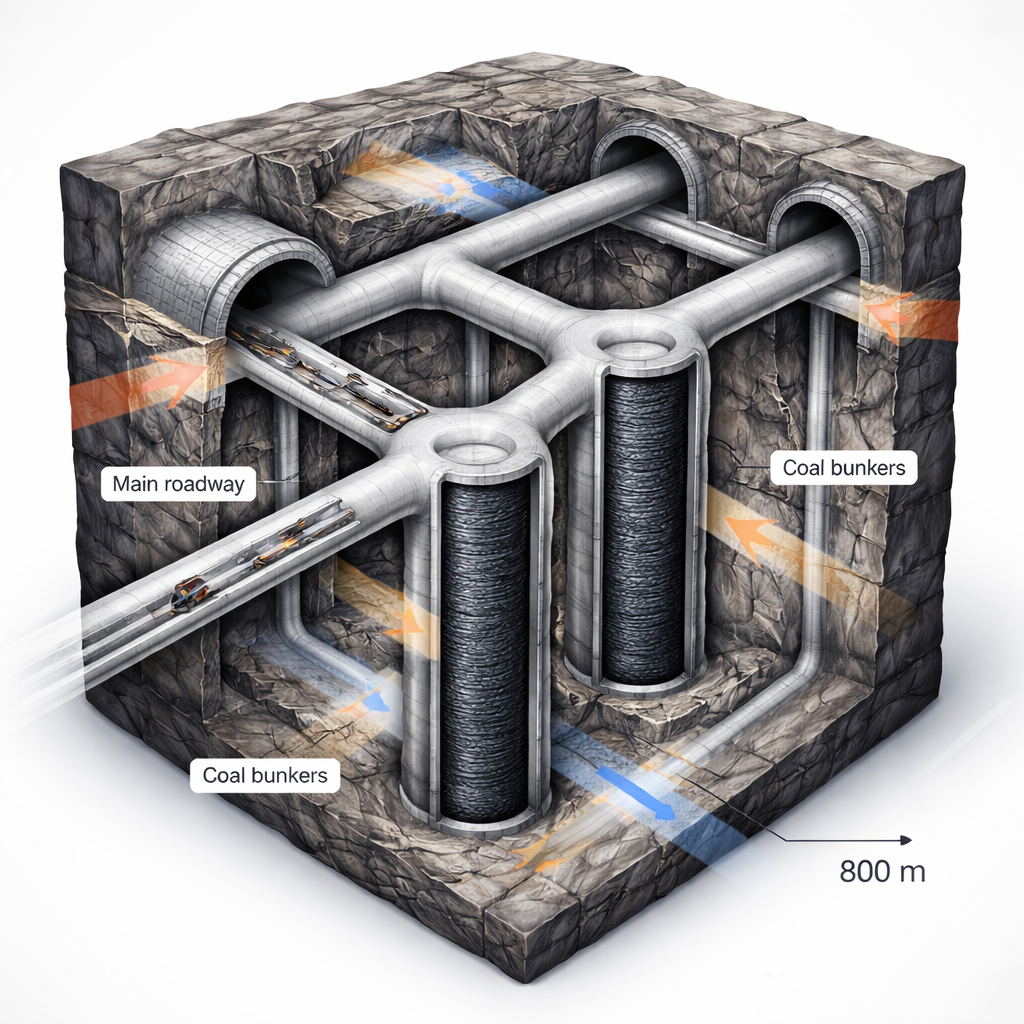
A maze of tunnels under extreme pressure
The researchers focused on a coal mine where the main tunnels lie more than 800 meters underground and form a three-dimensional maze. Track roadways, belt roadways, storage bunkers, and connecting passages intersect at many angles and in different sizes. These crossings, especially large ones nicknamed “bull-nose” sections, disturb the natural stress in the surrounding rock. Instead of a simple, even squeeze on a straight tunnel, the rock at intersections experiences overlapping pushes and pulls from several directions, making it much harder to predict and control.
How and where the rock starts to fail
To understand this hidden behavior, the team built a detailed three-dimensional computer model of the mine’s tunnel network and rock layers. They simulated the process of cutting out each roadway and watched how the rock responded. The model revealed “plastic zones” – regions around the tunnels where the rock has been pushed beyond its strength and begins to deform permanently. In straight sections of tunnel, these damaged zones were a few meters thick. But at complex intersections, the weakened areas from different tunnels overlapped and expanded, reaching depths of up to 6.6 meters into the rock. This “superposition expansion” means the rock arch that should carry the load becomes much thicker, looser and harder to control.
Stress patterns that drive tunnel deformation
Beyond simply mapping damage, the researchers examined how the shape of the stress field changes around the tunnels. They focused on a measure called deviatoric stress, which captures how much the rock is being distorted in shape rather than just squeezed. In simple, straight tunnels, high deviatoric stress formed two crescent-shaped zones on either side of the opening, close to the wall. At intersections, however, these crescents widened, shifted deeper into the rock, and became strongly uneven from side to side. Where peak deviatoric stress rose, the plastic (damaged) zone also thickened. The study quantified this link: when this stress exceeded about 12.6 megapascals, the damaged zone grew to the full 6.6 meters. In practical terms, the places where tunnels cross are exactly where the rock is most likely to crack, deform and threaten support systems.
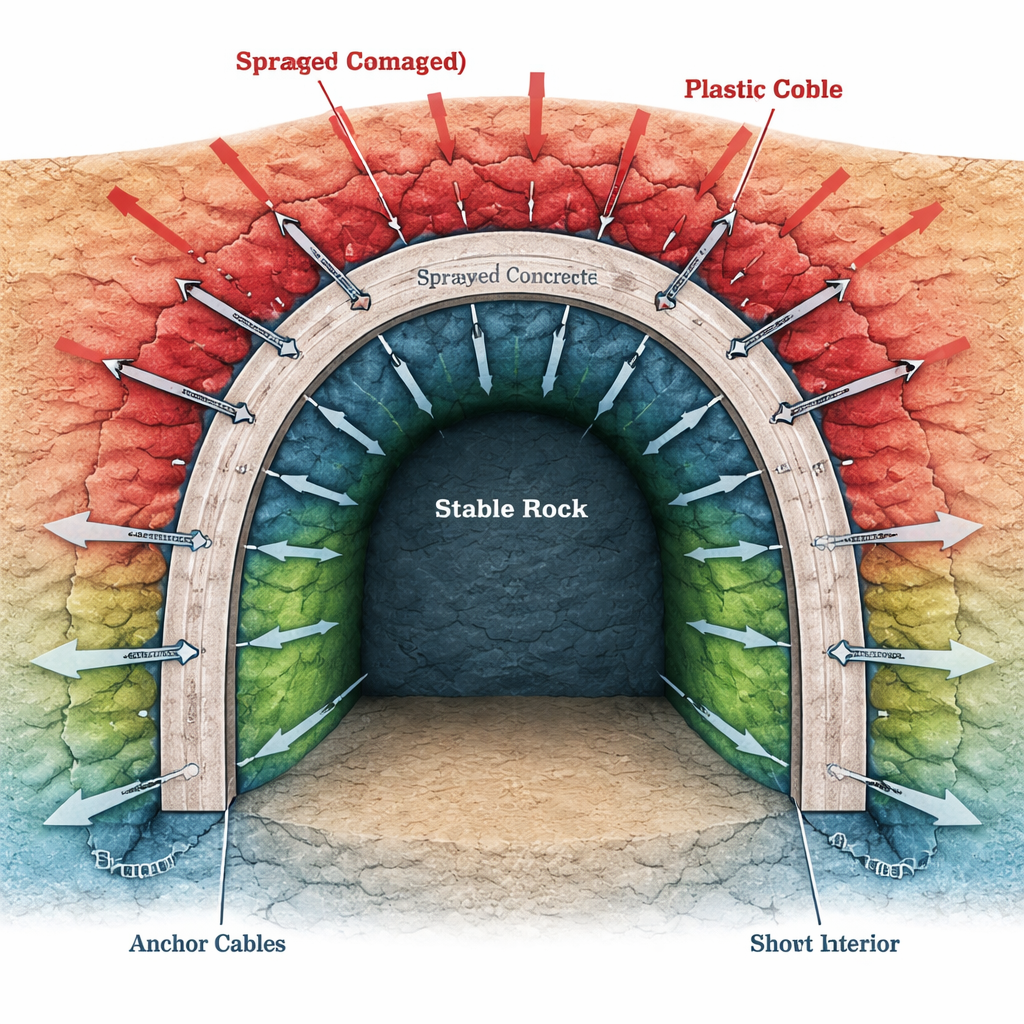
A three-step support strategy for safer tunnels
Recognizing that traditional single-layer supports could not cope with such conditions, the authors designed a new “collaborative” support system tailored to deep, complex tunnel networks. First, the freshly excavated rock is quickly sealed with a sprayed concrete layer, followed by short bolts to lock the shallow rock together, then more concrete. Second, long anchor cables are installed in a staggered pattern that reaches beyond the 6.6-meter damaged zone into more stable rock, creating overlapping pressure arches that help the rock and support act as one. Finally, high-pressure grouting injects cement slurry into cracks, binding broken rock and improving contact between rock and anchors. This staged, multi-layered approach is timed to match how the rock fails – from early surface cracking to deeper shear damage – so that each layer reinforces the next.
Real-world results in a working mine
The new system was tested in the same deep mine that provided the case study. The team monitored how much the roofs, floors and walls of key tunnels moved over several months, and measured the loads in the anchor cables. Compared with the mine’s previous support design, the combined deformation of the roof and floor dropped by roughly half, and sidewall convergence decreased by a similar amount. The time needed for the tunnels to reach a stable shape was cut to about 45 days, and the forces in the cables stayed well below their safe limits. To a lay reader, the takeaway is that carefully designed, multi-layer support can turn a dangerously unstable deep tunnel network into a manageable, long-lasting structure – improving safety for miners and reliability for the energy systems that depend on these underground routes.
Citation: Li, Sj., Lu, Wy., Ma, Xc. et al. Study on deformation characteristics and support technology of roadway in deep complex stress field. Sci Rep 16, 7373 (2026). https://doi.org/10.1038/s41598-026-38267-3
Keywords: deep underground mining, tunnel stability, rock support systems, coal roadway engineering, underground stress field