Clear Sky Science · en
Experimental investigation and optimization of mechanical and tribological performances of bio-based sustainable hybrid composites incorporating Nano-SiO₂ fillers
Why greener materials matter
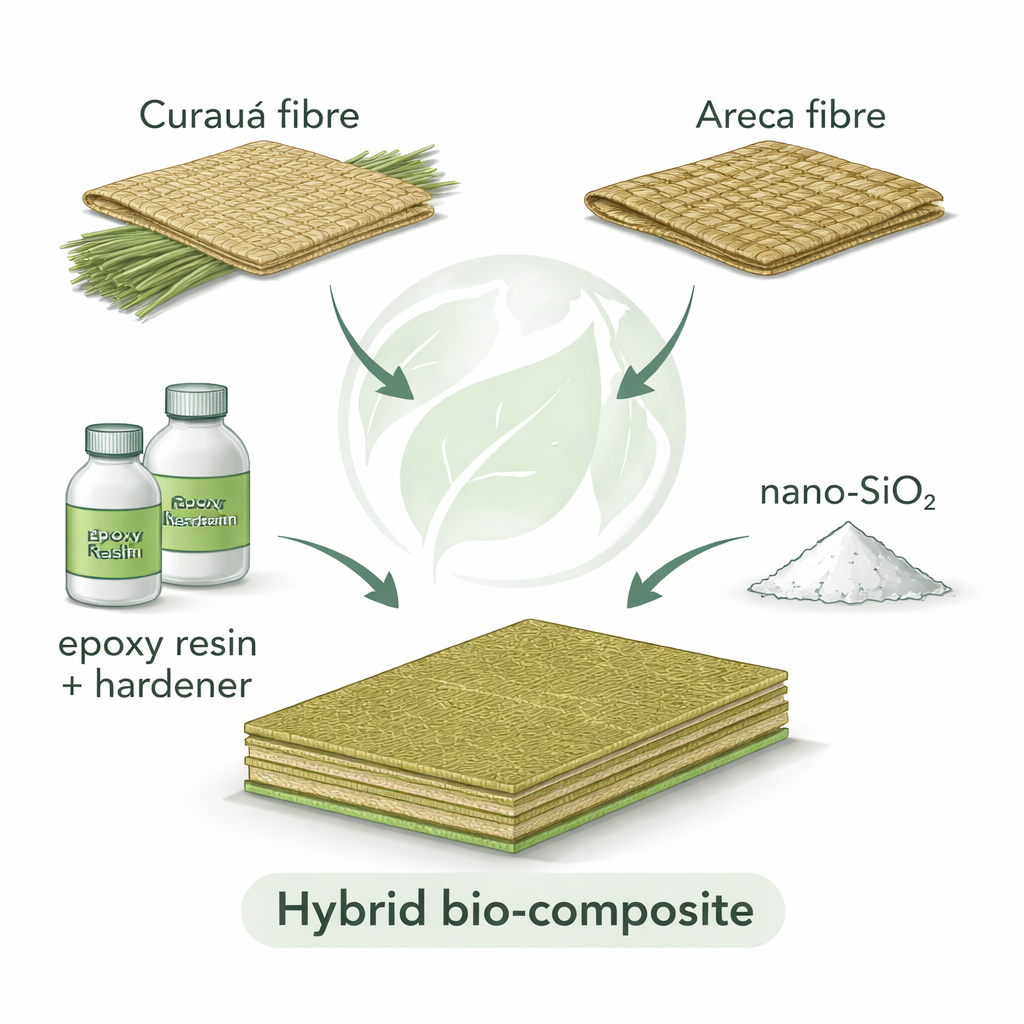
Cars, buildings, and machines are usually made with composites that rely on fossil-fuel–based fibres like glass and carbon. These materials are strong, but they are not kind to the planet. This study explores a cleaner alternative: a new composite made from two plant fibres, Curauá and Areca, held together with an epoxy glue and strengthened with tiny particles of silica (the main ingredient in sand). The goal is to see whether such a bio-based material can be tough enough and wear-resistant enough to replace traditional composites in real-world parts.
Plant fibres as building blocks
Curauá and Areca are natural fibres from tropical plants. Curauá is known for being very strong and stiff, thanks to its high cellulose content, while Areca fibres are tougher and better at absorbing energy. By combining them, the researchers created a “hybrid” fabric that aims to blend strength and toughness. These fibre mats were layered together and soaked with an epoxy resin that hardens into a solid plastic, forming thin panels. The team then added nano-sized particles of silicon dioxide (nano-SiO₂) to the resin to act like microscopic stones that can fill gaps, stiffen the surface, and improve resistance to scratching and wear.
Cleaning and tuning the fibres
Before making the panels, the fibres were given an alkali wash using sodium hydroxide (NaOH). This treatment strips away natural waxes and other surface impurities, roughening the fibre surface so the epoxy can grip it better. The scientists carefully varied three key factors: how long the fibres were treated, how much Curauá versus Areca was used, and how much nano-SiO₂ was added. They then tested how the panels behaved when pulled, bent, hit, and rubbed against a spinning metal disc. To avoid endless trial-and-error, they used a statistical tool called response surface methodology to find the best combination of settings with a limited number of experiments.
Finding the sweet spot for strength
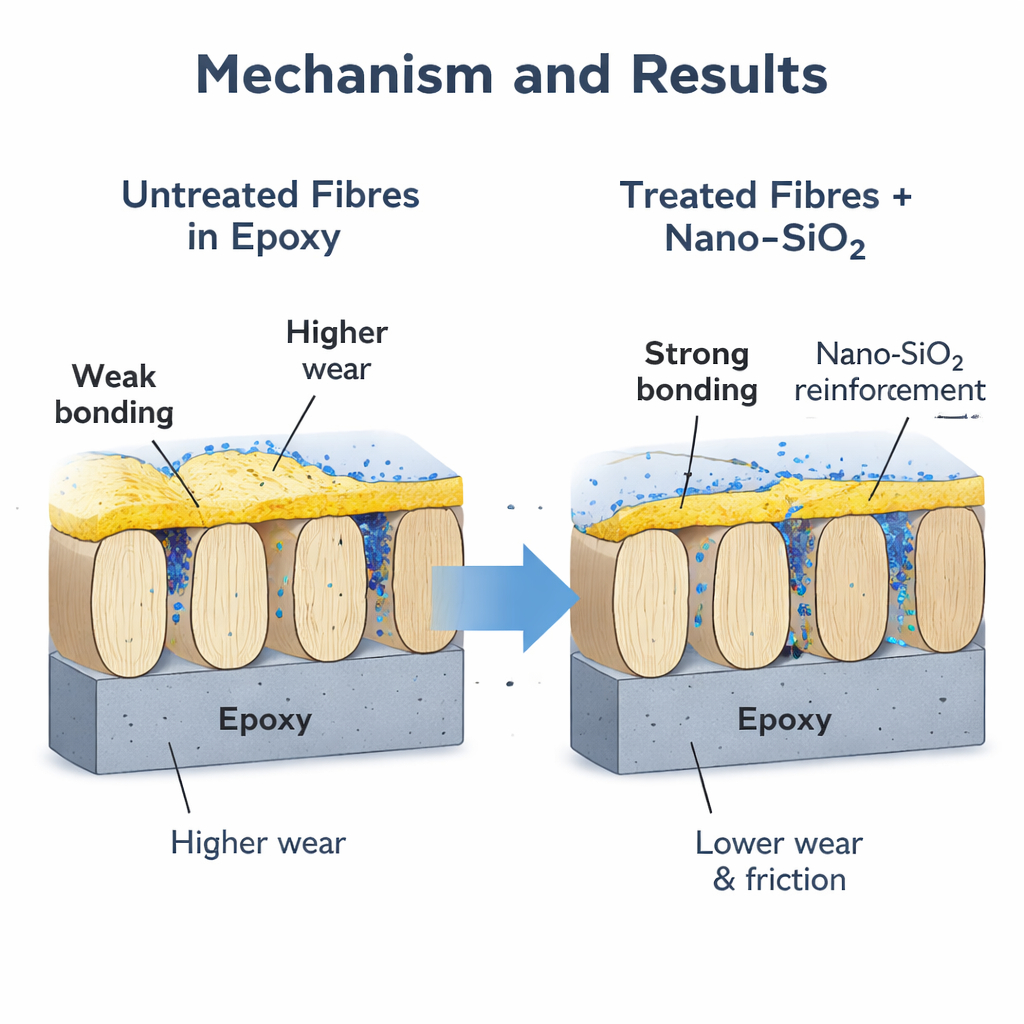
The panels with more Curauá fibre turned out to be stronger in tension and bending, because Curauá carries loads better than Areca. Panels richer in Areca, on the other hand, were slightly better at soaking up impact energy, reflecting its more flexible nature. The NaOH wash clearly helped: treated fibres bonded more tightly to the epoxy, so instead of sliding out when loaded, they tended to break, which is a sign of better stress transfer. Adding nano-SiO₂ improved performance up to about 3–4 percent by weight. At this level the particles were well spread, helping to bridge tiny cracks and harden the surface. Beyond that, they clumped together into weak spots, which actually reduced strength and toughness.
How the material behaves under friction
When the composite pins were pressed and slid against a metal disc, panels with higher Curauá content and well-dispersed nano-SiO₂ wore down more slowly and slid more smoothly. The best combination—67 percent Curauá in the fibre mix, 24 hours of NaOH treatment, about 3.75 percent nano-SiO₂, and a modest load of 10 newtons—gave a very low wear rate and a reduced coefficient of friction. Microscopic images backed this up: poorly optimized panels showed gaps between fibre and resin, pulled-out fibres, and deep grooves, while optimized panels showed tight bonding, fewer broken-out fibres, smoother tracks, and a thin protective film formed during sliding.
What this means for everyday products
Under the best conditions, the new bio-based composite reached strengths and wear resistance that make it a realistic candidate for practical parts, such as lightweight interior car panels, wear-resistant bushings, brake or clutch surfaces, and structural elements in sustainable buildings. Put simply, by carefully cleaning the plant fibres, blending the right mix of Curauá and Areca, and adding just enough nano-sized silica, the researchers built a greener material that is strong, tough, and slow to wear out. This work shows a promising path toward replacing some conventional, fossil-fuel–based composites with high-performing, plant-derived alternatives.
Citation: Velmurugan, G., Chohan, J.S., Maranan, R. et al. Experimental investigation and optimization of mechanical and tribological performances of bio-based sustainable hybrid composites incorporating Nano-SiO₂ fillers. Sci Rep 16, 7288 (2026). https://doi.org/10.1038/s41598-026-38263-7
Keywords: natural fibre composites, bio-based materials, nano silica reinforcement, wear-resistant polymers, sustainable engineering