Clear Sky Science · en
Effect of fins in enhancing phase change material fusion in a spherical thermal energy storage container
Storing Sunshine for Later
Modern life runs on steady energy, yet sunshine arrives only when the sky cooperates. This study explores a simple way to store daytime solar heat so it can be used hours later, using a special wax that melts and solidifies inside metal balls. By adding thin metal “fins” in just the right places, the researchers show they can make this wax charge and discharge heat much faster, a key step toward more reliable solar-powered heating and hot water.
Why Heat Storage Matters
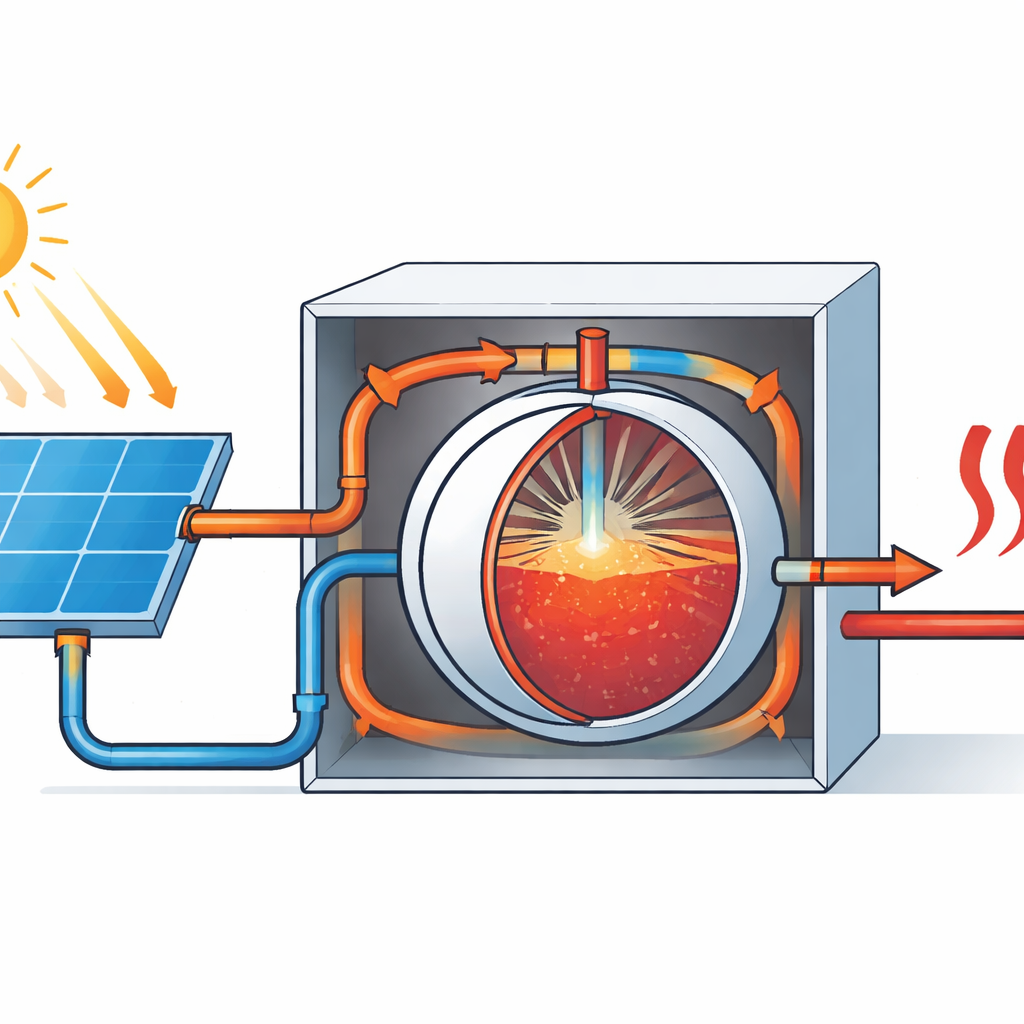
Solar collectors can warm water to comfortable temperatures, but clouds, sunset, and daily demand do not follow the same schedule. Thermal energy storage offers a buffer: it absorbs heat when the sun is strong and releases it when needed. A popular approach uses phase change materials—substances like paraffin wax that absorb a lot of energy as they melt and give it back as they freeze again, all around a nearly constant temperature. The catch is that such waxes conduct heat poorly, so without help they melt and solidify slowly, limiting how much useful heat can move in and out each day.
A Spherical Box of Wax
The team built a laboratory thermal storage system that mimics what might sit inside a solar water heater. At its heart are steel spheres about the size of a small melon, each filled with one kilogram of paraffin wax that melts near 60 °C, a good match for solar-heated water. Hot water, acting as a heat-transfer fluid, circulates around these spheres at two temperatures, 70 °C and 75 °C, while sensors track temperatures at the top, bottom, center, and sides inside the wax. By comparing how quickly the wax melts and re-solidifies, and how much heat flows in and out, the researchers evaluate different design options for the spheres.
Four Ways to Add Metal Fins
To help the wax exchange heat more quickly, the spheres can be fitted with copper fins—thin blades that conduct heat from the hot water through the steel shell and deep into the wax. The study compares four cases: a smooth sphere with no fins; a sphere with two fins penetrating from the top; one with two fins from the bottom; and a final version with four fins, two at the top and two at the bottom. In all cases, the fins run both outside and inside the sphere, so they touch the flowing water and the wax at the same time. This arrangement lets the fins act like heat highways, reducing cold pockets of solid wax that would otherwise linger far from the warm surface.
What Happens Inside as Wax Melts and Freezes
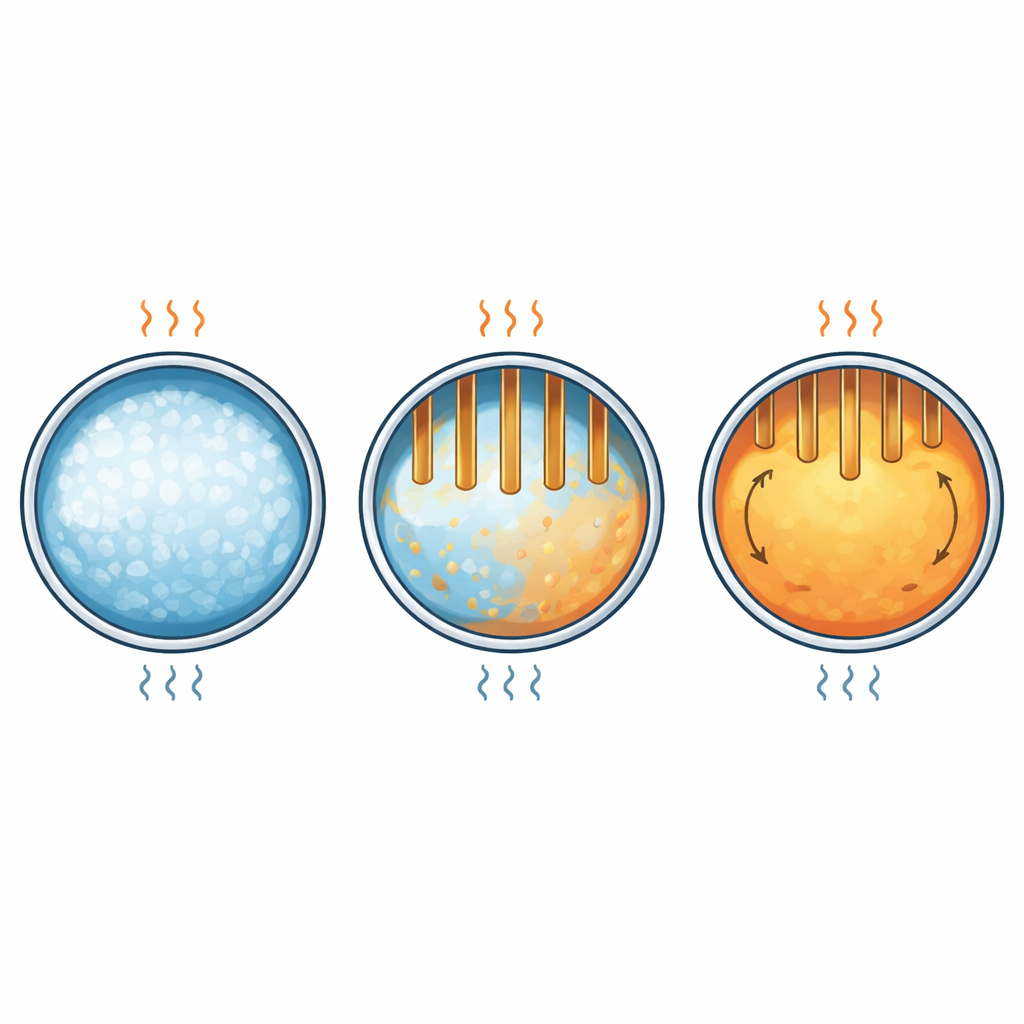
As heating begins, the wax near the sphere’s outer wall melts first. The resulting warm liquid wax is lighter and rises toward the top, while colder, heavier solid wax sinks, setting up slow circulation that further spreads the heat. During cooling, the process reverses: wax solidifies at the wall, and the denser solid settles toward the bottom. The researchers find that this natural motion alone is not enough; without fins, large regions of wax remain solid or liquid for a long time. Adding fins at the top speeds up melting near the region where liquid collects, while fins at the bottom attack the solid layer that tends to settle there. When fins are placed at both top and bottom, heat reaches all key regions, and the fraction of melted wax climbs and then falls much more steeply over time, showing faster charging and discharging.
Faster Charging and Discharging
Detailed measurements show that the top-and-bottom fin design clearly outperforms the others. Compared with the smooth sphere, it cuts melting time by about one-third and solidification time by nearly half, while maintaining similar overall heat capacity because the same amount of wax is used. It also delivers the highest efficiency and effectiveness, meaning a larger share of the incoming heat ends up stored in the wax and then recovered. Raising the water temperature from 70 °C to 75 °C further boosts melting speed, but the fin placement remains the dominant factor in performance.
What This Means for Everyday Systems
For non-specialists, the key takeaway is that small design tweaks inside a heat-storage capsule can have big real-world consequences. By simply positioning a few metal fins at both the top and bottom of a spherical wax-filled container, engineers can build thermal batteries that charge and discharge much more quickly without sacrificing how much heat they can hold. Such improved capsules could be packed into solar water heaters, building heating systems, or industrial heat-recovery units, helping smooth out the ups and downs of sunshine and making renewable heat more dependable.
Citation: Swami Punniakodi, B.M., Veeramanikandan, M., Manickam, M. et al. Effect of fins in enhancing phase change material fusion in a spherical thermal energy storage container. Sci Rep 16, 8440 (2026). https://doi.org/10.1038/s41598-026-38262-8
Keywords: thermal energy storage, phase change material, solar water heating, heat transfer fins, paraffin wax