Clear Sky Science · en
Utilizing deep learning models for early detection and classification of fruit diseases: towards sustainable agriculture and enhanced food quality
Why spotting sick fruit early matters
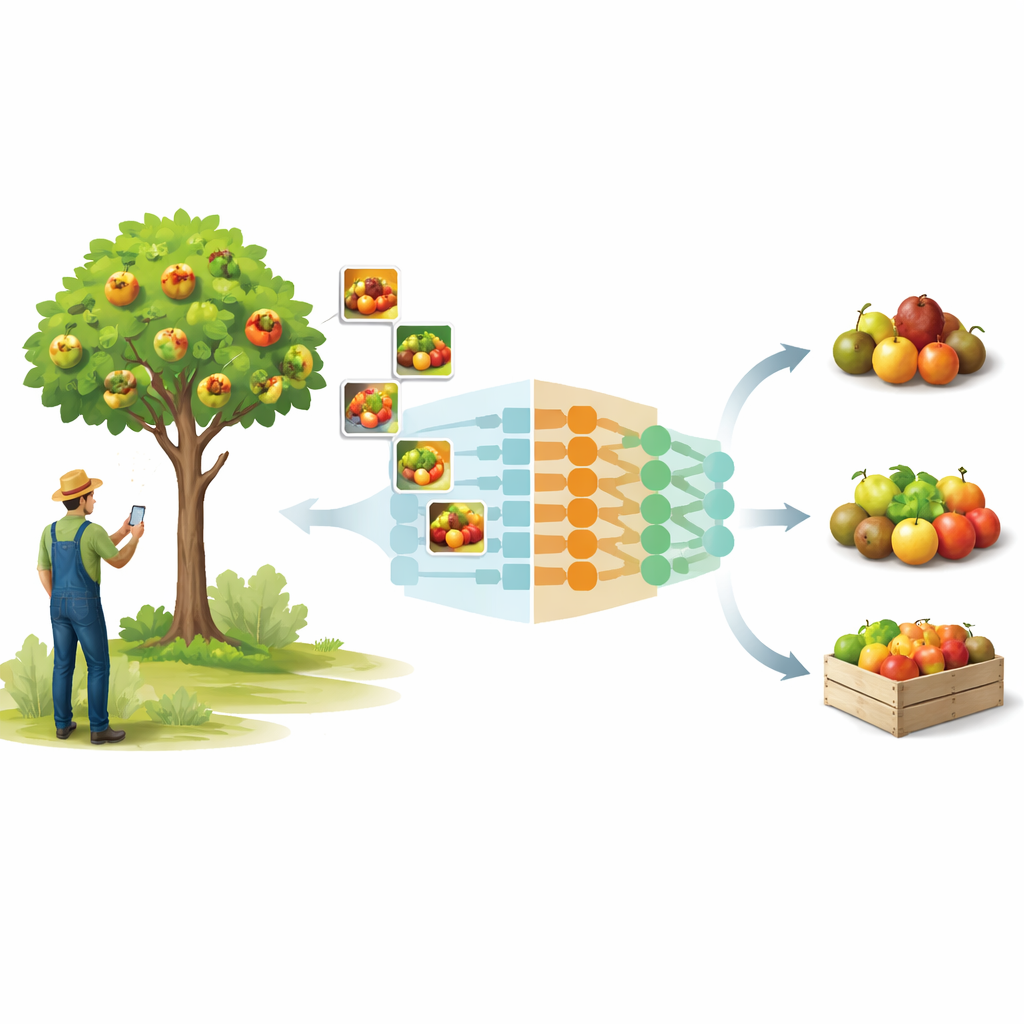
Bruised, blotchy fruit is more than a cosmetic problem—it can signal plant diseases that slash harvests, waste water and chemicals, and quietly raise food prices. Around the world, farmers still rely mostly on the naked eye to judge which fruits are healthy, a slow and error-prone process. This study explores how modern artificial intelligence can turn simple photos of fruit into an early-warning system, helping farmers protect crops, cut losses, and deliver better-quality food.
From smartphone photos to smart fields
The researchers set out to build tools that can automatically recognize diseases on common fruits just by analyzing pictures of leaves and fruits. They focused on six widely grown crops—apples, grapes, mangoes, bananas, guavas, and oranges—and collected thousands of images showing both healthy and diseased specimens. By teaching computers to distinguish subtle spots, discolorations, and texture changes long before a human might notice them, the goal is to give farmers rapid, objective feedback about plant health in the field.
Teaching computers to read fruit "fingerprints"
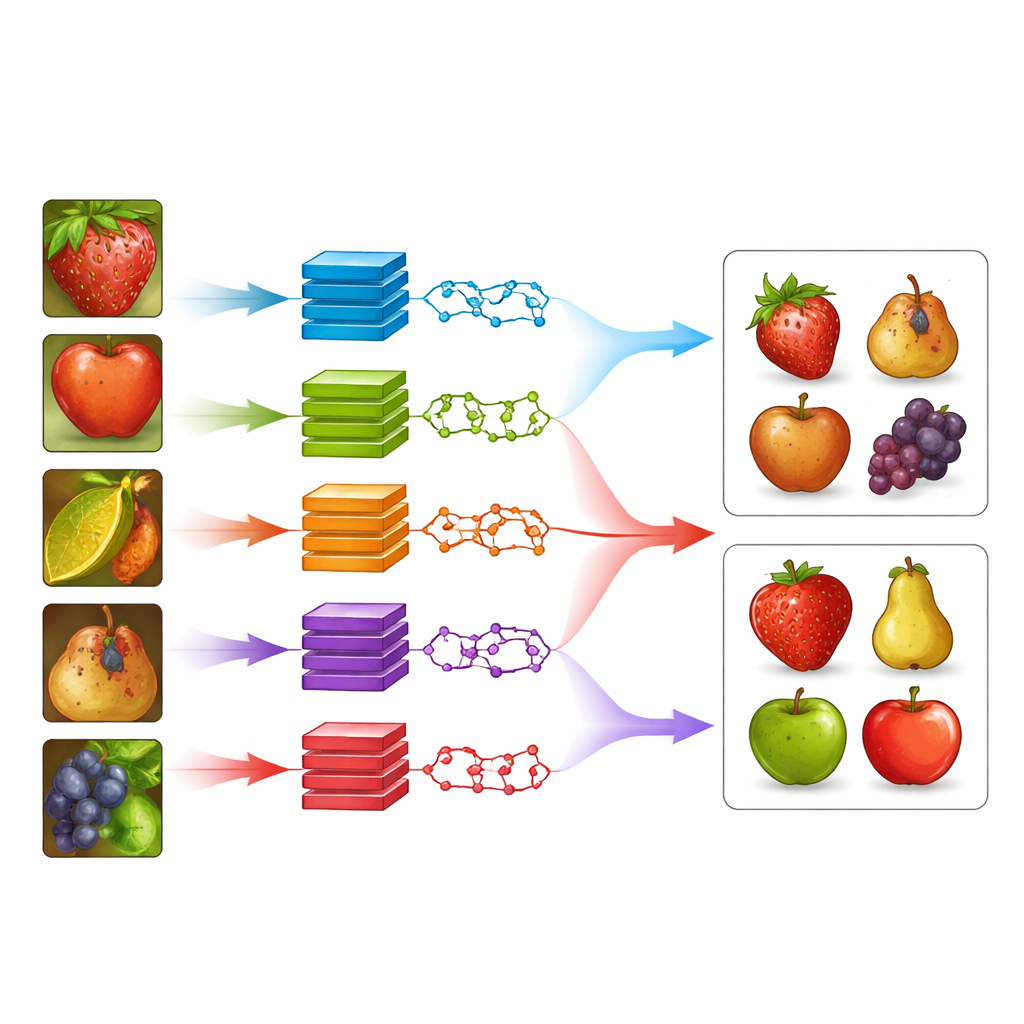
To do this, the team used deep learning, a branch of artificial intelligence that excels at finding patterns in images. Instead of hand-coding rules such as “look for brown circles,” they trained five different neural network designs—known as CNN, DenseNet121, EfficientNet B3, Xception, and ResNet50—to learn directly from the picture data. Before training, they cleaned and prepared the images: resizing them, correcting colors, and using tricks like rotation and flipping to create extra training examples. This image “grooming” step helps the models learn the important visual fingerprints of disease while ignoring distractions like background clutter or lighting changes.
Six fruits, many diseases, one core approach
The same overall recipe was applied across six separate case studies, each centered on a specific fruit and its key diseases. For example, orange images included healthy fruit as well as cases of citrus canker, black spot, and greening. Grapes had categories such as black rot and leaf blight; mangoes and guavas covered a wider range of problems; bananas and apples focused on several major leaf and fruit infections. For each fruit, the researchers trained all five deep learning models, then measured how accurately each one could sort new, unseen images into the correct disease category or “healthy.” This allowed a fair comparison of which designs were most reliable and efficient in realistic conditions.
How well the digital inspectors performed
The digital fruit doctors proved remarkably accurate. In many tests, the best models correctly classified more than 95 out of 100 images. A model called EfficientNet B3 stood out, reaching about 99% accuracy for grape and apple diseases while using computing resources efficiently. ResNet50 performed especially well for mango and guava, and a simpler CNN worked best for oranges. Even in harder cases, such as complex banana or guava datasets, at least one model still reached over 94–96% accuracy. The study also compared these results with earlier research and found that their carefully tuned models, boosted by thoughtful image preparation, generally matched or outperformed previous approaches.
What this means for farms and food
For farmers, these results suggest that a camera and a trained deep learning model could soon act like an always-on plant-health assistant, flagging problems early enough to save trees and vines rather than just salvaging what is left. Early, accurate detection makes it easier to treat only the plants that truly need attention, reducing wasted pesticides and preserving soil and water. Over time, such systems could support more sustainable agriculture—higher yields, less waste, and better-quality fruit in markets—by turning everyday images into fast, trustworthy health checks for our food crops.
Citation: Alrashdi, I., Sharawi, M., Ali, A.M. et al. Utilizing deep learning models for early detection and classification of fruit diseases: towards sustainable agriculture and enhanced food quality. Sci Rep 16, 8167 (2026). https://doi.org/10.1038/s41598-026-38259-3
Keywords: fruit disease detection, deep learning in agriculture, plant health monitoring, computer vision, sustainable farming