Clear Sky Science · en
ResNet18-ThunderSVM: Hybrid intelligence for handwritten digit recognition by fusing deep spatial features and high-performance classification
Why teaching computers to read handwriting matters
Every time a bank processes a check, a teacher grades a scanned test, or your phone turns scribbles into digital text, a hidden system must correctly read messy human handwriting. Getting machines to do this quickly and accurately saves time, cuts costs, and reduces human error. This paper presents a new way to recognize handwritten digits that aims to be both highly accurate and fast enough for real-world use, even on devices with limited computing power.
Blending two strengths into one smarter system
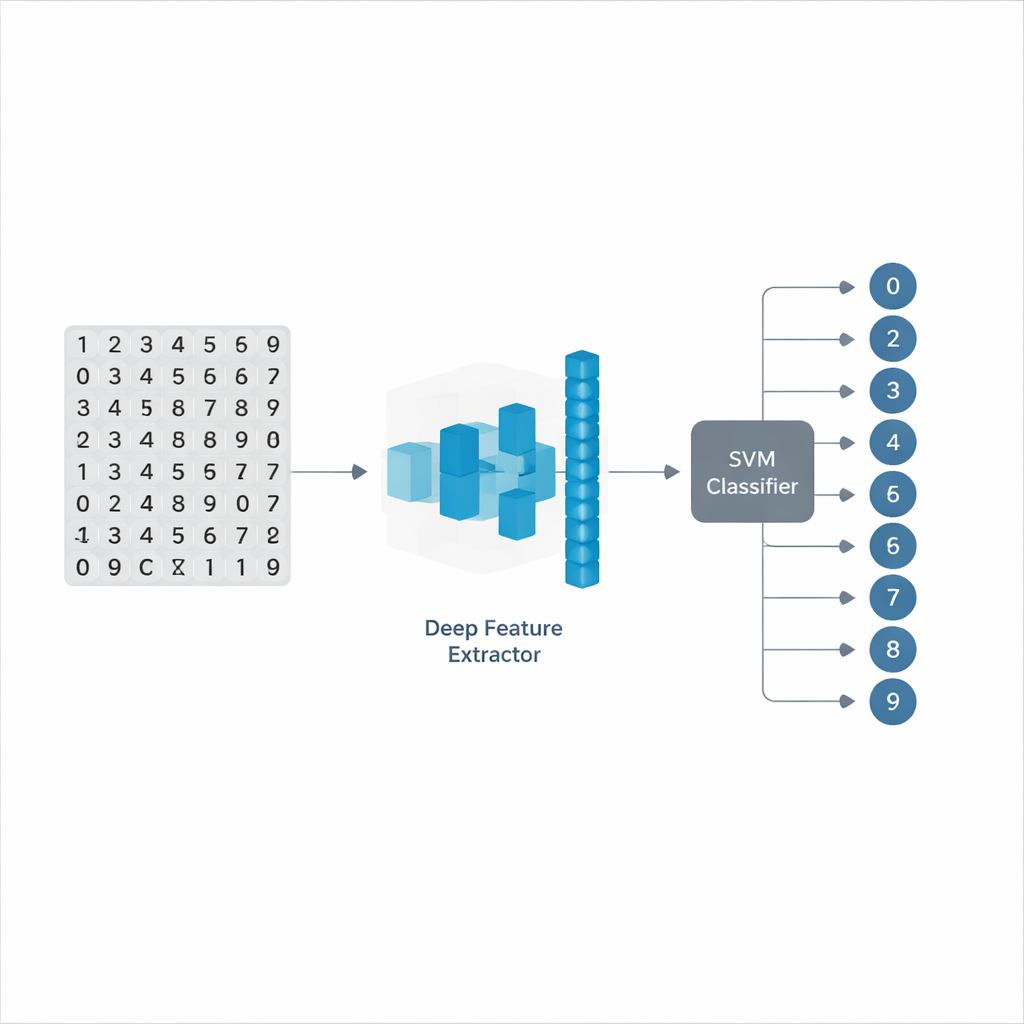
The researchers combine two different types of artificial intelligence into a single “hybrid” model they call ResNet18-ThunderSVM. The first part, ResNet18, is a deep neural network that is very good at automatically discovering patterns in images, such as strokes, curves, and shapes in handwritten numbers. The second part, ThunderSVM, is a fast, GPU-accelerated version of a classic machine learning method known for strong, stable decisions once good features are available. By letting ResNet18 handle the heavy lifting of feature discovery and then passing its distilled information to ThunderSVM for the final decision, the system aims to get the best of both worlds: rich understanding of images and efficient, reliable classification.
From raw pixels to confident decisions
Handwritten digits in this study come from four popular image collections: MNIST, EMNIST, USPS, and Fashion-MNIST. These datasets include simple digits, letters, postal-style writing, and small pictures of clothing items, offering a range of difficulty. All images are resized and normalized so their brightness falls within a stable range, helping the neural network learn more smoothly. ResNet18, fine-tuned rather than left frozen, gradually transforms each 2D image into a compact 512-number fingerprint that captures the most important visual details. This fingerprint is then gently scaled to keep its values well behaved and fed into ThunderSVM, which learns how to separate different digits using efficient mathematical rules called kernels.
How the new approach stacks up
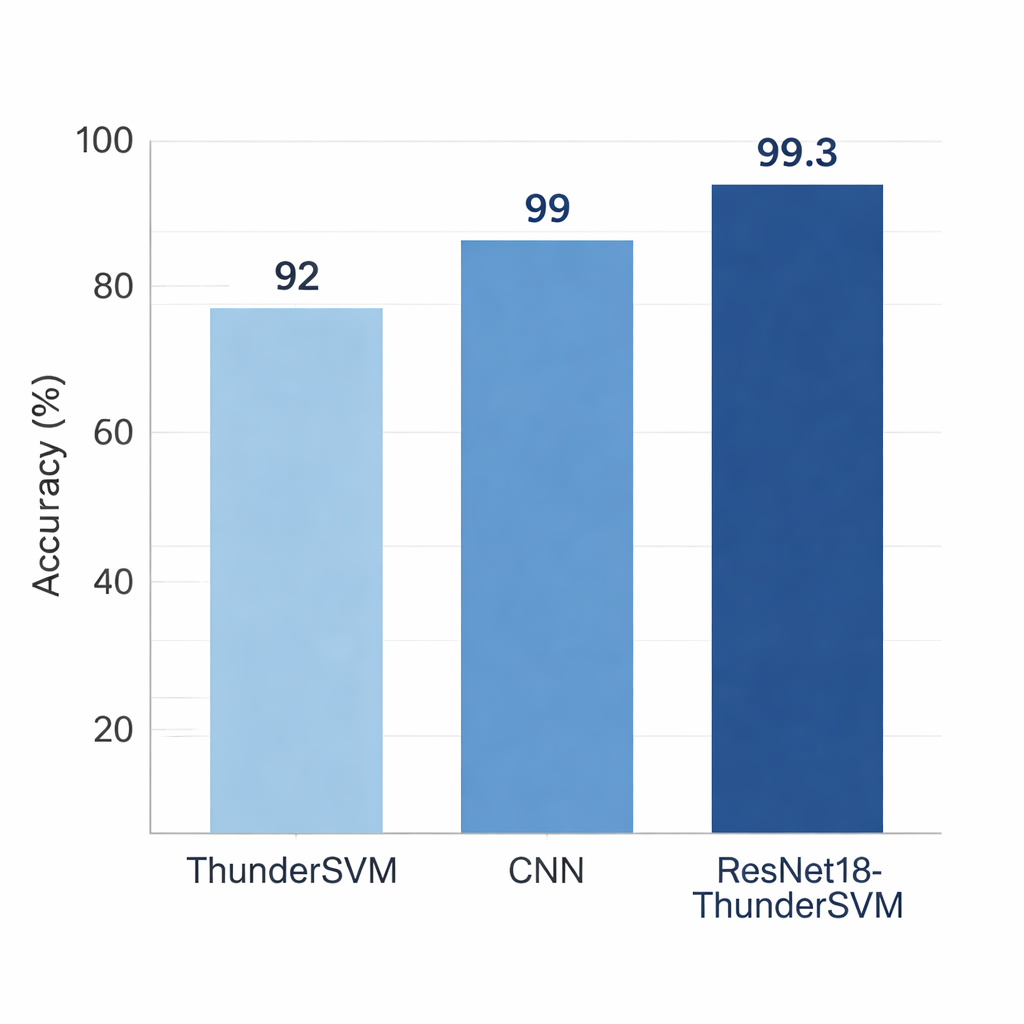
The authors compare their hybrid model with both traditional methods and many deep learning systems on the well-known MNIST digit dataset. Older approaches such as decision trees, random forests, and basic SVMs work reasonably well on small problems but fall short when digits vary in style or when the data scale grows. Pure deep networks like standard convolutional models, VGG16, and MobileNet perform much better but can require more training time or many more internal parameters. ResNet18-ThunderSVM reaches about 99.3% accuracy—near the very top—while using a moderate number of parameters and keeping processing speed high. It converges faster than a standalone ResNet18 classifier and clearly outperforms ThunderSVM that relies only on hand-crafted features.
Holding up under noise and new conditions
Real-world handwriting is often smudged, tilted, or written in unfamiliar styles. To mimic these challenges, the team tests their model on datasets with different writing habits and adds artificial “noise” to some images. Across EMNIST letters, USPS postal digits, and Fashion-MNIST clothing items, the hybrid model consistently beats both plain ThunderSVM and a strong CNN-based hybrid. Its accuracy drops less when noise is introduced, showing stronger robustness. The researchers also measure how long each part of the system takes and how much memory it uses. ResNet18-ThunderSVM is slower and heavier than the lightest networks but far more efficient than very deep models, striking a practical balance between speed, size, and accuracy.
What this means for everyday technology
For a non-specialist, the key message is that careful pairing of modern deep learning with classic machine learning can make computers better and more efficient at reading handwriting-like images. Instead of hand-crafting features or relying on huge end-to-end networks, this hybrid pipeline lets a smart vision front end feed a lean but powerful decision engine. The result is a system that reads digits extremely well, adapts better to new or noisy data, and remains suitable for devices that cannot afford massive models. This approach could be extended beyond digits to medical scans, traffic scenes, and other visual tasks where accuracy, speed, and limited computing resources must all be balanced.
Citation: Zhang, C., Tu, C., Wang, Z. et al. ResNet18-ThunderSVM: Hybrid intelligence for handwritten digit recognition by fusing deep spatial features and high-performance classification. Sci Rep 16, 7701 (2026). https://doi.org/10.1038/s41598-026-38258-4
Keywords: handwritten digit recognition, deep learning, support vector machines, hybrid models, image classification