Clear Sky Science · en
Single-station analysis of Campi Flegrei (Italy) seismic signals using multiscale entropy and unsupervised learning
Why this restless Italian volcano matters
Just west of Naples lies Campi Flegrei, a vast volcanic crater ringed by busy neighborhoods and home to more than two million people. Although it has not erupted since the 1500s, the ground there is rising, gas is leaking out, and small earthquakes are becoming more frequent. Keeping watch on such a restless volcano is vital, but the sheer volume of noisy seismic data makes it hard for human experts to spot subtle warning signs in time. This study explores how a form of artificial intelligence can listen to a single seismic station and automatically pick out unusual behavior that might flag changes in the volcano’s state.
Listening to a noisy volcano with one ear
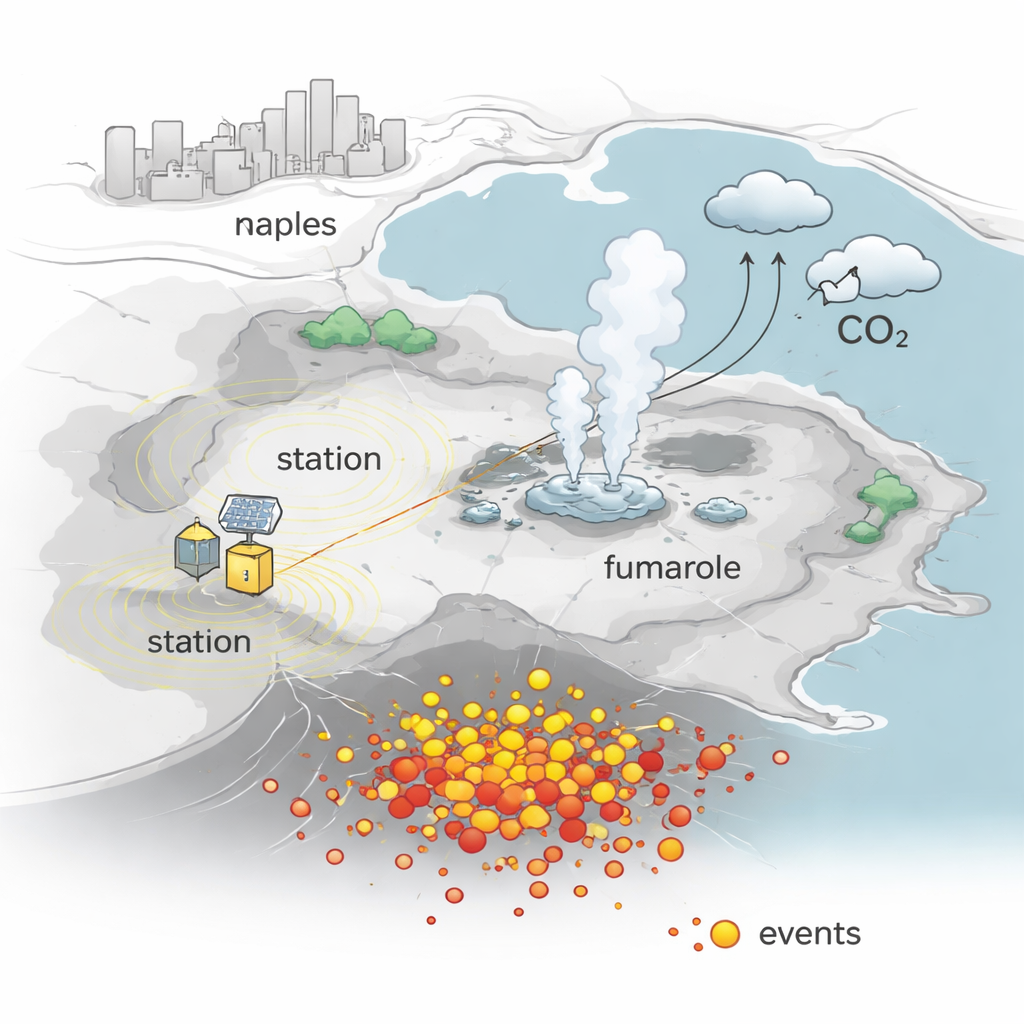
Campi Flegrei is a collapsed volcanic crater, or caldera, roughly 12 kilometers across, overlapping the western districts of Naples and the coastal town of Pozzuoli. Since the 1950s, the area has cycled through quiet periods and unrest, marked by ground uplift, swarms of small quakes, and changes in the hot gases escaping from vents. In the Pisciarelli area, one of the most active zones, a seismic station sits only about 50 meters from a roaring fumarole and bubbling mud pool. This location is ideal for sensing tiny tremors linked to gas and hot water moving underground, but it is also plagued by continuous background noise. The authors set out to determine whether a single such station, analyzed with smart algorithms, could reliably distinguish meaningful signals from the constant volcanic rumble.
Teaching a neural map to sort volcanic signals
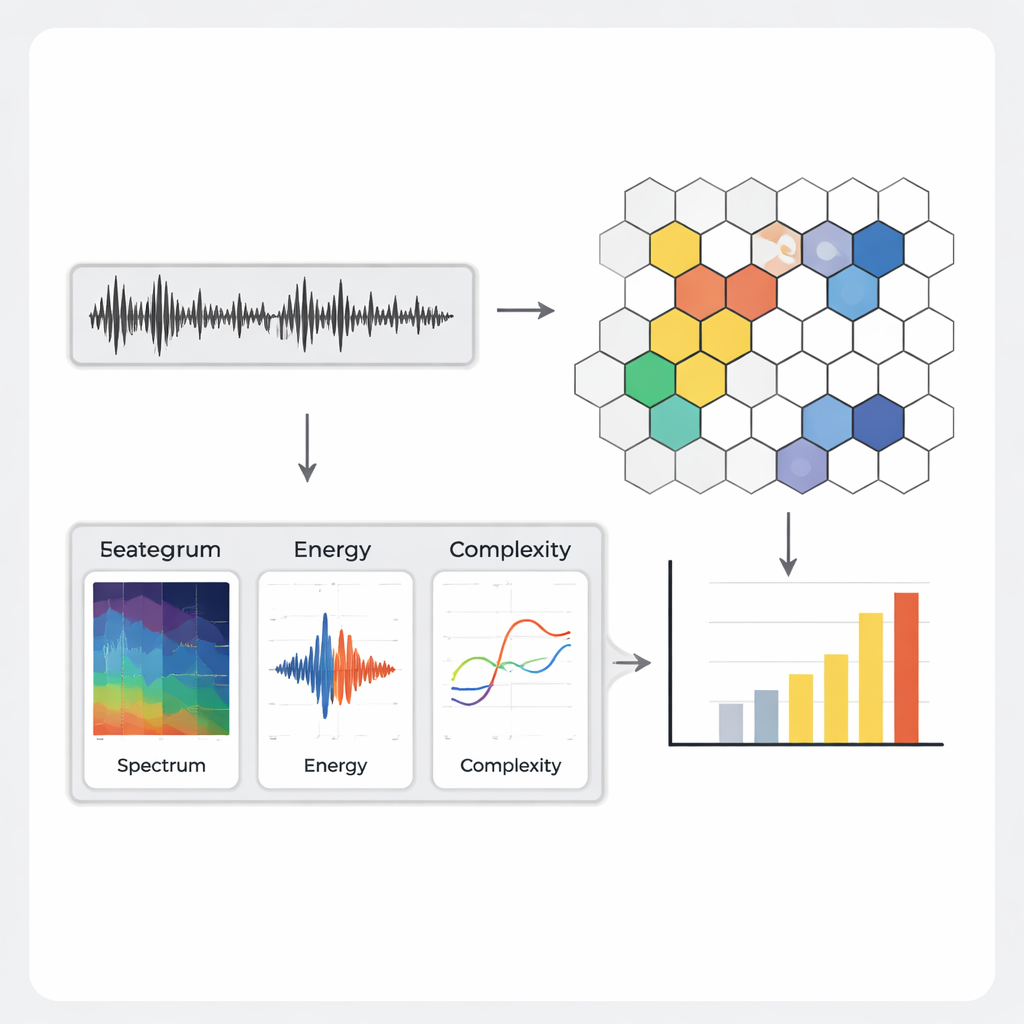
The researchers turned continuous recordings from 2023 into a vast collection of one-minute snippets and then translated each snippet into a compact “fingerprint” that a computer could compare. They used three types of fingerprints: one capturing the shape of the signal’s frequencies, one describing how its strength changes in time, and one—called multiscale entropy—that measures how complex and irregular the signal is across different time scales. These fingerprints were fed into a Self-Organizing Map, a kind of neural network that arranges similar patterns close together on a grid. Without any human labels, the map learned to group minutes of data that had similar seismic behavior, forming clusters that could be inspected later.
Finding hidden glitches, quakes, and steam tremors
Once trained, the system immediately uncovered an unexpected pattern: many minutes from a specific month fell into one corner of the map, pointing to a change in the station’s behavior. On closer inspection, this cluster turned out to be linked to a technical malfunction that began on June 18 and was fixed a month later—an issue that had not been obvious beforehand. After excluding that period and retraining with the more informative fingerprints, the map began to isolate clusters rich in earthquakes reported in the official catalog, including some small events that had not been catalogued at all. Other clusters were dominated by the steady vibration, or tremor, of the Pisciarelli fumarole. By tracking how concentrated each day’s data were on the map, the authors defined a “clustering index” that rose when the station recorded long stretches of similar tremor-like activity.
Weather, gas, and the volcano’s daily mood
The team compared this clustering index with independent measurements of rainfall, carbon dioxide gas flux, and temperature around Pisciarelli. On several occasions, peaks in the index coincided with spikes in CO₂ emissions and episodes of heavy rain, suggesting that both gas release and water infiltration into the ground can modulate the fumarolic tremor picked up by the station. Applying the same approach to nearby stations showed that the clearest tremor clusters appeared only at sensors closest to the fumarole, underlining how localized these signals are. Finally, the authors projected new data from early 2025 onto the previously trained map. In April and early May, the clustering index climbed steadily in step with a rise in overall seismic energy and higher fumarole temperatures, indicating more intense hydrothermal activity. Shortly after both measures dropped sharply, the area experienced a magnitude 4.4 earthquake—the largest in the recent sequence.
What this means for people living near Campi Flegrei
For residents and civil protection agencies, the key message is that advanced pattern-recognition tools can turn a single seismic station into an early-warning ear for a restless volcano. By compressing complex signals into simple fingerprints and letting a neural map sort them, the method can automatically flag instrument problems, uncover previously unnoticed earthquakes, and track changes in the constant tremor of rising gas and hot fluids. While it does not predict eruptions on its own, this approach gives scientists a faster, clearer view of how Campi Flegrei is breathing and shifting from day to day, helping them focus expert attention when the underground system shows signs of unusual stress.
Citation: Grimaldi, A., Amoroso, O., Scarpetta, S. et al. Single-station analysis of Campi Flegrei (Italy) seismic signals using multiscale entropy and unsupervised learning. Sci Rep 16, 7669 (2026). https://doi.org/10.1038/s41598-026-38257-5
Keywords: Campi Flegrei, volcano monitoring, seismic tremor, machine learning, multiscale entropy