Clear Sky Science · en
Quantum optimized hierarchical chunk encoding with robust embedding for perceptual integrity and compression tolerant visual data protection
Why hiding data in pictures matters
Every day we share and store countless photos and videos—of hospital scans, security footage, personal memories and more. These images can be copied, compressed, edited and reposted in seconds, often without our knowledge. The study behind this article explores a new way to hide digital “signatures” inside images so they survive routine compression and tampering while remaining invisible to the human eye. This could help prove ownership, detect fakes and protect sensitive visual data in a world overflowing with digital media.
Invisible ink for the digital age
Instead of relying only on traditional encryption, the authors focus on digital watermarking: blending extra information directly into an image. A good watermark should be three things at once: hard to notice, hard to destroy and practical to use at scale. Existing techniques often fall short. Many work well only for specific file formats, slow down small devices or break when images are heavily compressed or slightly altered. The new approach, called Quantum-Optimized Hierarchical Chunk Encoding (QHCE), aims to deliver watermarks that stay hidden, survive real-world processing and can still be recovered accurately.
Breaking pictures into smart pieces
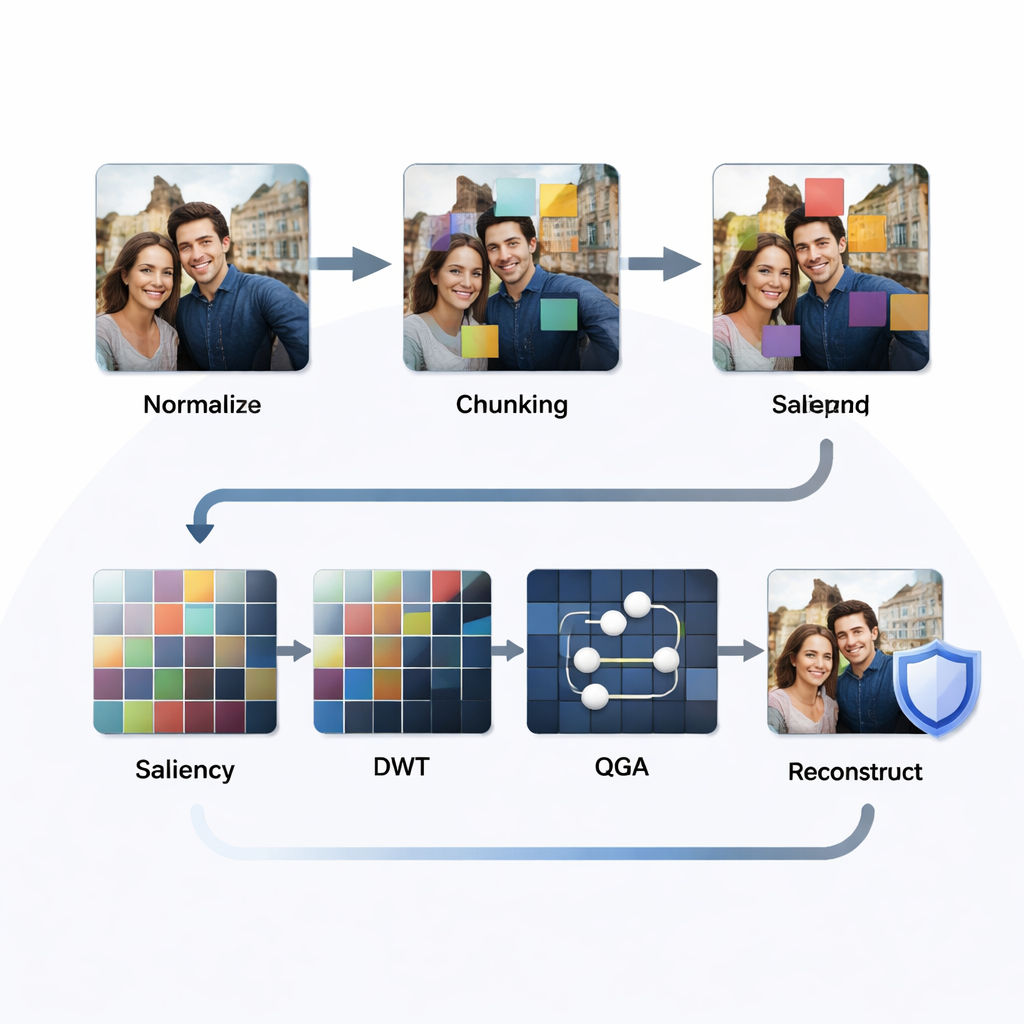
QHCE starts by preparing the image so that differences in lighting or format do not matter. Then, instead of treating the picture as one big block, it divides it into smaller regions, or “chunks,” whose sizes depend on how much detail they contain. Busy areas full of edges and texture are split into finer pieces, while smooth sky or wall regions stay larger. The system measures each chunk’s visual importance using simple cues: how varied the pixel values are and how many edges they contain. Chunks rich in detail are chosen as preferred spots for hiding information, because small changes there are much harder for the human eye to notice.
Hiding data where eyes won’t see it
Once the best regions are selected, QHCE shifts them from the usual pixel view into a frequency view, a bit like separating a song into bass, mid-tones and treble. The watermark bits are then woven into mid-level frequencies that strongly influence texture but are less noticeable than broad brightness or sharp edges. The strength of each tiny change is adjusted according to what the human eye can just barely detect, so the image still looks the same to viewers. To guard against damage from compression or noise, the hidden message is also wrapped in error-correcting codes and duplicated in multiple spots, so it can be pieced back together even if parts are lost.
Letting quantum-inspired search tune the system
A key twist in this work is how the authors fine-tune where and how strongly to embed the watermark. Instead of manually picking these settings, they use a “quantum genetic algorithm,” a search method inspired by how quantum bits can represent many possibilities at once. This optimizer explores different combinations of locations, frequency bands and strengths and scores them based on three goals: keeping the image visually faithful, packing in enough data and keeping the hidden bits readable after compression and attacks. Over several rounds, it homes in on settings that strike a strong balance between invisibility and toughness.
Putting the method to the test
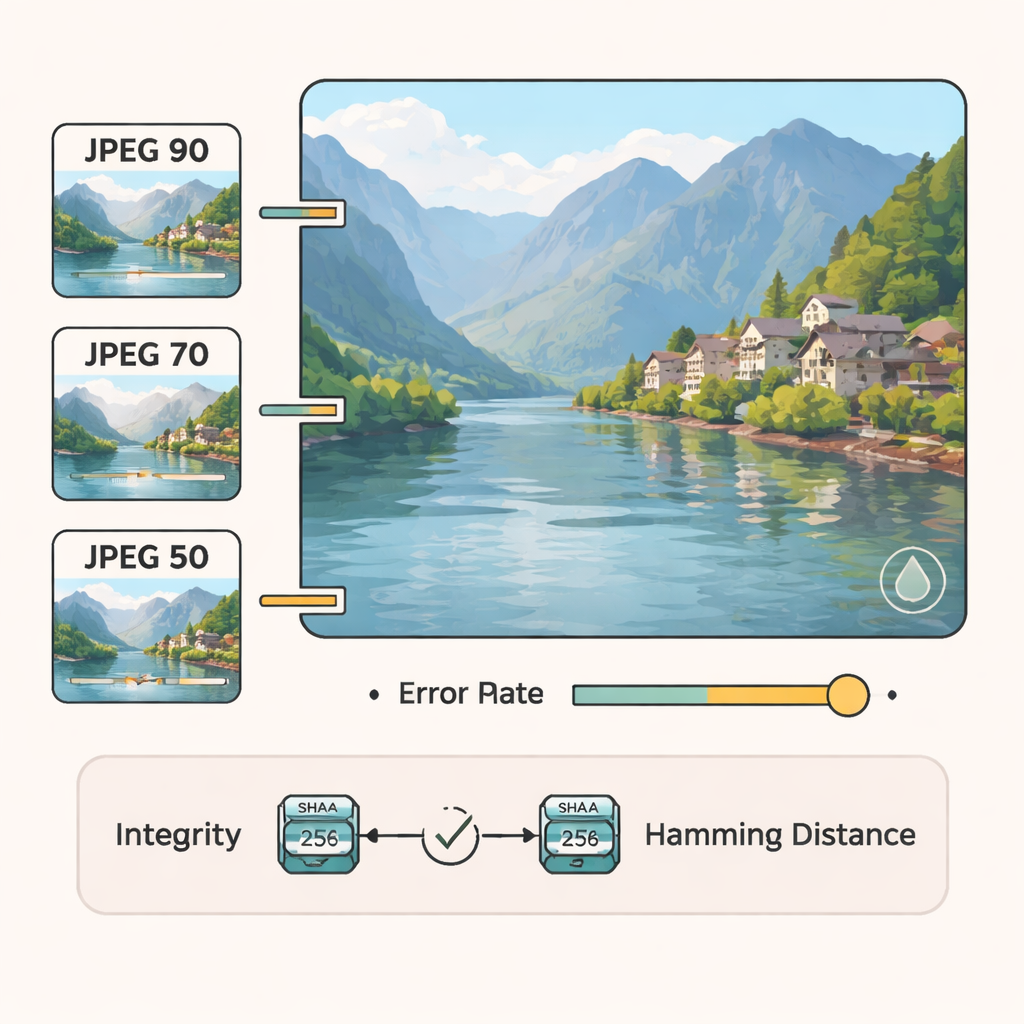
The researchers tested QHCE on a standard collection of high-quality photos and then simulated typical internet-style handling by applying JPEG compression at several quality levels. They measured how close the protected images looked to the originals and how accurately the watermark could be recovered. The results were striking: on average, the protected images were almost indistinguishable from the originals, while the recovered watermarks remained correct even after moderate compression. Compared with other methods that rely on more rigid transforms or deep learning alone, QHCE carried more hidden data, ran faster and showed fewer errors.
What this means for everyday images
In plain terms, this research shows that it is possible to hide robust “proof of authenticity” inside pictures without visibly changing them, and without giving up when the images are compressed, resized or slightly corrupted. By combining content-aware chunking, eye-guided hiding and quantum-inspired tuning, QHCE keeps images looking natural while making their hidden signatures very hard to strip away. As quantum computing and visual security tools mature, approaches like this could underpin future systems for verifying news photos, protecting medical scans, securing surveillance footage and tracking image misuse across the web.
Citation: Suresh, G., Kumar, J.A., Perumal, V.K. et al. Quantum optimized hierarchical chunk encoding with robust embedding for perceptual integrity and compression tolerant visual data protection. Sci Rep 16, 7100 (2026). https://doi.org/10.1038/s41598-026-38249-5
Keywords: digital watermarking, image security, compression robust, quantum optimization, visual data integrity