Clear Sky Science · en
Correlational analysis of distinct contributions and overlaps between visual, visual attention, and perceptual spans
Why how we see words matters
When you read a sentence, your eyes don’t glide smoothly across the page—they jump, pause and quietly juggle several letters at once. This study asks a simple but important question: which aspects of what we see during these brief eye pauses really matter for reading speed in skilled adult readers? By carefully comparing three different "spans" of vision in the same people, the authors show that only one of them has a clear, unique link to how fast we read.
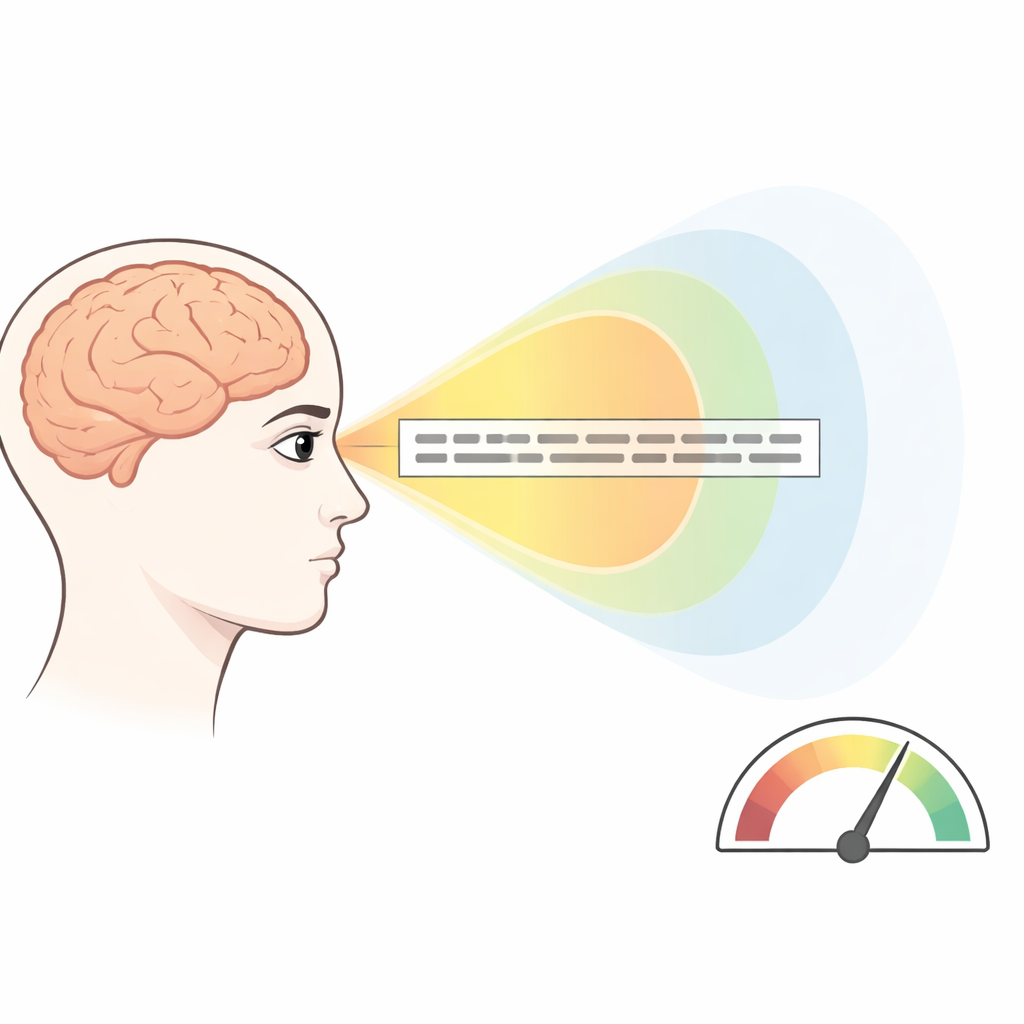
Three ways of looking at a line of text
The researchers focus on three related but distinct ideas. The visual span is how many letters, arranged like a word, you can correctly identify at a glance without moving your eyes. It reflects the raw sharpness and clarity of the visual system for single letters, and is strongly influenced by simple features like letter size and spacing. The visual attention span is about how many letters you can attend to at once in the center of your gaze, even when crowding is minimized. It captures how broadly attention can spread over a string of symbols. Finally, the perceptual span is the region around where your eyes are currently fixated from which you actually extract useful information while reading continuous text, including words just ahead in the line.
Measuring what the eyes and mind can handle
To compare these spans fairly, the team tested the same 30 young adults using the same font, letter size and display conditions. Visual span was measured with brief flashes of three-letter strings shown to the left or right of a fixation point, and counting how far out people could still name the center letter reliably. Visual attention span was assessed with tasks where short strings of six consonants appeared very briefly and participants either reported all the letters they saw or just one cued letter. Perceptual span was estimated with an eye‑tracking method: while participants silently read sentences, only a limited window of letters around the fixation point was shown normally; letters beyond that window were replaced with meaningless characters. By gradually enlarging this window, the researchers identified the smallest region that allowed reading as fast as when the whole sentence was visible.
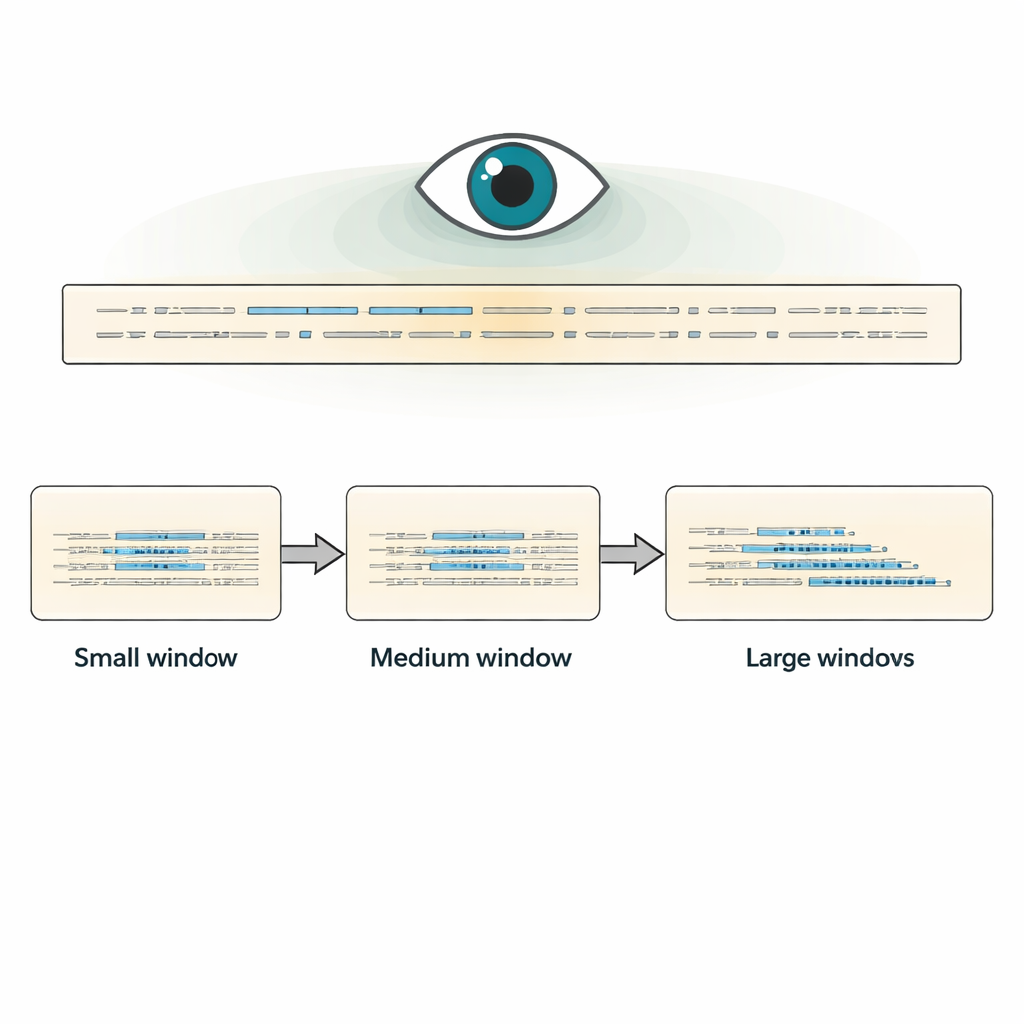
How the three spans relate to one another
Standardizing the conditions revealed some clear differences. On average, participants could recognize about eight letters in the visual span task, attend to about five letters at once in the visual attention task, and use information from almost nine letters in the perceptual span window. Visual span was modestly linked to both of the other spans, which makes sense because all three rely on seeing clearly spaced letters. Surprisingly, visual attention span and perceptual span did not correlate with each other, suggesting they tap into different underlying abilities: one more about how widely attention can spread in the center of gaze, the other more about how efficiently readers use information from words ahead in the sentence. All three spans were also tied to simple short‑term memory measures, reflecting the need to briefly hold letter sequences in mind while responding.
What best predicts how fast we read
The crucial test was how these measures relate to real reading. When participants read normal sentences, all three spans showed similar patterns: people with larger spans read faster, made fewer eye fixations and needed fewer forward eye jumps along the line. But when the authors used statistical models to ask which span uniquely explains reading speed once the others are taken into account, only perceptual span stood out. Readers with a larger perceptual span not only read faster overall, they also spent less time on each fixation. Visual span and visual attention span, despite their correlations with reading, did not add independent explanatory power beyond what was captured by perceptual span.
What it means for everyday reading
To a non‑specialist, the key message is that being a fast reader is less about how many letters you can see sharply or attend to at a single glance in isolation, and more about how far ahead in the line of text your brain can make use of information while your eyes are briefly stopped. This practical "window of useful vision"—the perceptual span—appears to be the main visual factor that sets a limit on adult reading speed. While all three spans tell us something about how the eyes and brain cooperate during reading, this study suggests that the perceptual span is the most directly relevant for how quickly we move through a page of text.
Citation: Frey, A., Meary, D., Loichot, M. et al. Correlational analysis of distinct contributions and overlaps between visual, visual attention, and perceptual spans. Sci Rep 16, 8438 (2026). https://doi.org/10.1038/s41598-026-38243-x
Keywords: reading speed, perceptual span, visual attention, eye movements, letter recognition