Clear Sky Science · en
Analysis of the long-term sealing integrity of cement sheath in CO2 storage wells
Why this matters for climate solutions
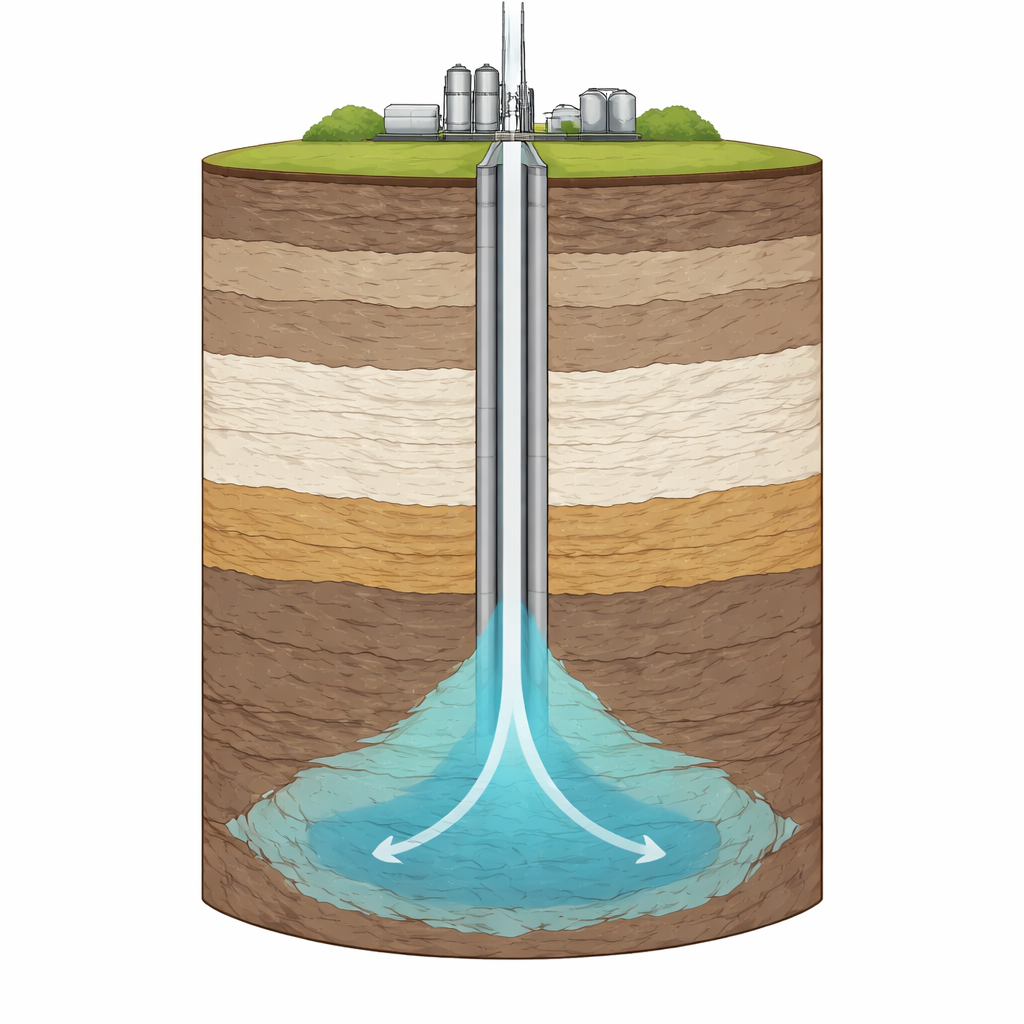
As the world looks for ways to cut carbon emissions, burying carbon dioxide deep underground in old oil and gas fields is one of the most practical options we have today. But for this approach to be safe, the wells used to inject CO2 must stay tightly sealed for decades or longer. This paper examines a hidden weak spot in those wells—the cement ring that seals the steel pipe to the surrounding rock—and asks a simple but crucial question: how does long-term contact with CO2 slowly damage this cement and threaten the seal?
The hidden barrier around a well
Deep underground, an injection well looks like a set of concentric tubes. A steel casing runs down the hole, surrounded by a ring of hardened cement, which is in turn surrounded by rock. That cement sheath blocks fluids from slipping up along the outside of the pipe. Over years of CO2 injection, however, two things happen at once: the pressure inside the casing rises and falls as operations change, and CO2 gradually reacts with the cement. Together, these effects can cause tiny gaps, called micro-annuli, to open at the contact between the casing and the cement—small in size but large enough to become future leak paths.
How CO2 slowly weakens the seal
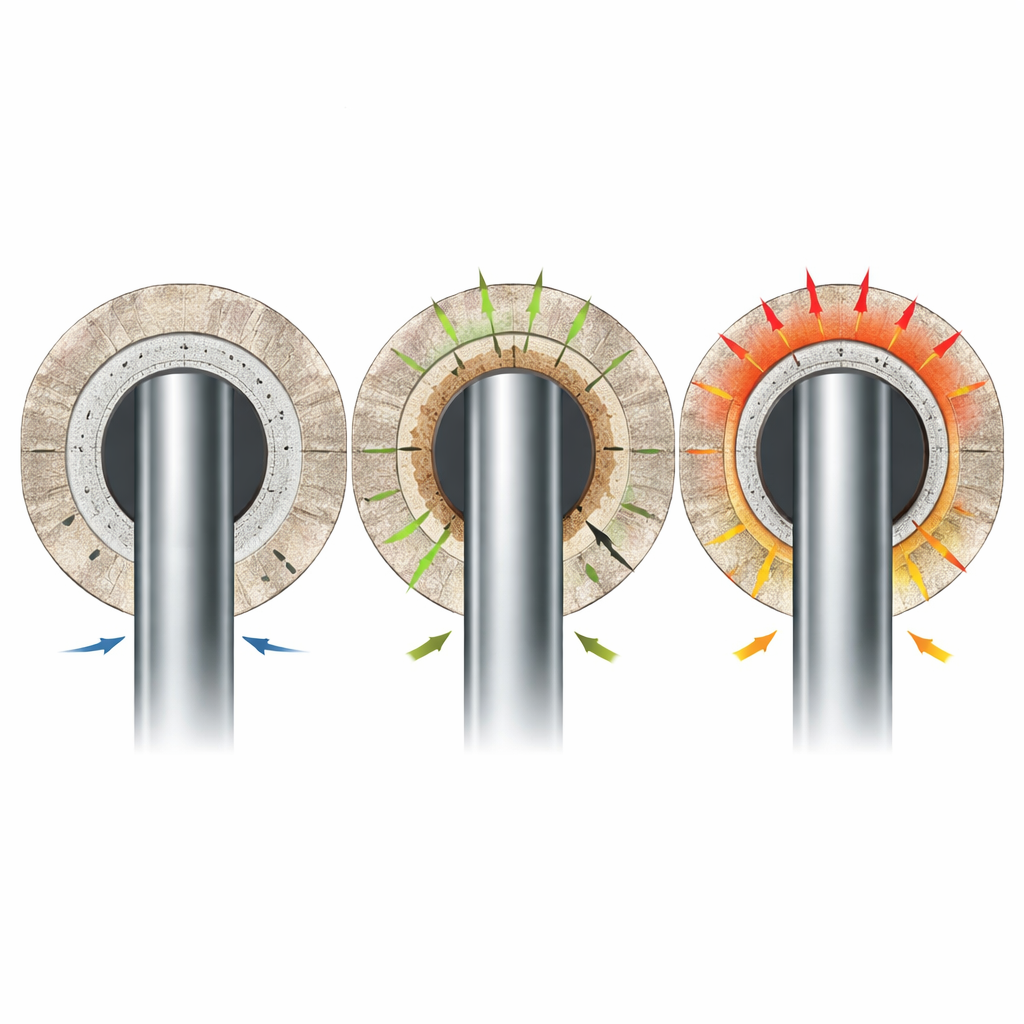
Laboratory studies show that when CO2 first invades cement, it can briefly make it denser and stronger by forming new minerals. With longer exposure, that protective layer dissolves, pores grow, and the material weakens. The authors represent this damage as a corroded inner layer of cement with different properties from the still-intact outer layer. Using a detailed mechanical model based on well-established theories of how thick tubes deform under stress, they treat the steel casing and rock as elastic and the corroded cement as a material that can first deform elastically and then flow plastically when pushed too hard. This allows them to calculate how stresses and radial displacements evolve during injection and when pressures are later lowered.
Following the stress from pressure to tiny gaps
The model tracks how pressure inside the casing compresses the cement during injection, and how unloading that pressure causes it to spring back—though not perfectly, because plastic deformation leaves permanent strain. The most critical region is the inner side of the cement, right next to the casing, where stresses are highest and plastic behavior appears first. The authors show that when CO2 has formed a weakened corroded layer, this inner section of cement experiences higher compressive stress during loading and larger permanent deformation after unloading than intact cement would. As the pressure is reduced, the contact force at the casing–cement interface can switch from squeezing to pulling; once that pulling exceeds the bond strength, the two surfaces separate and a micro-annulus forms. Their equations then predict the width of this gap from the relative radial movements of steel and cement.
What operating choices matter most
By applying their analytical model with realistic well and material data from a Chinese CO2 injection project, the authors explore how three design and operating factors influence sealing integrity: injection pressure, thickness of the corroded cement layer, and thickness of the steel casing wall. Raising injection pressure from 40 to 100 megapascals drives much larger plastic deformation; under otherwise identical conditions, the predicted micro-annulus opening grows from about 0.02 millimeters to more than 0.11 millimeters, greatly increasing the chance of leakage. Increasing the thickness of the corroded cement layer from 5 to 30 millimeters does increase stresses, but only modestly enlarges the final gap. In contrast, using thicker casing walls significantly reduces stress in the cement and shrinks the micro-annulus size, because the stiffer pipe shares more of the load and deforms less.
From equations to safer CO2 storage
Put simply, the study shows that long-term CO2 exposure makes the cement around storage wells more vulnerable, and that pressure cycles during operation can then pull the steel and cement apart to create tiny leakage pathways. By building a closed-form mathematical model that couples corrosion damage and mechanical loading, the authors provide a practical way to estimate when and where such gaps might form and how wide they may become. For non-specialists, the key takeaway is that careful control of injection pressures and the use of sturdier casings can strongly improve the long-term reliability of underground CO2 storage. This kind of predictive tool helps engineers design wells that are more likely to stay tight for decades, supporting carbon storage as a dependable part of the climate toolkit.
Citation: Zhao, K., Zheng, S., Meng, H. et al. Analysis of the long-term sealing integrity of cement sheath in CO2 storage wells. Sci Rep 16, 8829 (2026). https://doi.org/10.1038/s41598-026-38242-y
Keywords: CO2 geological storage, well integrity, cement corrosion, carbon capture and storage, subsurface sealing