Clear Sky Science · en
Refractive outcomes and predictability after cataract surgery combined with GATT or Kahook Dual Blade goniotomy
Why this matters for people with cataracts and glaucoma
Many older adults live with both cataracts, which cloud the eye’s natural lens, and glaucoma, which damages the optic nerve when eye pressure is too high. Surgeons now often treat both problems in a single operation. This study asked a practical question that matters deeply to patients: if your cataract surgery is combined with one of two popular minimally invasive glaucoma procedures, will your vision after surgery be as sharp and predictable as with cataract surgery alone?
Modern eye surgery aims for glasses-free vision
Today’s cataract operations are planned with remarkable precision. Using detailed eye measurements and advanced computer formulas, surgeons can choose an artificial lens that aims not only to clear the cloudy vision, but also to reduce the need for glasses. People who also need glaucoma surgery understandably hope that this extra step will not spoil that careful planning. Earlier, more invasive glaucoma operations sometimes changed the shape or length of the eye, causing unexpected nearsightedness, astigmatism, or other “refractive surprises” after surgery.
Two gentler glaucoma add-ons: GATT and KDB
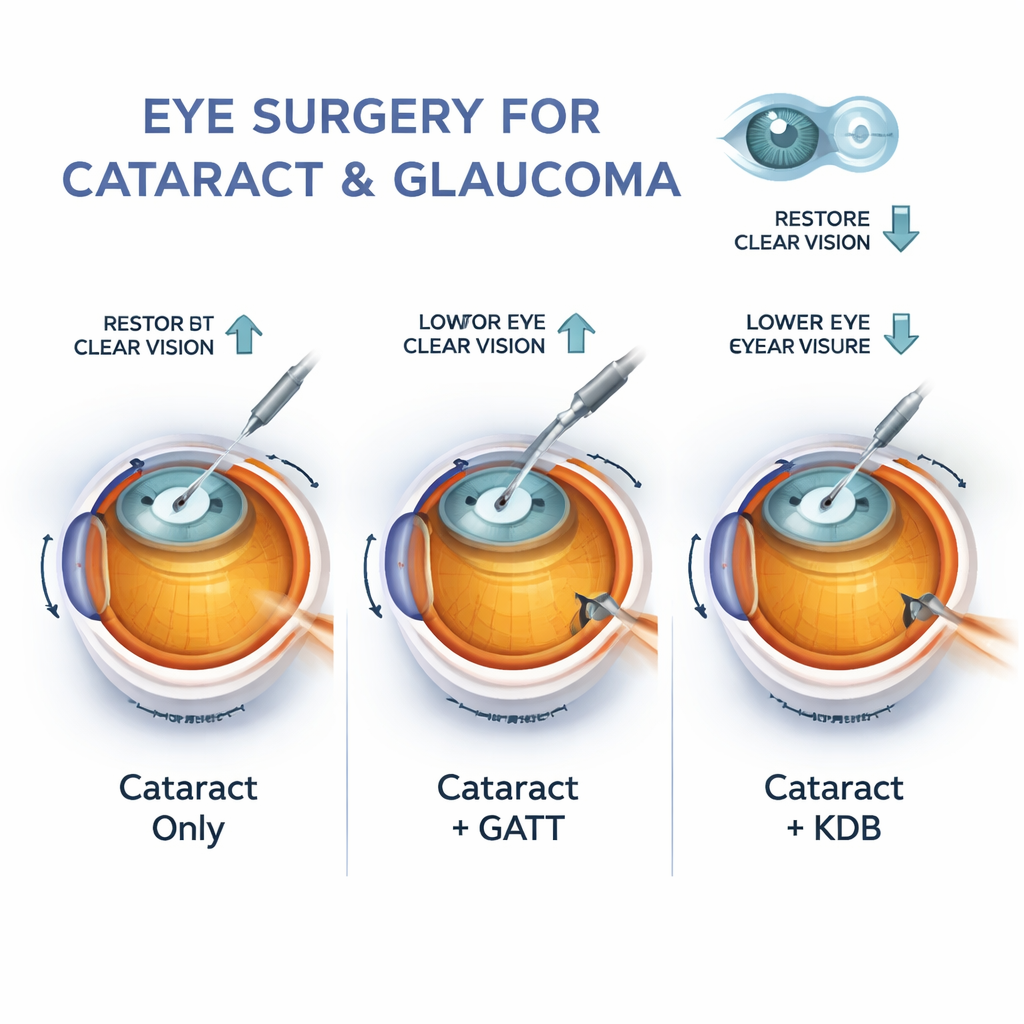
The researchers focused on two minimally invasive glaucoma surgeries, known by their acronyms GATT (gonioscopy-assisted transluminal trabeculotomy) and KDB (Kahook Dual Blade goniotomy). Both procedures are done from inside the eye through the same small clear-corneal incision used for cataract surgery. Instead of creating a new drainage pathway on the outside of the eye, they gently open or remove tissue in the eye’s natural drainage system to lower eye pressure. Because they disturb the eye’s structure less than older glaucoma surgeries, they are expected to have less impact on the eye’s final focusing power.
What the study measured and who was included
This multicenter study looked at 292 eyes from 215 adults who had standard cataract surgery alone or cataract surgery combined with GATT or KDB. All eyes were measured before surgery with modern optical devices, and surgeons used a widely accepted calculation method (the Barrett formulas within the VERION planning system) to predict each patient’s final glasses prescription. About two months after surgery, the team checked how closely the real-life prescription matched what had been predicted, looking at the overall focus (sphere), astigmatism, and the direction of that astigmatism. They also tracked how much the operations lowered eye pressure in the three groups.
Vision accuracy held steady across all three procedures
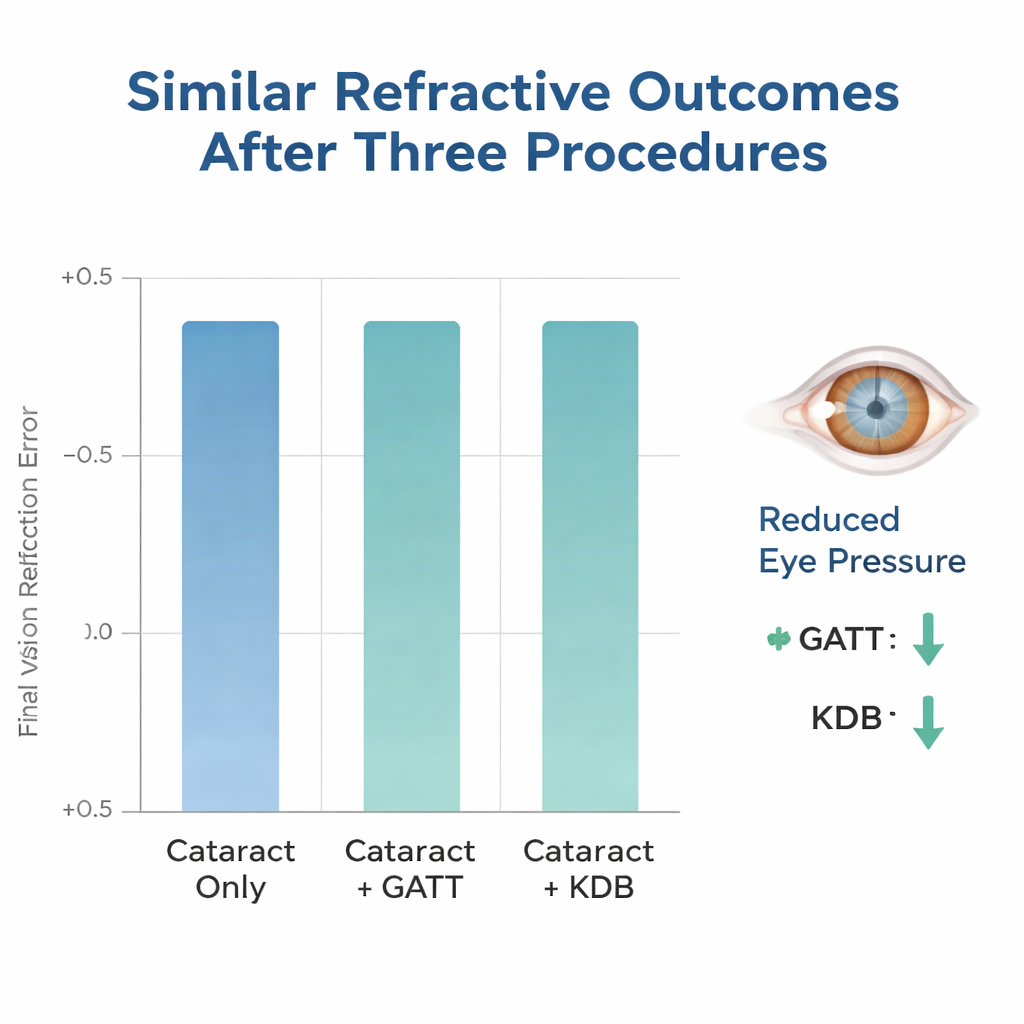
The main finding is reassuring: the difference between the predicted and actual prescriptions was small and statistically similar whether patients had cataract surgery alone, cataract plus GATT, or cataract plus KDB. In other words, adding either minimally invasive glaucoma procedure did not make vision outcomes less predictable. At the same time, both GATT and KDB groups experienced a meaningful drop in eye pressure, while the cataract-only group had only a modest pressure reduction. When the researchers searched for factors that might explain the small mismatches that did occur, only the curvature of the clear front window of the eye (the cornea) showed a significant, but still weak, relationship with final focusing error.
What this means for patients and surgeons
For patients who need both cataract and glaucoma treatment, these results suggest they do not have to choose between lowering eye pressure and aiming for precise visual outcomes. When planned with modern measurement tools and formulas, cataract surgery combined with GATT or KDB appears to deliver vision that is just as accurately predicted as cataract surgery alone, at least in eyes of average size. This supports using standard lens selection targets without routinely “building in” extra compensation for the glaucoma procedure.
The bottom line for everyday decision-making
In plain terms, this study indicates that people with typical eye dimensions can expect reliable, glasses-focused results whether their cataract surgery is done by itself or paired with GATT or KDB to control glaucoma. The add-on glaucoma procedures effectively lower eye pressure without noticeably disturbing the eye’s final focusing power. While special situations—such as unusually short or long eyes—still need more research, the findings give patients and surgeons greater confidence that combining these modern operations can safely tackle two eye diseases in one visit while keeping visual expectations realistic and clear.
Citation: de Sousa Franco, C.G.V., Akio Pereira I, E., Pereira, A.C.A. et al. Refractive outcomes and predictability after cataract surgery combined with GATT or Kahook Dual Blade goniotomy. Sci Rep 16, 7137 (2026). https://doi.org/10.1038/s41598-026-38240-0
Keywords: cataract surgery, glaucoma, minimally invasive glaucoma surgery, intraocular lens, refractive outcomes