Clear Sky Science · en
Dung beetle optimization for probabilistic force analysis of heliostat support structures
Why wind and mirrors matter
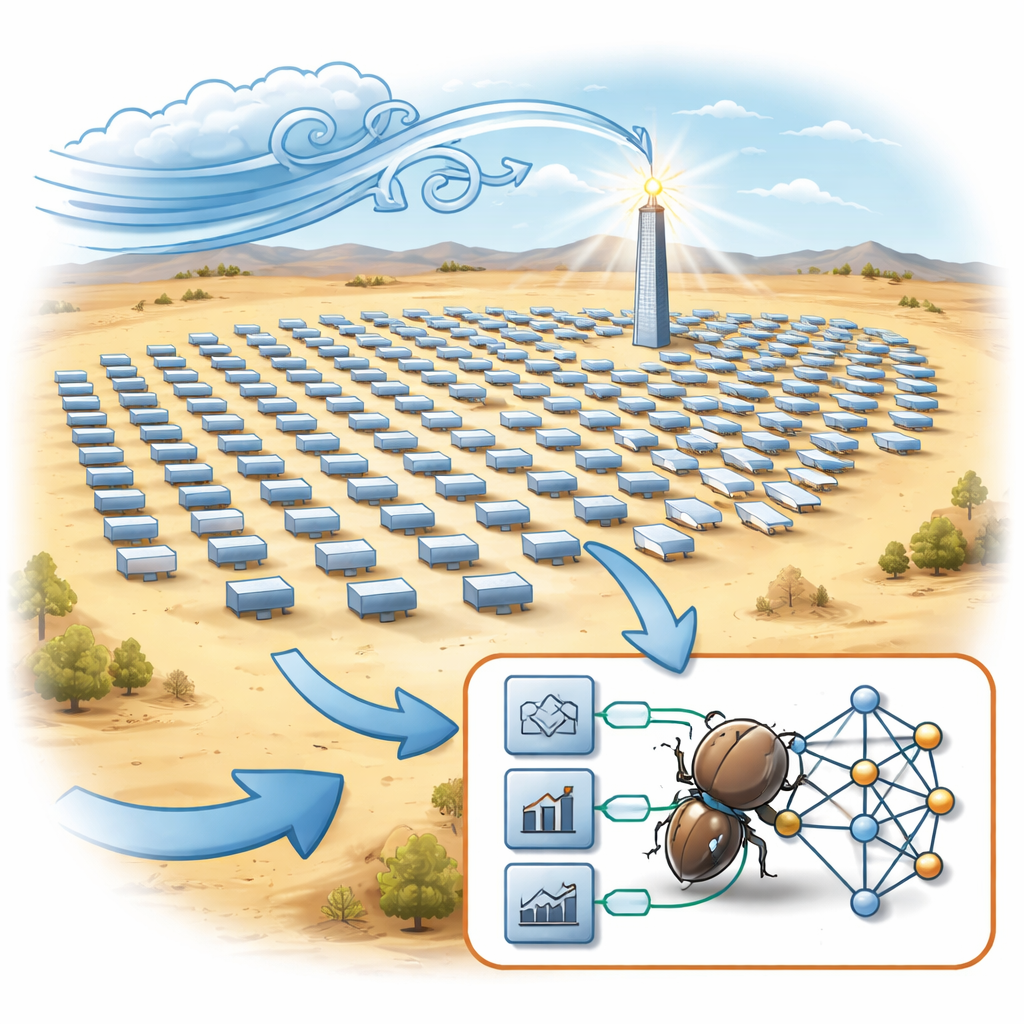
Huge fields of mirrors, called heliostats, are at the heart of some solar power plants. They track the sun and reflect light onto a central tower to make electricity. But in open, windy deserts, these tall mirror structures are constantly beaten by gusts and turbulent air. If engineers misjudge those wind forces, supports can be overbuilt and costly—or worse, underbuilt and unsafe. This paper explores how to better predict wind forces on heliostat supports using a nature-inspired computer algorithm modeled on dung beetles, aiming to keep solar power both safe and affordable.
How wind pushes on solar mirrors
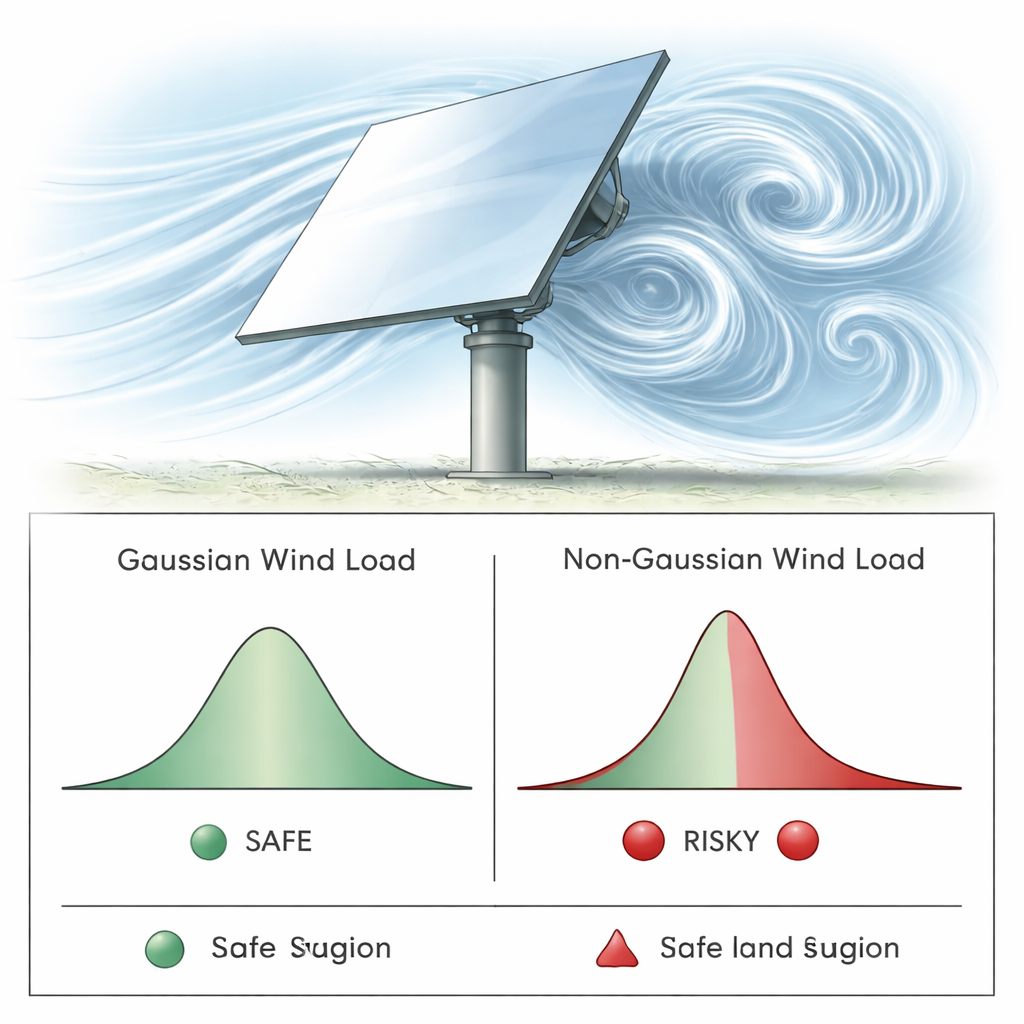
Heliostats are more than flat mirrors on poles. They have beams, columns and joints that all feel wind in different ways. Traditionally, engineers assume that the constantly changing wind pressure behaves like a neat, bell-shaped curve—the classic "normal" or Gaussian distribution. Earlier studies, however, showed that real wind pressures on heliostats often break this rule, especially in certain parts of the mirror surface. That means simple models can misjudge peak forces that matter most for preventing structural failure. The authors set out to examine the true, random behavior of wind forces on the support structure, not just on the mirror surface, under many combinations of wind direction and mirror angle.
From desert measurements to wind tunnel tests
The study begins with careful wind measurements at an actual heliostat site in a northwestern desert region of China. The team installed a roughly 10-meter mast with multiple anemometers to capture how wind speed and direction change with height over more than 87 hours. They then recreated this atmospheric boundary layer in a specialized wind tunnel using spires and roughness blocks on the floor to mimic the desert terrain. A scaled heliostat model, about 1/50 the real size, was mounted on a high-precision six-axis force sensor. By rotating the model through 130 combinations of elevation (mirror tilt) and azimuth (horizontal pointing direction), they recorded how drag, lift and overturning moments varied with realistic, gusty wind.
Sorting orderly winds from wild ones
To tell whether wind forces behaved like a tidy bell curve or had more extreme, lopsided behavior, the researchers focused on two statistics: skewness, which measures left–right imbalance, and kurtosis, which measures how heavy the tails of the distribution are (how often big outliers appear). For each operating condition, they computed these two numbers for drag, lift and base overturning moment on the support. By comparing the results with earlier criteria from building and roof studies, they developed a new, stricter rule tuned to heliostats: if skewness stays within plus or minus 0.2 and kurtosis is 3.2 or less, the force can be treated as Gaussian; otherwise it is non-Gaussian. This rule correctly classified about 97 percent of all tested cases when checked against detailed time histories and histograms.
What a dung beetle teaches about wind
Testing 130 wind conditions in the tunnel gives only a set of discrete points, but designers need to predict behavior at many more angles and speeds. Here the dung beetle optimizer comes in. Inspired by the way dung beetles roll, steer and protect their food balls, this algorithm searches for the best set of parameters for a prediction model. The authors used it to train a neural network that links mirror angle, wind direction and wind speed to the skewness and kurtosis of the forces on the support. Compared with more familiar methods such as particle swarm optimization, grey wolf optimization and standard backpropagation networks, the dung beetle approach produced more accurate predictions and smaller errors, especially for the statistics that govern rare, extreme loads.
Turning statistics into safer solar fields
By combining the new Gaussian rule with the dung beetle–based predictions, the team mapped out where wind forces behave gently and where they become erratic. They found that drag and lift tend to be well-behaved (Gaussian) at low mirror elevations but shift to non-Gaussian at steeper tilts, where organized swirls of air form around the mirror edges. Overturning moments show the opposite pattern, becoming more predictable at higher tilt angles. For practical design, this means that under many everyday conditions engineers can safely use simpler, Gaussian-based methods that are cheaper to compute. Under specific high-risk angles, however, they should use more advanced models that account for heavy tails and outliers. In short, the study offers a clear, physics-based guide for when straightforward assumptions are enough and when a more cautious, detailed approach is needed to keep heliostat fields both robust and cost-effective.
Citation: Luo, H., Liang, Y., Xiong, Q. et al. Dung beetle optimization for probabilistic force analysis of heliostat support structures. Sci Rep 16, 6893 (2026). https://doi.org/10.1038/s41598-026-38236-w
Keywords: heliostat wind loads, solar tower structures, Gaussian non-Gaussian forces, dung beetle optimization, wind tunnel testing