Clear Sky Science · en
Composition and antioxidant activity of Abies marocana essential oil
Why a Mountain Fir Tree Matters to Everyday Health
The Moroccan fir, Abies marocana, grows only on a few cool, high peaks in northern Morocco. Its fragrant needles and twigs produce an essential oil that could one day help replace some synthetic additives now found in foods, cosmetics, and health products. This study takes a close look at what is inside this rare tree’s oil and how its natural ingredients behave as antioxidants—molecules that help protect our cells from damage linked to aging and chronic disease.

A Rare Tree in a Rugged Landscape
Abies marocana is an evergreen conifer that forms striking forests on the stony slopes of the Rif Mountains near Chefchaouen. Because it is found only in a small area and lives under a special mix of Atlantic and Mediterranean climates, its chemistry may differ from that of better-known firs and pines. Earlier work on related species showed that their needles and cones contain many useful natural substances, from pleasant-smelling oils used in soaps and perfumes to compounds with antiseptic and anti-inflammatory effects. Yet, until now, the essential oil from Moroccan fir itself had never been fully examined.
What Scientists Found in the Fir’s Fragrance
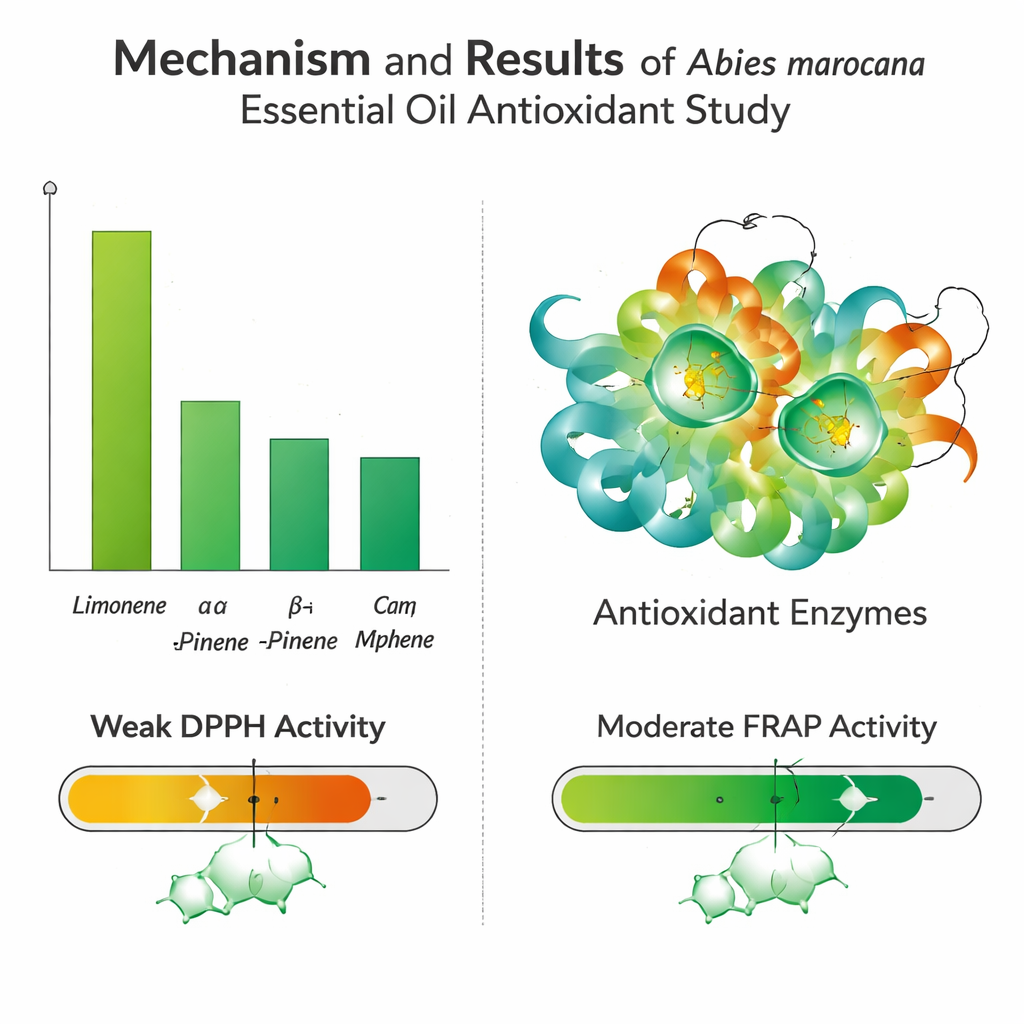
To unlock the oil, the researchers collected aerial parts of the tree—mainly needles and small twigs—from Mount Tazaout and used steam distillation, a standard way to separate essential oils from plant material. The yield was modest: only about a quarter of a milliliter of oil from 100 grams of dried plant. Using gas chromatography–mass spectrometry, a technique that separates and identifies volatile molecules, they detected 49 distinct compounds accounting for more than 97% of the oil. Most were light, easily evaporated molecules known as monoterpene hydrocarbons. Four standouts dominated the mix: limonene (about 38%), alpha-pinene (21%), beta-pinene (13%), and camphene (11%). These are the same types of molecules that give citrus peels and pine forests their sharp, fresh scents.
Testing the Oil’s Antioxidant Power
The team then assessed how well the fir oil could act as an antioxidant using two common laboratory tests. In the DPPH test, a deep-purple solution fades as antioxidant molecules neutralize a stable free radical. Here, the fir oil performed poorly: it required a high concentration to cut the radical level in half, far weaker than the synthetic antioxidant BHT used as a comparison. In the FRAP test, which measures the oil’s ability to donate electrons and reduce iron ions, the oil did noticeably better. It still lagged behind a strong natural standard, the plant compound rutin, but showed a moderate reducing power. Measurements of total phenolic content—another marker linked to antioxidant strength—revealed only small amounts of these powerful ring-shaped molecules, helping to explain why the oil does not behave as a strong all-purpose antioxidant.
Peering Inside at the Molecule–Protein Dance
Because test-tube chemistry alone cannot reveal how these natural substances might work in the body, the researchers turned to molecular docking, a computer modeling method often used in early-stage drug discovery. They focused on seven abundant components of the oil, especially the two mirror-image forms of limonene, and asked how strongly each would be expected to bind to two enzyme targets involved in oxidative stress: NAD(P)H oxidase and nitric oxide synthase. The simulations suggested that both forms of limonene can nestle into pockets on these proteins and form stable, mostly hydrophobic contacts, yielding more favorable binding scores than the other tested molecules. This hints that, even though the whole oil is a weak radical scavenger, some of its individual ingredients may still interact meaningfully with biological machinery related to oxidation.
What This Means for Natural Products
For non-specialists, the key message is that the essential oil from this rare Moroccan fir is rich in pleasant-smelling, citrus- and pine-like compounds but is only a modest antioxidant when tested as a whole. Its chemistry is distinct from that of other fir species, and computer models point to limonene as the most promising ingredient for influencing proteins tied to oxidative stress. While this oil alone is unlikely to replace powerful synthetic antioxidants in foods or medicines, it could still find roles in cosmetics, aromatherapy, or “functional” products where mild antioxidant effects, natural origin, and a unique scent profile all matter. Further work on individual components, different parts of the tree, and combinations with other natural extracts may uncover more potent and practical uses.
Citation: El Bakkali, M., Bouchfara, A., Zerrad, H. et al. Composition and antioxidant activity of Abies marocana essential oil. Sci Rep 16, 6904 (2026). https://doi.org/10.1038/s41598-026-38235-x
Keywords: essential oils, antioxidants, Abies marocana, limonene, molecular docking