Clear Sky Science · en
Physicochemical characterization of banana pseudostem, peduncle, and leaf-derived microcrystalline cellulose as directly compressible excipients
Turning Farm Waste into Helpful Medicine
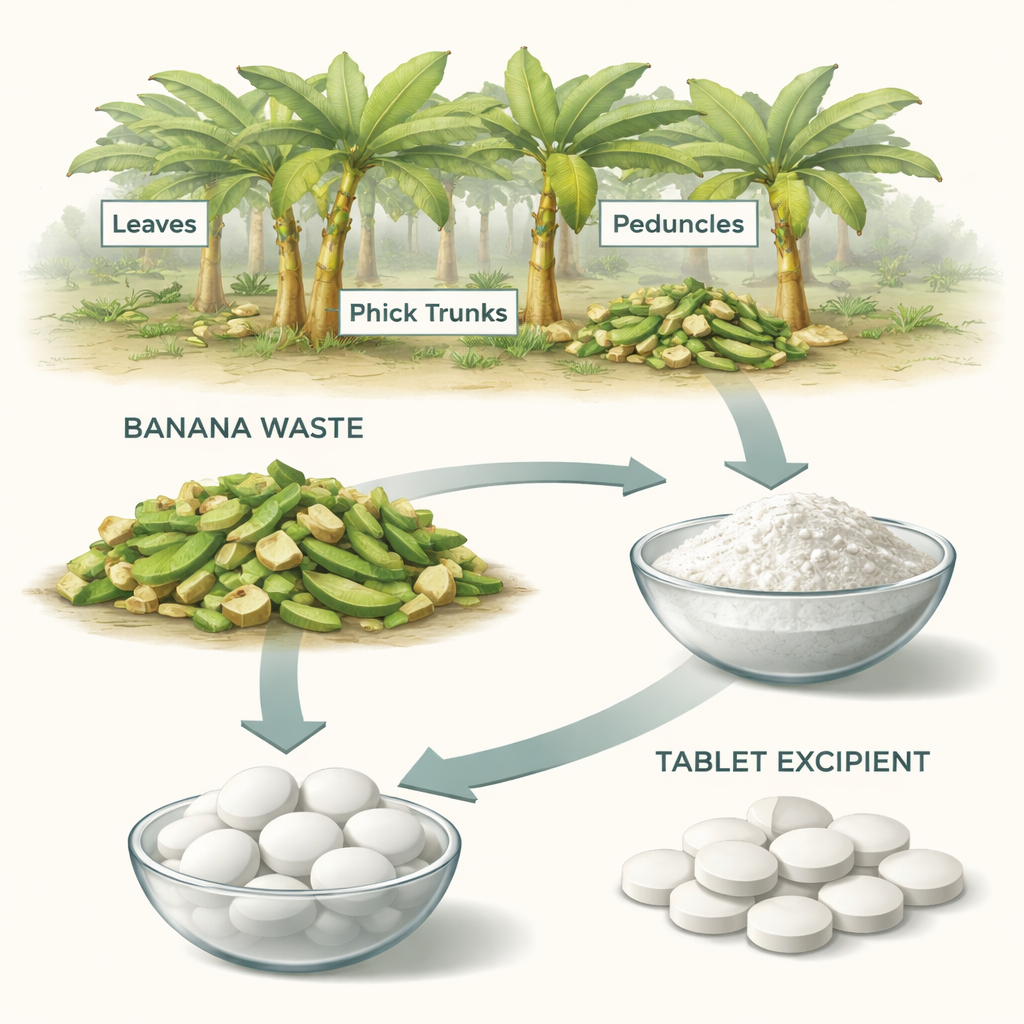
Banana plants feed millions of people, but after the fruit is harvested, mountains of stems, leaves, and stalks are usually thrown away. This study asks a simple question with big implications: can that so‑called waste be transformed into a clean, reliable ingredient for common medicines like pain‑relief tablets? By doing so, farmers could gain extra income, drug makers could cut costs, and less pressure would fall on forests that currently supply most cellulose, a key tablet ingredient.
From Banana Fields to Useful Powder
Instead of using wood, the researchers focused on three parts of the banana plant: leaves, the tall “pseudostem” that looks like a trunk, and the peduncle, the thick stalk that holds the bunches of fruit. These parts are rich in cellulose, a natural fiber that gives plants strength. The team collected these materials in Ethiopia, cleaned and chopped them, and used a carefully tuned, chlorine‑free process to strip away unwanted components such as lignin and hemicellulose. What remained was bright, purified cellulose, which they then converted into microcrystalline cellulose—known in industry as MCC, a fine powder widely used to bind tablets together.
Cleaner Chemistry for a Greener Supply
Many traditional methods for making MCC rely on harsh chemicals, including chlorine‑based bleaches that can leave behind troublesome residues and create environmental concerns. In contrast, this work used mixtures of mild acids and hydrogen peroxide, a more environmentally friendly bleaching agent, to whiten and purify the fibers. Careful adjustment of temperature, timing, and acid strength produced high yields of MCC: more than four‑fifths of the purified cellulose from banana pseudostems and peduncles was successfully converted into useful powder. Laboratory tests showed that this banana‑based MCC matched the structure and purity of a standard commercial product, Avicel PH‑101.
Putting Banana Fiber to the Tablet Test
Producing a clean powder is only half the story; it also has to work inside real tablets. The team compressed tablets made purely from banana MCC and compared them with tablets made from commercial MCC. They measured hardness, how easily tablets crumble (friability), how fast they break apart in water (disintegration), and how quickly a test drug—paracetamol—dissolves and becomes available. Tablets made from banana pseudostem and peduncle MCC were strong enough to handle packaging and transport, yet disintegrated faster than the commercial ones, which helps medicines act quickly. Even when paracetamol made up a large share of the tablet, the banana‑based powders still produced tablets that met official standards for quality in almost all tested cases.
Matching Performance of Commercial Ingredients
To understand why the banana‑derived powders performed so well, the researchers examined them with several advanced tools. X‑ray tests showed that their internal crystal structure closely resembled that of commercial MCC, which is important for tablet strength. Electron microscope images revealed that the cellulose fibers had been broken down into small, rod‑like particles ideal for packing together under pressure. Thermal tests confirmed that the material stays stable at high temperatures, an important safety consideration in manufacturing. Overall, the banana MCC looked and behaved much like standard MCC, while offering good flow, packing, and bonding properties needed for modern tablet machines.
What This Means for Patients and the Planet
In everyday language, this study shows that the “trash” left in banana fields can be cleaned up and turned into a high‑quality, tablet‑making powder comparable to what drug companies now buy from wood‑based sources. The method avoids chlorine, reduces environmental impact, and takes advantage of an abundant, renewable resource—especially in countries where bananas are a major crop. If scaled up, farmers could earn more, manufacturers could lower costs, and pressure on forests could ease, all while patients continue to receive reliable medicines made from an ingredient that began life as a banana stem.
Citation: Wledesilasse, A., Joseph, N.M., Gabriel, T. et al. Physicochemical characterization of banana pseudostem, peduncle, and leaf-derived microcrystalline cellulose as directly compressible excipients. Sci Rep 16, 7552 (2026). https://doi.org/10.1038/s41598-026-38234-y
Keywords: banana waste, microcrystalline cellulose, tablet excipients, sustainable pharmaceuticals, agricultural biomass