Clear Sky Science · en
A time-dependent reliability model for spatial intermittent motion mechanisms via constant-amplitude alternating fatigue load equivalent method
Why Keeping Space Machines Moving Matters
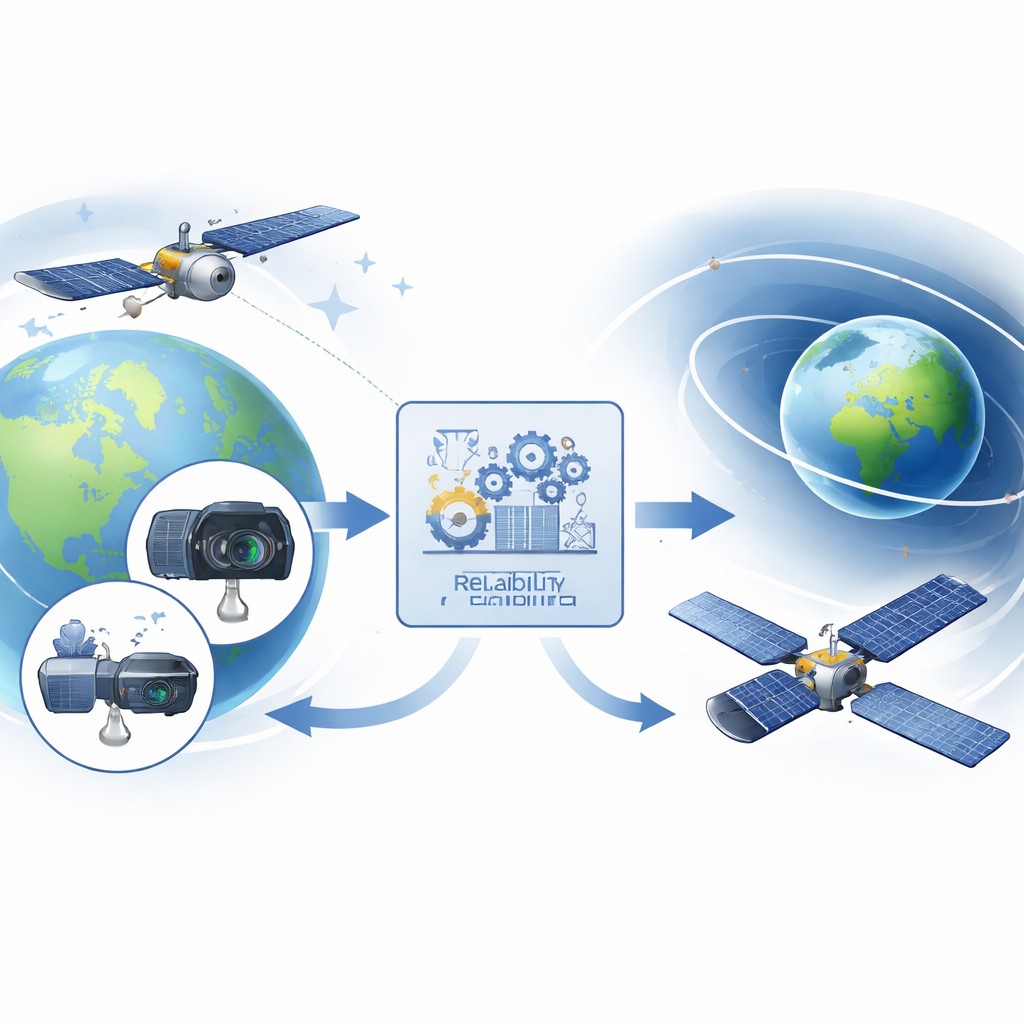
Every modern satellite depends on small, precise machines that start and stop on command: a camera that refocuses for a sharper image, a solar array that slowly turns toward the Sun, or a hinge that deploys a panel only once. If any of these motion units jam, an entire mission can be crippled. Yet these parts move only occasionally, often after long periods of silent drifting in orbit, making their long-term reliability extremely hard to predict with ground testing alone. This study tackles that challenge by proposing a new way to estimate how likely such mechanisms are to survive years of intermittent use in the harsh space environment.
Hidden Weak Spots in Space Hardware
The authors focus on a spaceborne camera’s focusing mechanism as a representative example. This device repeatedly nudges the detector to compensate for tiny shifts in the optics and to image objects at different distances. Each focus action is brief, followed by long periods of inactivity. In orbit, however, the mechanism must work amid vacuum, temperature swings, and microgravity, and it cannot be repaired if something goes wrong. The team first uses a standard engineering approach called Failure Mode and Effects Analysis to systematically list how each part might fail and how serious the consequences would be. This process highlights the ball screw—essentially a precision spiral shaft that converts motor rotation into straight-line motion—as the most vulnerable link because wear can strip its protective coating and lead to parts welding together and seizing.
Turning Random Space Stresses into a Manageable Picture
Space mechanisms do not feel a single steady load; instead, they face irregular pushes and pulls over many years. Traditional reliability models often simplify this by assuming independent failures or by looking only at the worst single load. These shortcuts can miss complex interactions and time trends. The authors instead build on a classic idea that compares how much stress a part experiences with how much strength it has left. They refine this by carefully limiting both stress and strength to realistic ranges, rather than allowing mathematically infinite extremes that never occur in real hardware. This double-truncation step brings calculated reliability closer to what engineers actually see.
From Intermittent Motion to Fatigue Damage
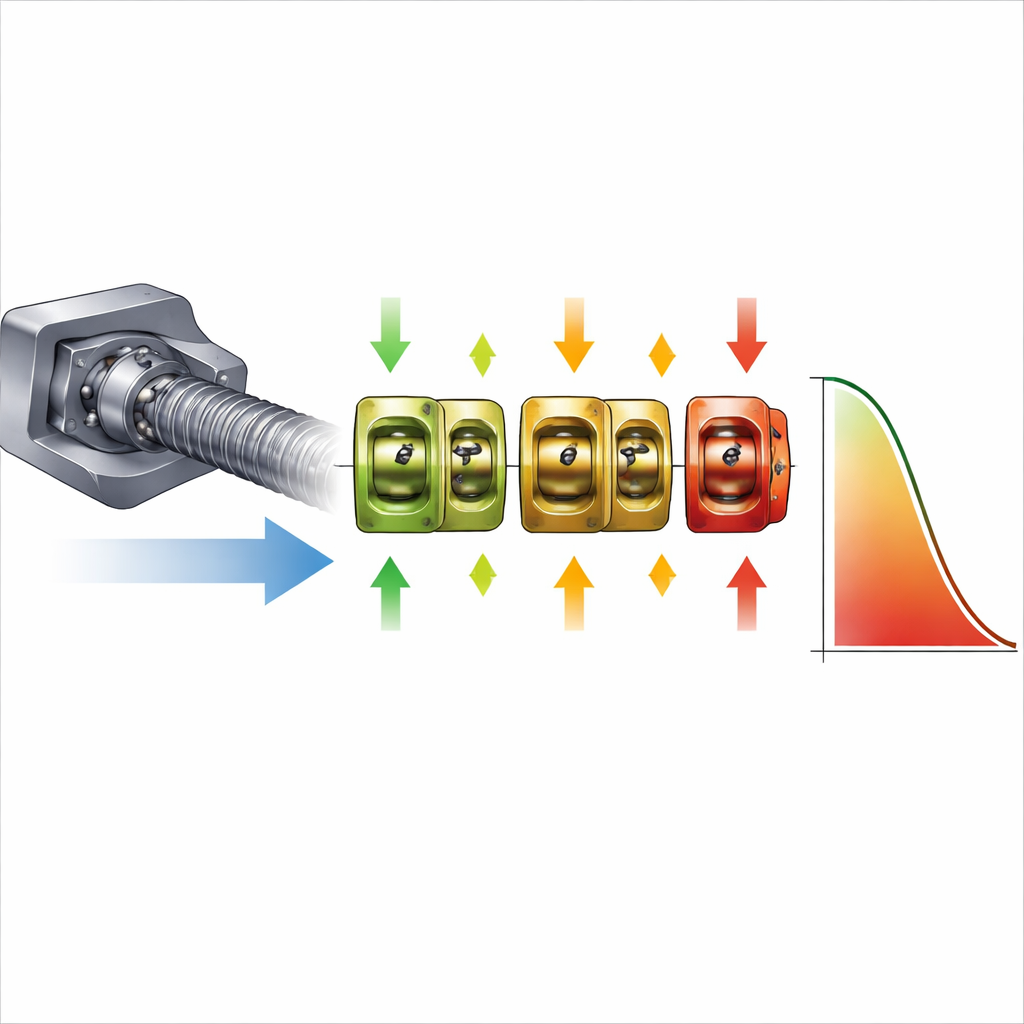
To capture the real behavior of intermittent motion, the paper introduces a dynamic equivalence method. All the messy, random load cycles that a mechanism might experience are converted into an idealized, constant back-and-forth load with the same number of cycles and a conservative amplitude. If the part can survive this standardized fatigue scenario, it will also withstand the original, more irregular history. The authors then describe how each focus operation adds a small, random amount of damage to the ball screw. Over time, these damage “steps” accumulate, and the remaining strength of the component declines in a staircase-like fashion. Mathematically, this is treated as a compound process where both the timing of operations and the damage per operation are random, mimicking the true on-orbit usage pattern.
Testing the Model in a Virtual Space Lab
Because collecting real-life failure data from satellites is costly and slow, the team turns to detailed numerical experiments. They combine established wear laws for ball screws, material fatigue data, and realistic orbital temperature cycles to generate the input parameters for their model. Then they compare the model’s predictions to large-scale Monte Carlo simulations, which act as a computational “gold standard” by simulating many random lifetimes directly. Across a wide range of operating times, their method tracks the simulated results very closely, with errors under one percent, while a more conventional approach based only on instantaneous loads and simple statistics can be off by several percent. The authors also outline how the same framework could be applied to other intermittent systems, such as solar array deployment drives.
What This Means for Future Space Missions
In plain terms, the study offers spacecraft designers a sharper, more realistic way to forecast whether key intermittent mechanisms will still work after thousands of on-orbit actions. By converting messy, irregular loading into a carefully chosen equivalent fatigue scenario and by modeling damage as a series of accumulated hits, the approach avoids the need for huge test datasets while remaining conservative—tending to slightly underestimate reliability rather than overestimate it. This makes it particularly useful for missions where failure is not an option but testing opportunities are limited. The framework can guide design choices, material selection, and maintenance-free lifetimes for many types of moving hardware in space, ultimately helping keep satellites functional and science data flowing for their full intended lives.
Citation: Cheng, P., Zhang, T. & Zhu, Y. A time-dependent reliability model for spatial intermittent motion mechanisms via constant-amplitude alternating fatigue load equivalent method. Sci Rep 16, 8446 (2026). https://doi.org/10.1038/s41598-026-38228-w
Keywords: space mechanisms, satellite reliability, fatigue damage, intermittent motion, spaceborne cameras