Clear Sky Science · en
Sustainable valorization of copper mine waste into construction materials by alkali activation
Turning Mine Waste into Building Blocks
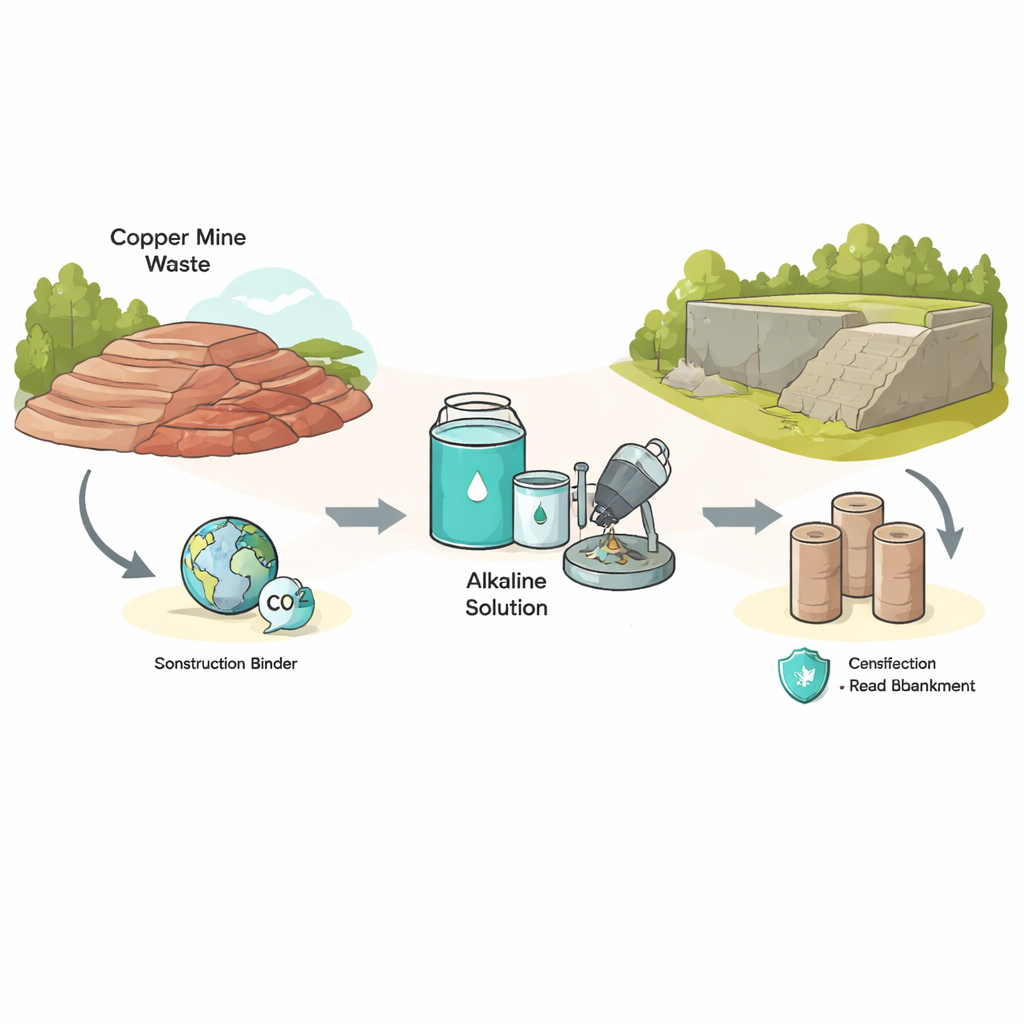
Copper mines leave behind vast mounds of leftover rock and mud that can pollute water and scar landscapes for decades. This study explores a way to turn that troublesome waste into a useful construction material, potentially cutting greenhouse-gas emissions from cement and making mine sites safer at the same time. By using common alkaline solutions to “activate” copper mine waste, the researchers show it can harden into a strong, durable binder suitable for earthworks and other infrastructure.
Why Copper Waste Is a Problem and an Opportunity
Modern copper production generates enormous quantities of waste: for every ton of copper, well over a hundred tons of tailings are left behind. These tailings are usually stored in large dams or ponds that can leak metals into rivers and groundwater, create dust, or even fail catastrophically. Yet chemically, this waste is rich in silica, alumina and iron—ingredients that can form solid, stone-like networks when treated correctly. At the same time, ordinary Portland cement, the world’s standard construction binder, is responsible for about 7–8% of global human-made carbon dioxide emissions. Finding ways to replace part of that cement with materials made from mine waste could both reduce emissions and clean up old industrial sites.
A Simple Recipe: Waste, Alkaline Solution, and Time
The researchers collected fine copper mine waste from the Sarcheshmeh mine in Iran, dried and sieved it to a sand-like powder, and then mixed it with small amounts of water and alkaline solutions. They tested sodium hydroxide (a strong base), sodium silicate (a liquid glass solution), and blends of the two at different dosages. The mixtures were compacted into small cylinders and cured at room temperature for either 7 or 28 days, mimicking how a stabilized soil or fill might behave in the field. The team then measured how much load the samples could bear before crushing, how stiff they were, how they responded to repeated freezing and thawing, how many metals they released into water, and what their internal structure looked like under powerful microscopes.
Strength, Durability, and Clean Leachate
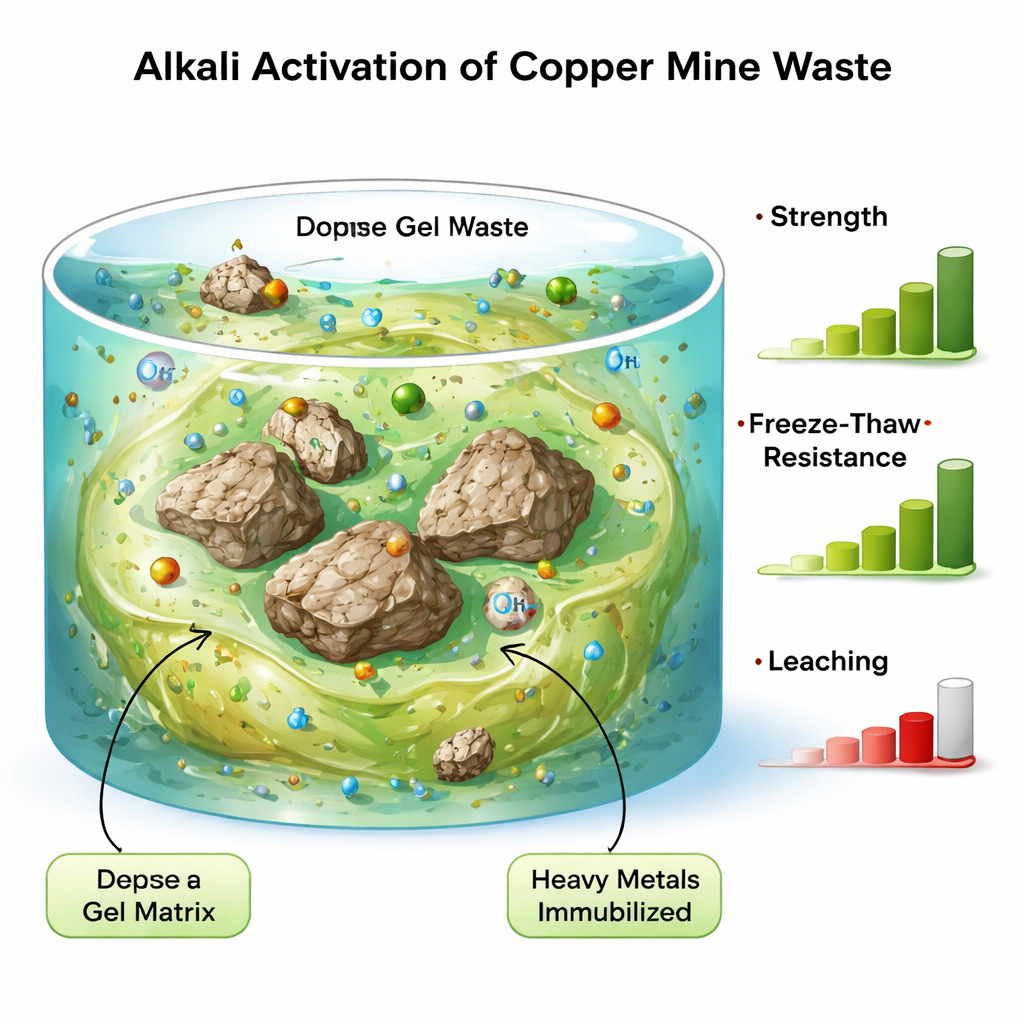
Performance depended strongly on the type of alkaline solution. Specimens activated only with sodium silicate became the strongest, reaching about 16.5 megapascals of compressive strength after 28 days—more than double that of samples made with sodium hydroxide alone, and far above many previously reported mine-waste binders. Blended activators gave intermediate results. All mixtures became stiffer and stronger with time as a dense, glue-like network formed between particles. When one of the best-performing blends was cycled through freezing and thawing up to twelve times, it lost only about 23% of its strength, showed almost no mass loss, and displayed only minor surface cracking, indicating promising resistance to harsh temperature swings.
Locking Up Metals Inside a Dense Microstructure
Since copper mine waste contains trace amounts of metals such as copper, zinc, lead and arsenic, the team also examined how much of these could leach out when the hardened material was soaked in water. The leachate stayed near neutral in pH and had low electrical conductivity and dissolved solids—well within international guidelines for drinking and irrigation water. Compared with untreated waste, the activated materials released 50–85% less of the measured metals, with sodium-silicate mixes showing the lowest concentrations. Microscopy and elemental analysis revealed dense, mostly glassy gels binding the particles together, with iron and copper incorporated directly into this network. In other words, the same reaction that created strength also helped trap potentially harmful elements inside the solid matrix.
From Lab Samples to Real-World Barriers
Overall, the study demonstrates that iron-rich copper mine waste can be transformed into a mechanically robust and chemically stable binder using only alkaline solutions and ambient curing, without adding cement or other precursors. The resulting material is strong enough for many geo-environmental applications, such as embankments, mine backfill and engineered barriers, and it resists both freeze–thaw damage and metal leaching under the tested conditions. While further work is needed to test long-term performance and variations in waste composition at full scale, the approach offers a promising pathway to turn a large and hazardous waste stream into low-carbon construction materials within a circular economy framework.
Citation: Fattahi, S.M., Nastooh, M.Y., Heydari, A. et al. Sustainable valorization of copper mine waste into construction materials by alkali activation. Sci Rep 16, 7043 (2026). https://doi.org/10.1038/s41598-026-38224-0
Keywords: copper mine waste, alkali-activated binder, low-carbon construction, mine tailings reuse, heavy metal immobilization