Clear Sky Science · en
Green and chemical synthesis of PEGylated ginger gold nanoparticles for neuro-nanomedicine applications
Ginger, Gold, and the Challenge of Treating the Brain
Many promising drugs for conditions like Alzheimer’s and Parkinson’s never reach the brain in useful amounts because of the blood–brain barrier, a tight protective wall around our most delicate organ. This study explores an inventive workaround: tiny gold particles cloaked with a common medical polymer and natural compounds from ginger. By comparing a conventional chemical recipe with a plant-based “green” method, the researchers show how a gentler route to making these particles could deliver more medicine to the brain while being kinder to nerve cells.
Why the Brain Is So Hard to Reach
The brain is shielded by the blood–brain barrier, which acts like a vigilant border checkpoint, letting only selected molecules pass. While this protects us, it also blocks many useful drugs, forcing doctors to rely on high doses that can harm the rest of the body. Gold nanoparticles offer a way around this problem. They are so small that, when properly designed, they can slip through the barrier, carry drugs on their surface or inside them, and be tuned in size and coating for specific medical tasks. However, traditional chemical methods for making these gold particles often rely on harsh reagents that can leave behind toxic traces – an unacceptable risk for sensitive brain tissue.
Turning Ginger into a Nano-Factory
To tackle this, the scientists used ginger extract as a natural workshop for building the nanoparticles. Ginger is rich in compounds such as gingerols and shogaols, already known for antioxidant and anti-inflammatory effects in the brain. In the green method, ginger extract both reduces gold salts into tiny metallic particles and coats them at the same time, forming a protective “corona” around each particle. A second layer of polyethylene glycol (PEG) – a widely used, biocompatible polymer – is then added to help the particles stay stable in the bloodstream and avoid rapid clearance. For comparison, a chemical method used a standard reducing agent to first make the gold particles, followed by later loading of ginger and then PEG. 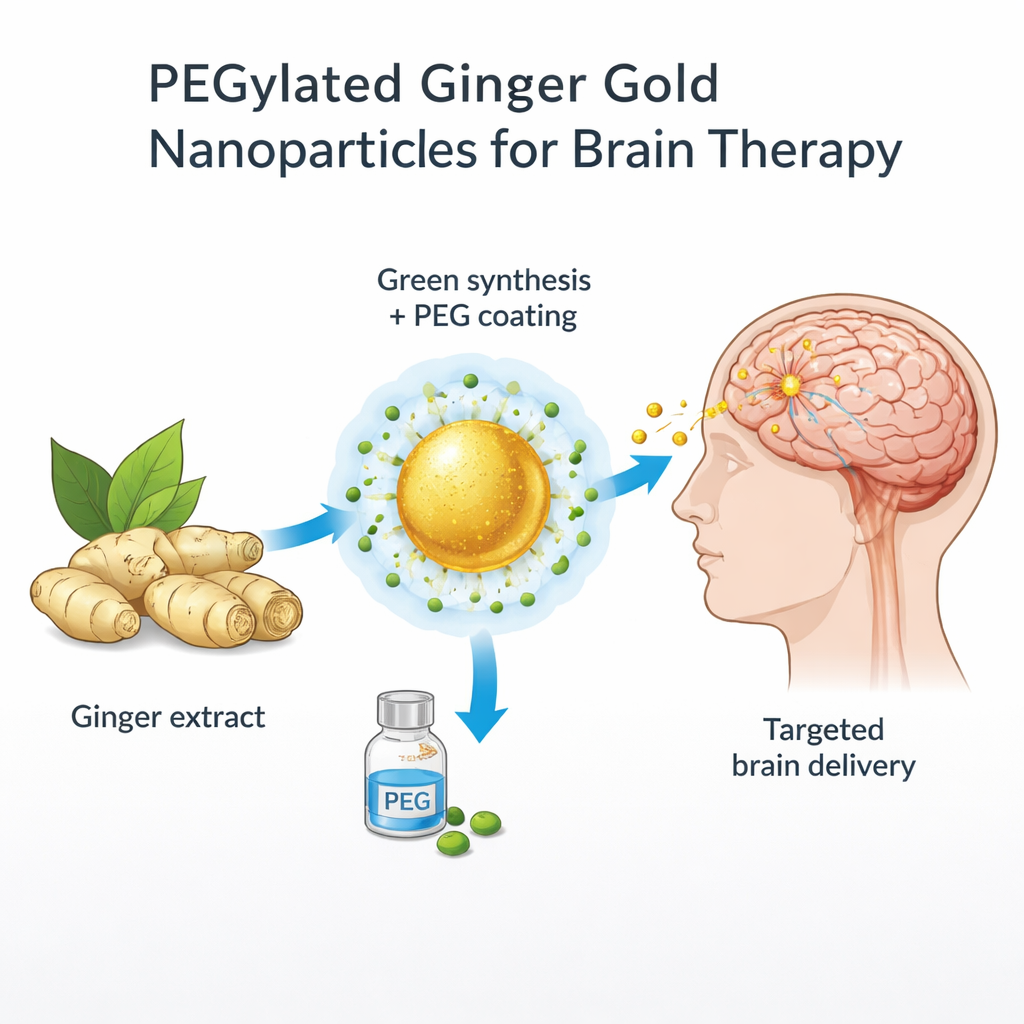
Shaping and Packing the Nano-Carriers
The team carefully examined the particles made by both methods using electron microscopes and light-scattering techniques. All formulations were roughly spherical and in the 10–20 nanometer range – about ten thousand times smaller than the width of a human hair – a size considered favorable for entering brain cells. The green-made ginger–gold particles were slightly larger but more uniform in size and carried a somewhat more negative surface charge, signs of a stable suspension that is less likely to clump. Most importantly, when they measured how much ginger extract actually ended up associated with the particles, the green formulation trapped significantly more: about 81% of the starting ginger compared with about 62% for the chemical version. Both held a large drug load overall, but the green particles did so more efficiently and more consistently.
Slow Release and Gentler Interaction with Nerve Cells
Next, the researchers tracked how ginger compounds leaked out from the nanoparticles over four days in a fluid mimicking blood. Both systems showed an early burst followed by a slower, sustained release. Yet the green-made particles delivered far more of their cargo over time, reaching about 85% release after 96 hours, versus about 60% for the chemically made ones. Mathematical models suggested that in the chemical particles, drug escape is limited mainly by simple diffusion through a dense shell. In contrast, the green particles release ginger through a mix of diffusion and gentle rearrangement of their soft, plant-based coating, leading to a steadier, more complete delivery. When the team exposed neuron-like PC12 cells to these materials, the difference was stark: chemically synthesized particles reduced cell survival in a clear dose-dependent way, while green-synthesized particles – especially those carrying ginger – kept more than 70–80% of cells alive even at the highest tested levels and were statistically indistinguishable from untreated cells. 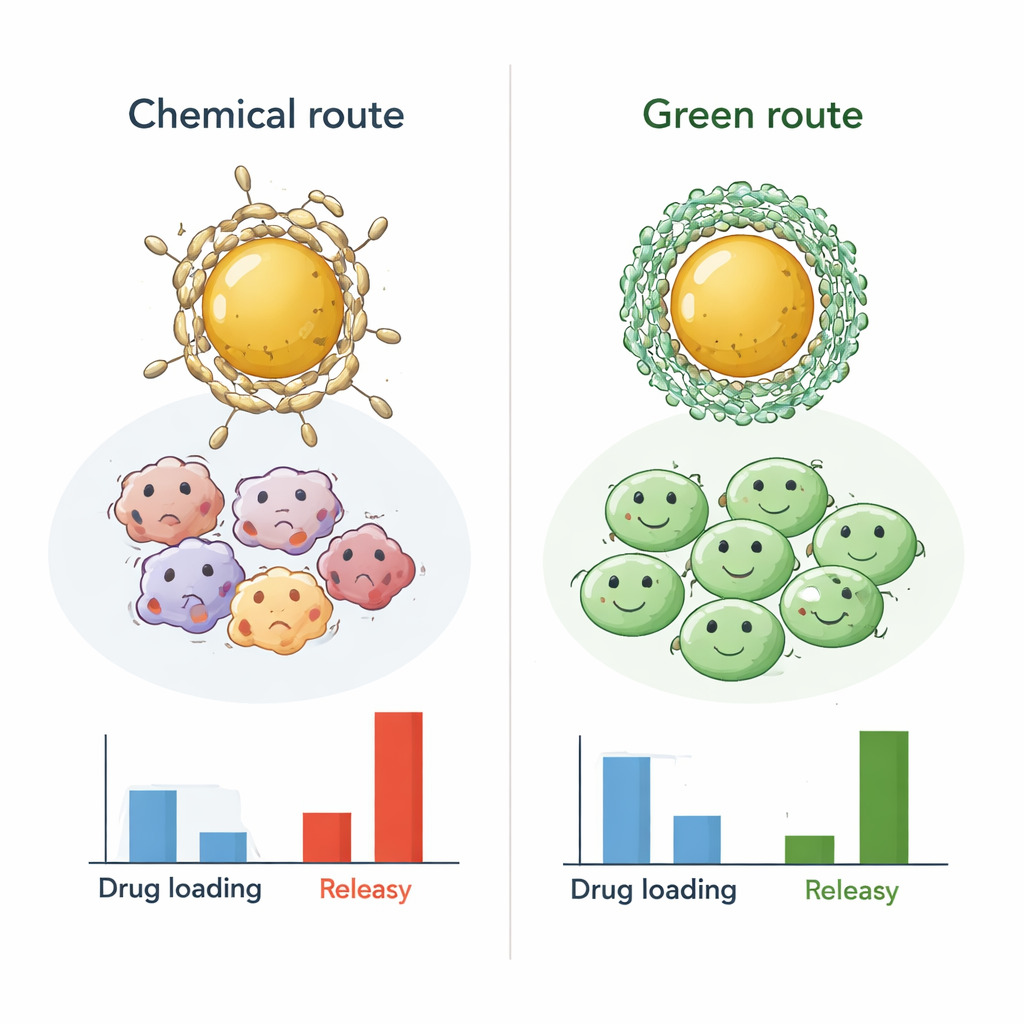
What This Could Mean for Future Brain Therapies
For non-specialists, the key message is that how we make nanoparticles matters as much as what they are made of. In this work, using ginger not only replaces toxic chemicals but also turns the plant’s natural brain-protective molecules into an integral part of the carrier. The green-made PEGylated ginger–gold nanoparticles held more active compounds, released them in a more sustained fashion, and showed remarkably low toxicity to nerve-like cells. While these findings still need to be confirmed in animal models and, eventually, in people, they point toward a new class of “gentle” brain delivery systems that combine engineering with botanical wisdom. Such platforms could one day help move fragile neuroprotective drugs across the brain’s defenses more safely and effectively, opening fresh avenues for treating stubborn neurological diseases.
Citation: Monfared, E.H., Fathi-karkan, S. & Keshavarzi, Z. Green and chemical synthesis of PEGylated ginger gold nanoparticles for neuro-nanomedicine applications. Sci Rep 16, 7369 (2026). https://doi.org/10.1038/s41598-026-38217-z
Keywords: gold nanoparticles, ginger extract, green nanotechnology, brain drug delivery, neuroprotection