Clear Sky Science · en
The ecological role of Pholas dactylus (Mollusca, Bivalvia) empty burrows
Hidden Homes in the Seafloor
Along rocky coasts, much of marine life happens out of sight, tucked into cracks and holes in the seabed. This study reveals how the empty burrows of a little‑known clam, Pholas dactylus, quietly shape an underwater neighborhood in the northern Adriatic Sea. By watching these burrows with an underwater time‑lapse camera for nearly a week, the researchers show that these abandoned tunnels don’t go to waste: they become prime real estate, feeding grounds, and shelters for a surprising variety of snails, crabs, fish, and other creatures.
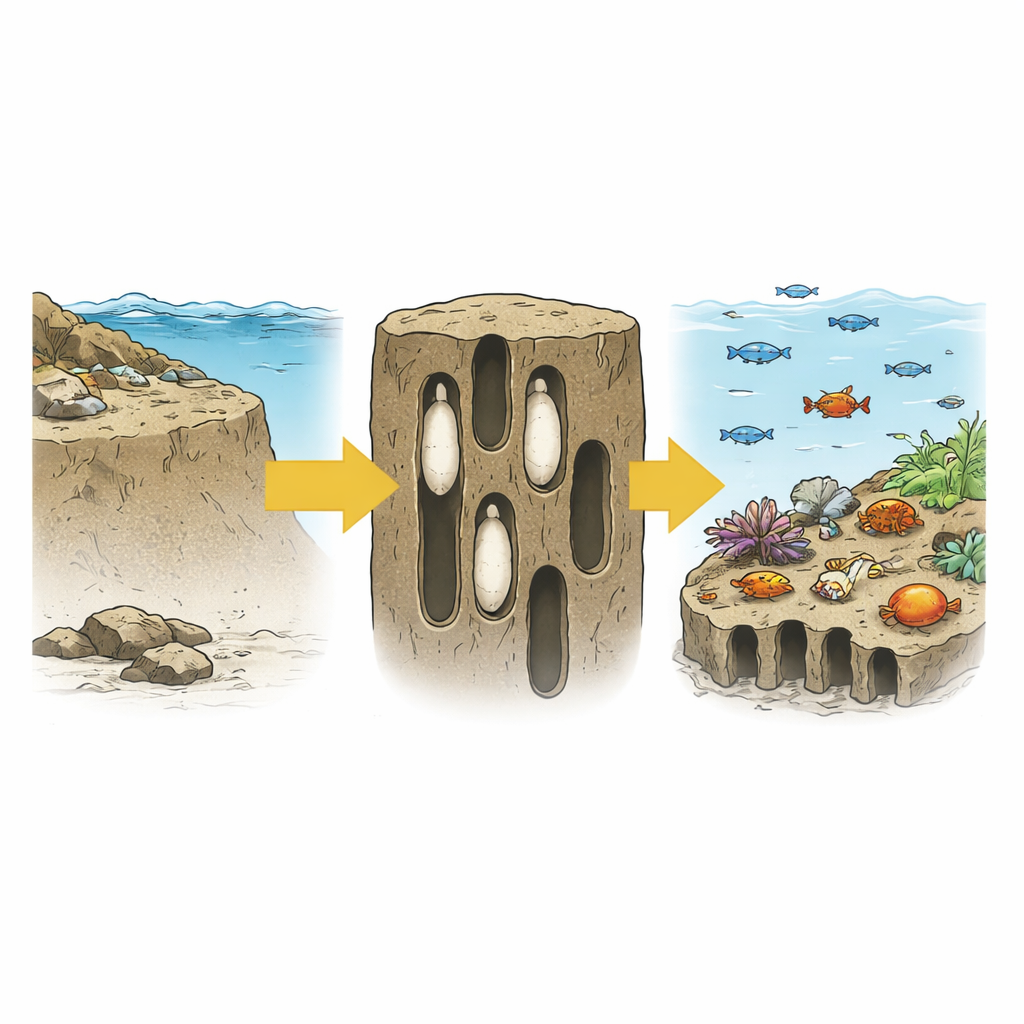
How a Clam Becomes a Builder
Pholas dactylus is a rock‑boring bivalve that spends its life slowly grinding a tunnel into coastal stone. In doing so, it acts as an “ecosystem engineer,” reshaping the physical habitat much like a beaver alters a river. When these clams die or move, their empty burrows remain as ready‑made hideouts and nesting sites. The authors worked along Italy’s Conero Riviera, where these burrows pepper the underwater cliffs and ledges. They wanted to know: which animals use these holes, how do they behave around them, and do their routines change from day to night?
Watching a Square of Seafloor Around the Clock
To answer these questions, divers installed a custom time‑lapse camera at 7 meters depth, pointing at a 50 by 50 centimeter patch of rock riddled with Pholas burrows. Over six days in June 2022, the system snapped a photo every three minutes, day and night, producing more than 2,600 images and over 130 hours of observation. The team then examined each frame, identifying every visible animal and recording what it was doing in relation to the burrows. They grouped behaviors into two simple categories: “burrow interaction,” when an animal entered, emerged from, perched on, or dug around a hole; and “no interaction,” when it simply passed by or lingered nearby without using the burrow.
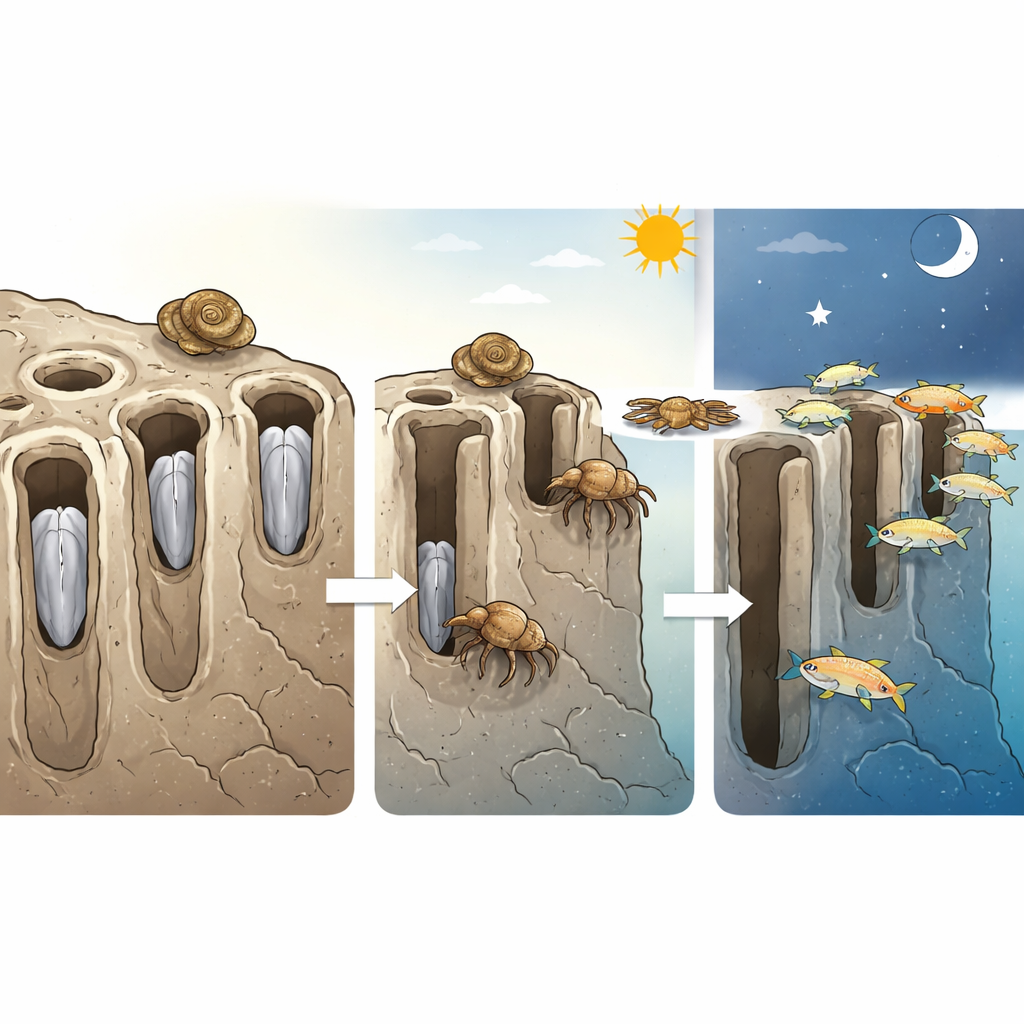
Busy Neighbors and Daily Routines
The camera revealed a rich community: 34 different taxa from five major groups, including snails (Gastropoda), worms (Polychaeta), crabs and related crustaceans (Malacostraca), sea urchins, and bony fish (Teleostei). Snails, crustaceans, and fish dominated the scene. Snails were often seen moving over the rock, sometimes lingering on top of burrow openings. One common snail, Hexaplex trunculus, a known predator of mussels, frequently hovered around burrows or stood on them for long periods, likely using the area as a foraging ground. Crustaceans such as small crabs and squat lobsters showed especially complex behavior: they climbed onto burrow rims, disappeared inside, and even appeared to clean or maintain the tunnels by digging out sediment.
Day and Night Patterns in an Underwater City
By sorting the images into six daily time windows—from dawn through late night—the researchers uncovered distinct daily rhythms. Crabs and their relatives were most active at night, matching their reputation as mainly nocturnal foragers. Some, like Pilumnus crabs, interacted with burrows particularly after sunset, possibly linked to mating and sheltering behaviors. Blenny‑like fish used the burrows differently: although they swam around mostly during daylight, they tended to use the holes more intensively at night, likely for nesting or sleeping. Another fish, the brown comber, appeared mainly in daytime and showed less attachment to specific burrows, roaming the area in search of food. Together, these patterns show that the same small set of holes supports feeding, reproduction, and refuge for multiple species over a full 24‑hour cycle.
Why These Quiet Tunnels Matter
This work highlights that the seemingly simple act of a clam boring into rock has far‑reaching effects. Even after the original animal is gone, its tunnel continues to shelter and organize a miniature community, softening currents, trapping sediment, and allowing animals that prefer rocky and sandy conditions to coexist side by side. In human‑impacted coasts, where large, structure‑building organisms are often lost, such small‑scale engineering can be crucial for maintaining biodiversity. By using non‑intrusive time‑lapse monitoring, the study not only uncovers the hidden daily life of these burrow‑dwellers, but also underscores how protecting bioeroding clams like Pholas dactylus means safeguarding the many species that depend on the homes they leave behind.
Citation: Marrocco, T., Coppari, M., Cerrano, C. et al. The ecological role of Pholas dactylus (Mollusca, Bivalvia) empty burrows. Sci Rep 16, 8304 (2026). https://doi.org/10.1038/s41598-026-38212-4
Keywords: ecosystem engineers, marine biodiversity, benthic behavior, bioerosion, rock-boring bivalves