Clear Sky Science · en
Residual cholesterol levels are associated with carotid plaque stability in patients with carotid stenosis
Why hidden cholesterol matters for stroke risk
Most people know that “bad” LDL cholesterol can clog arteries, but fewer have heard of remnant, or residual, cholesterol—the leftover cholesterol in certain blood fats. This study asks a practical question with real-world consequences: in people who already have narrowing of the neck arteries that feed the brain, does a higher level of this leftover cholesterol make the fatty buildups there more likely to break apart and trigger a stroke?
Neck arteries and the danger of fragile buildup
The carotid arteries run up each side of the neck, carrying blood to the brain. Over time, fatty deposits called plaques can grow inside these vessels, narrowing them—a condition known as carotid stenosis. Not all plaques are equally dangerous. Some are "stable," with a thick, smooth cap that tends to hold together. Others are "unstable," with a thinner covering, more soft fat, and small surface cracks or ulcers. Unstable plaques are far more likely to rupture, form clots, and send debris into the brain, causing an ischemic stroke. Because stroke is a leading cause of death and disability worldwide, spotting who has these fragile plaques is crucial.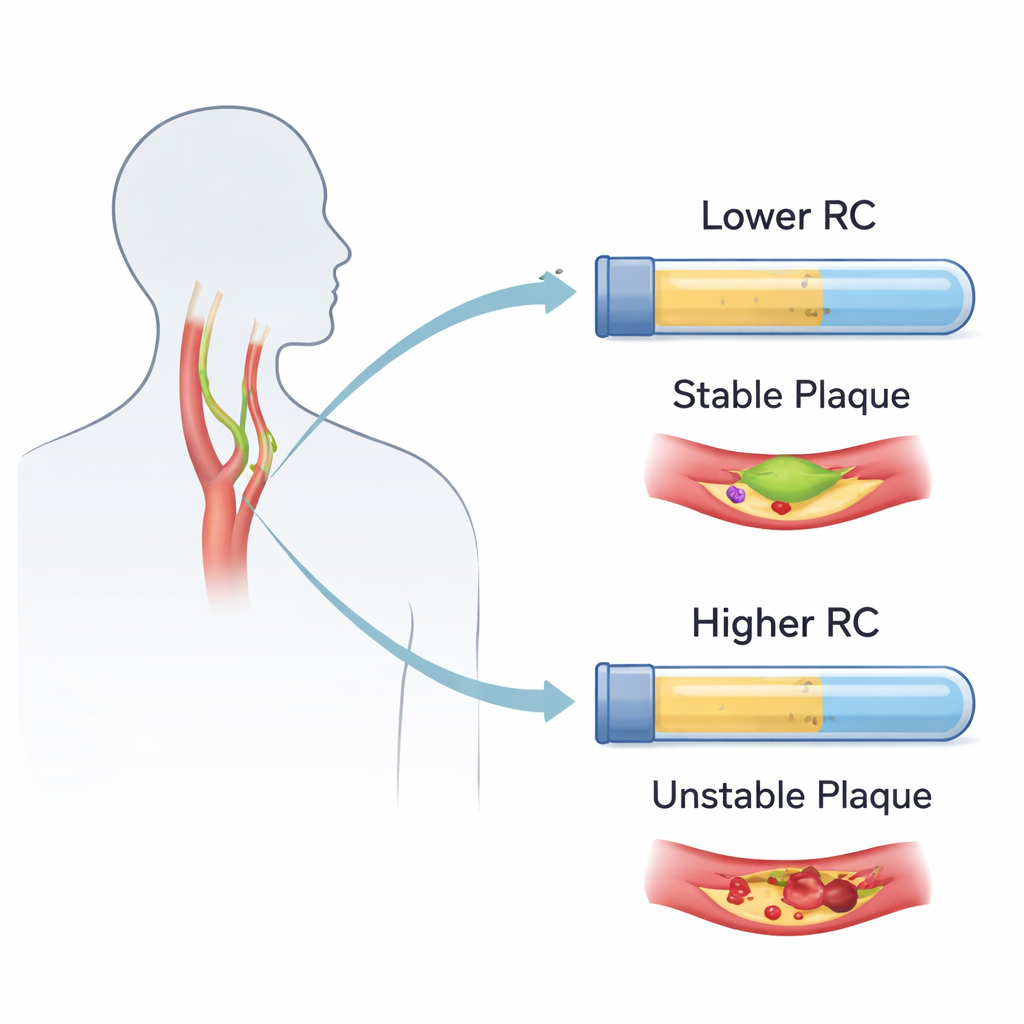
A closer look at remnant cholesterol
Residual (or remnant) cholesterol is the cholesterol carried in triglyceride-rich particles such as very low-density and intermediate-density lipoproteins. Unlike standard cholesterol tests that focus on LDL and HDL, remnant cholesterol is calculated from routine lab values using a simple formula, making it easy and inexpensive to obtain. Earlier research in generally healthy groups showed that people with higher remnant cholesterol had more heart attacks and strokes and were more likely to have unstable plaque. What had not been clear was whether this pattern held in people who already had carotid narrowing—and whether there was a practical cutoff level that signaled higher risk.
What the researchers did with over 500 patients
Researchers in Tianjin, China, reviewed data from 507 hospitalized adults with carotid stenosis between 2019 and 2024. All had neck artery ultrasound scans and fasting blood tests on the same day. Ultrasound specialists classified plaques as stable or unstable based on their shape, surface smoothness, and internal appearance. The team then compared remnant cholesterol levels between people with stable versus unstable plaques and used statistical models to separate the effect of remnant cholesterol from other factors such as age, blood pressure, diabetes, and standard cholesterol measures. They also examined whether the relationship differed between patients with milder narrowing (less than 70% blockage) and those with severe narrowing (70% or more).
Higher remnant cholesterol linked to fragile plaques
Among the 507 patients, 271 had stable plaques and 236 had unstable plaques. People with unstable plaques had clearly higher levels of remnant cholesterol, as well as higher triglycerides and total cholesterol and lower “good” HDL cholesterol. After accounting for many other influences, remnant cholesterol still stood out as an independent marker: for each step up in this measure, the odds of having an unstable plaque rose by about 44%. The link was present even in patients with only mild to moderate narrowing, but it was much stronger in those with severe stenosis, suggesting that leftover cholesterol is especially worrisome when the artery is already badly narrowed. A risk-forecasting analysis showed that a remnant cholesterol level above about 0.435 millimoles per liter identified patients more likely to harbor unstable plaques with reasonable sensitivity and specificity.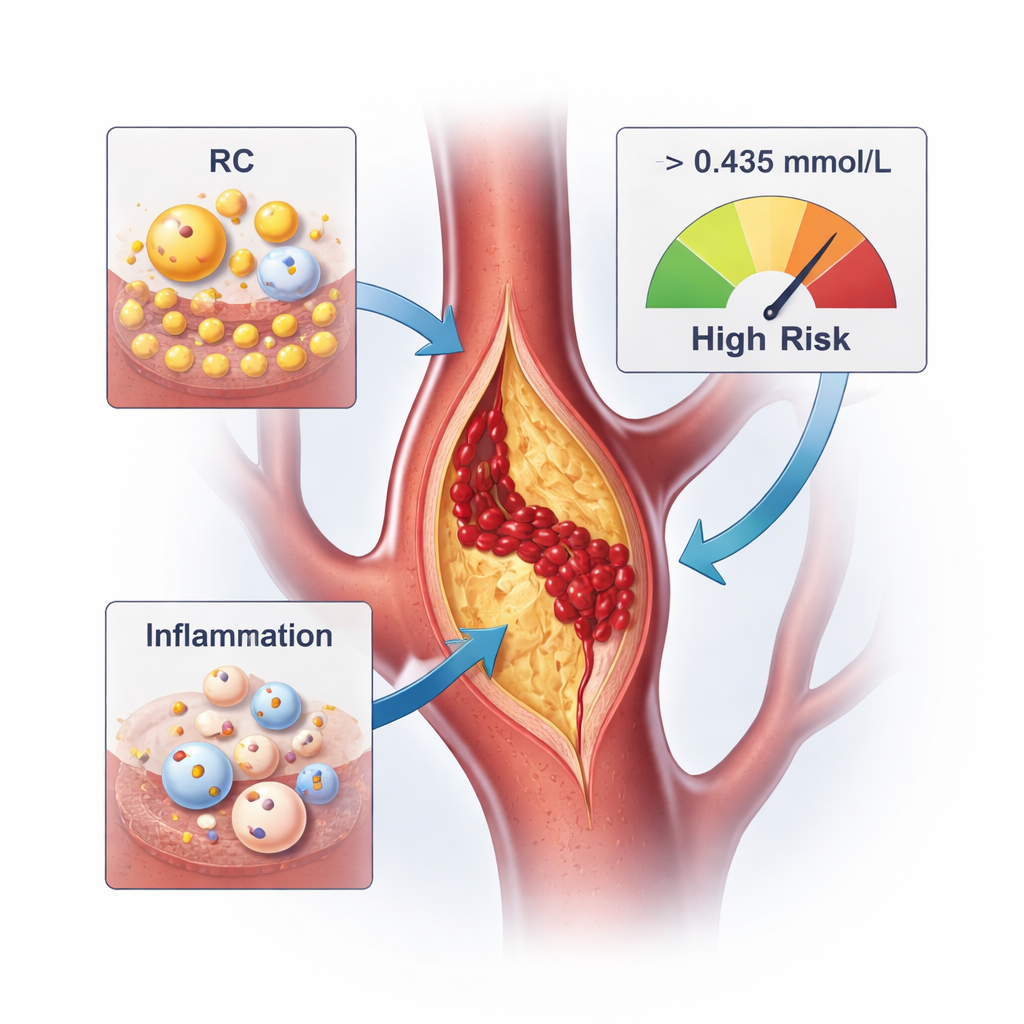
Possible biological roots of the risk
The study also explored how remnant cholesterol might connect to other blood markers. Higher remnant cholesterol levels tracked closely with higher uric acid, triglycerides, total and LDL cholesterol, and an index linked to insulin resistance. They were also modestly associated with higher white blood cell and neutrophil counts, hinting at increased inflammation. These patterns fit with the idea that remnant cholesterol-rich particles may more readily slip into artery walls, fuel inflammatory reactions, damage the vessel lining, and promote the formation of soft, rupture-prone plaque, even in people whose LDL cholesterol is already treated with drugs like statins.
What this means for patients and prevention
For everyday patients with known carotid narrowing, this research suggests that the story does not end with an ultrasound report or a standard cholesterol panel. A simple calculation using routine blood tests can reveal remnant cholesterol levels, and values above about 0.435 millimoles per liter may flag a higher chance that neck artery plaques are fragile and more likely to cause stroke, especially when the narrowing is severe. While this type of study cannot prove cause and effect, it supports using remnant cholesterol as a practical, low-cost tool to refine stroke risk assessment and guide more intensive monitoring and treatment. In short, paying attention to this “leftover” cholesterol could help doctors better protect the brain.
Citation: Li, W., Gao, K., Zhang, H. et al. Residual cholesterol levels are associated with carotid plaque stability in patients with carotid stenosis. Sci Rep 16, 6969 (2026). https://doi.org/10.1038/s41598-026-38210-6
Keywords: stroke risk, carotid artery plaque, remnant cholesterol, artery narrowing, cholesterol testing